Before Politics, There Was Metal: Why “Metallurgica” Fits Lula’s Story
The visual joke connects Metallica’s famous lettering with Luiz Inácio Lula da Silva’s beginnings as a metalworker. In an election year when Brazil is revisiting the president’s labor roots, the reference has a particular historical resonance.
Before Luiz Inácio Lula da Silva occupied Brazil’s presidential palace, he worked in the country’s industrial heartland. Before he became a political figure recognized internationally, he was a metalworker and labor organizer in the factories around São Paulo. That biography contains an unexpectedly effective visual pun: replace the name of a legendary heavy-metal band with a word evoking metallurgy, and “Metallurgica” suddenly makes sense.
The timing gives the joke a contemporary context. On August 16, 2026, Lula launched his reelection campaign at the historic Primeiro de Maio stadium in São Bernardo do Campo, where the metalworkers’ assemblies of the late 1970s had helped establish his national reputation. The location was deliberately symbolic. Nearly five decades later, industrial labor was again central to the way Lula’s political identity was presented.
As of October 12, Brazil is approaching an October 25 presidential runoff between Lula and Flávio Bolsonaro. The country’s political arguments are intense, but the Metallurgica concept works primarily through biography, graphic design and music culture rather than through an electoral prediction or an official campaign message.
What Does “Metallurgica” Actually Mean?
It is not the title of a Metallica album, a new rock band or a formally established Portuguese word used as a political slogan. The graphic uses “Metallurgica” as a stylized variation on metalúrgico, the Portuguese term for a metalworker, deliberately shaped to resemble the visual identity of Metallica.
That resemblance is the entire mechanism. Metallica’s name is famous for its sharp, elongated outer letters and forceful angular silhouette. Moving from a word associated with metalworking to the visual language of heavy-metal music gives the design two meanings at once. One comes from a profession; the other comes from popular music.
The connection is specific to Lula because his industrial employment was not a passing detail in his life. It became foundational to his public biography and to the labor movement through which he entered national politics.
The Photograph That Explains the Entire Design
Historical photographs from the ABC Paulista strikes show a younger Lula addressing thousands of factory workers. His full beard and thick hair became familiar features of the trade-union leader years before his later presidential portraits.

In these images, the young organizer is surrounded by people rather than ceremonial state symbols. The setting is collective and industrial, with microphones and factory workers replacing the formal scenery associated with presidential office.
That historical visual language also explains the portrait chosen for Metallurgica. The caricature evokes an earlier Lula with dark sunglasses, curly hair, a beard and a collared shirt. It points toward the union-era persona rather than attempting to document a specific event from 2026.
One word connects the factory floor to the heavy-metal stage. The typography tells half the story; the biography tells the rest.
EllieShirt Editorial InterpretationWhy Did Lula Return to São Bernardo do Campo in 2026?
The significance of the August campaign launch becomes clearer against the history of the venue. The Primeiro de Maio stadium, formerly known as Vila Euclides, hosted enormous labor assemblies during the industrial strikes that helped elevate Lula into national political life.
Returning there in 2026 connected the current election to an older argument about workers and representation. Reuters reported that the campaign also faced a substantially changed labor market. Traditional factory employment and union participation no longer define Brazil’s workforce in quite the same way. App-based jobs and informal work create questions that the political movements of the 1970s did not encounter in their present form.
The contrast makes the historical imagery especially interesting. The Metallurgica reference is rooted in an identifiable industrial past, while public discussion around contemporary labor extends far beyond the factory gates.
 Lula at the installation of the new ABC Metalworkers’ Union leadership, July 26, 2026. Photo: Ricardo Stuckert / Lula Oficial, via Flickr and Wikimedia Commons, CC BY-SA 4.0.
License details.
Lula at the installation of the new ABC Metalworkers’ Union leadership, July 26, 2026. Photo: Ricardo Stuckert / Lula Oficial, via Flickr and Wikimedia Commons, CC BY-SA 4.0.
License details.
How the Metallica-Inspired Artwork Changes the Meaning
The Metallurgica design uses a solid red background, pale angular lettering and a distressed monochrome portrait. Above Lula’s head, the word METALLURGICA takes the visual position normally reserved for a rock band’s name. The elongated first and final letters create the familiar lightning-like shape.
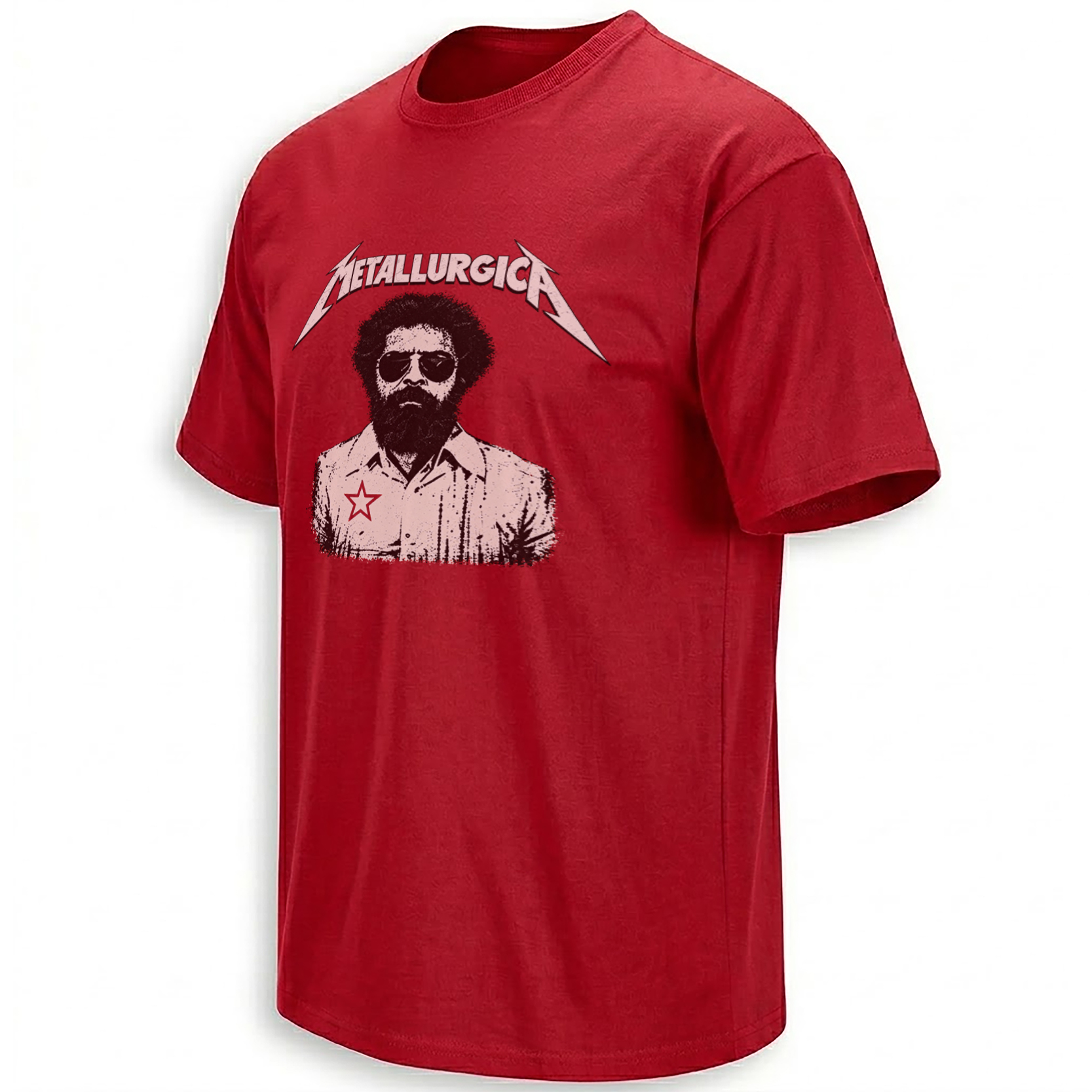
The red star adds a third reference: the political symbolism associated with the Partido dos Trabalhadores, which Lula helped found in 1980. The graphic therefore combines three distinct visual languages — Brazilian labor history, partisan iconography and heavy-metal merchandise.
It is an unofficial visual parody, not a Metallica collaboration or a verified campaign release. Its cultural interest lies in how quickly a recognizable type treatment can alter the way a familiar public figure is depicted.
Why Music-Logo Parodies Work So Well
Music typography often operates almost like a portrait. A distinctive band’s lettering can remain recognizable even when its actual name has been replaced. In parody culture, this allows an artist to move an unrelated subject into the world of another cultural reference without reproducing an entire album cover.
Here, the wordplay is unusually coherent because the term “metal” already exists in both worlds. Rather than inventing a random celebrity crossover, the graphic draws its humor from Lula’s documented profession.
The wider Politics collection provides the political-art context, while the Metallica collection and broader Music collection connect the design to rock imagery. For related pieces featuring the same political figure, the Lula product archive offers another path through the visual references.
Frequently Asked Questions
What does Metallurgica mean?
It is a stylized wordplay combining Metallica’s recognizable name and logo style with metalúrgico, the Portuguese term for a metalworker.
Why is Lula associated with metalworkers?
Before becoming president, Lula worked in metal manufacturing and became a prominent labor organizer in Brazil’s ABC industrial region.
What does the red star represent?
It references the visual symbolism associated with Brazil’s Workers’ Party, founded in 1980.
Is Metallurgica an official Metallica release?
No. It is an independently created parody concept inspired by heavy-metal typography.
Why does Lula’s metalworker past matter in 2026?
His reelection campaign returned to the historic São Bernardo do Campo labor venue in August 2026, connecting current political discussion with his earlier union-organizing career.
Is Metallurgica an official campaign design?
No. The shirt is a cultural parody using historical and political imagery, not an official election announcement.
Political opinions about Lula vary, but the factual foundation of this particular joke is clear. His industrial background is part of Brazilian political history, and Metallica’s lettering is part of global music culture. Put them together, and an unconventional visual pun becomes immediately understandable.
Metallurgica Shirt combines Luiz Inácio Lula da Silva’s metalworker origins with Metallica-inspired typography. The distressed portrait, red star and industrial-poster aesthetic reference Brazilian labor history through heavy-metal visual culture.