
Whose House? Protecting the Architecture of the Edge in Los Angeles
When defensive dominance transforms a stadium layout into an impenetrable territory.
Every football community develops a local shorthand—a verbal calling card that resonates through the concourses long before kickoff. In Southern California, that phrase has always been an interrogation of ownership. When the stadium lights reflect off the polished turf, the collective roar answers the call, drawing a hard boundary line that opposing offenses find increasingly impossible to cross. The geography of the gridiron dictates that the perimeter must be secured at all costs, turning the defensive line into a structural foundation where games are systematically dismantled.
Roster evolution in the modern era relies on finding anchors—generational forces who bring an immediate defensive culture to the turf. When a premier pass rusher lines up on the edge, the entire stadium design shifts to accommodate that gravity. Film analysts map out the slide protections, opposing coordinators stay awake late altering their chip-block strategies, and the fan community immediately adopts the mindset that the house is perfectly locked down. This territorial claim is the driving energy behind a fast-moving movement in football lifestyle wear.
The Structural Mechanics of Edge Superiority
To understand why fan subcultures rally behind individual defensive stars, you have to look past simple sack numbers on a box score. True impact is measured in spatial disruption. An elite edge rush forces an offensive tackle to over-extend his kick-slide, opening up internal gaps and making the quarterback step up prematurely into a collapsing pocket. It is a calculated restriction of space, turning a standard play design into a claustrophobic panic drill.
“When you dominate the line of scrimmage, you don’t just win a singular rep; you change the spatial options for the entire offense. The pocket shrinks, the timing routes fail, and the field belongs entirely to the defense.”
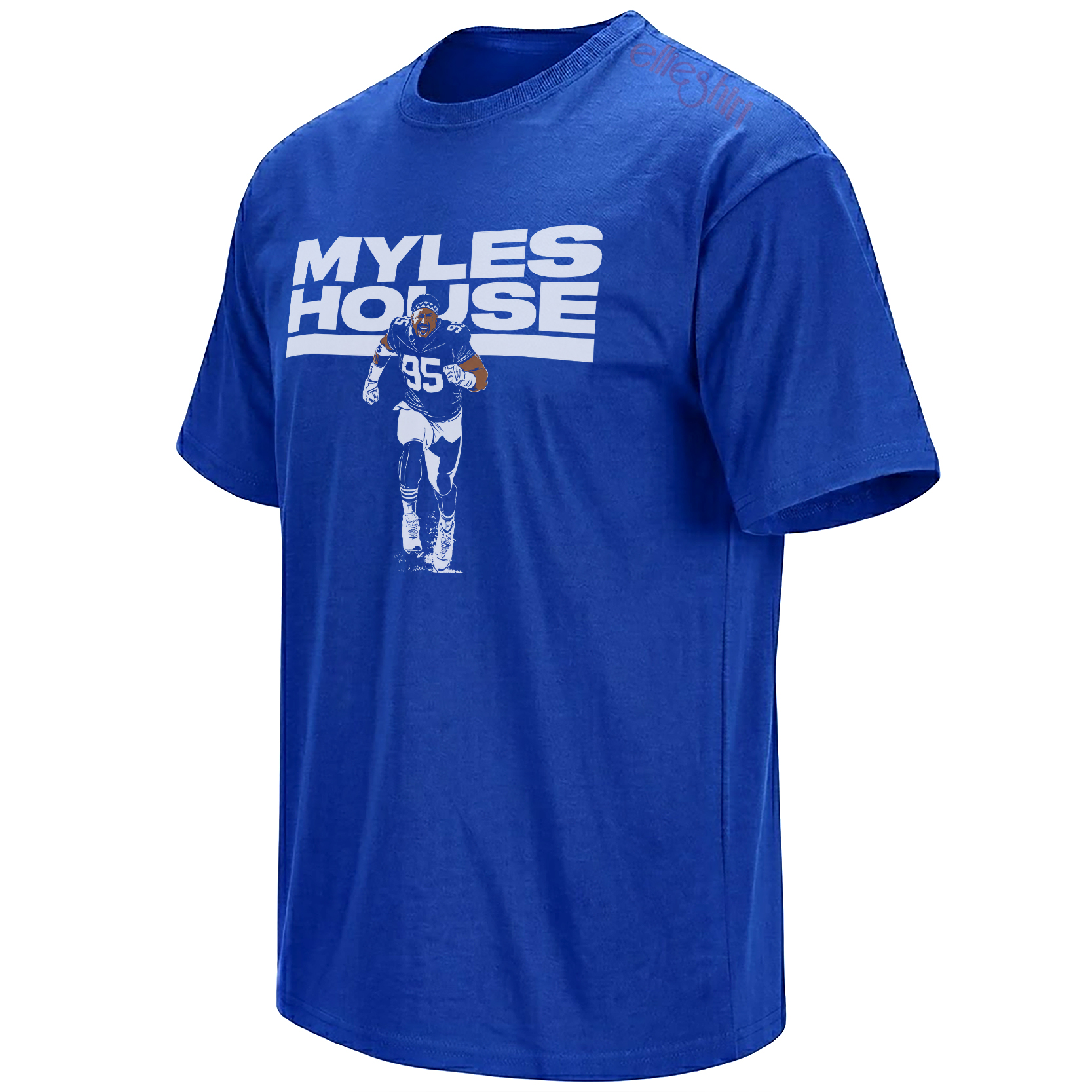
The Los Angeles Rams Myles Garrett Myles House Shirt pays homage to this absolute territorial control. It is designed not as standard commercial retail apparel, but as a visual timestamp of defensive authority. For the fans navigating the digital spaces of Reddit and X/Twitter, or tailgating across the pavement outside the stadium, this release serves as a premium symbol of a team reclaiming its identity as an elite defensive powerhouse.
Archival Print Quality and Premium Streetwear Alignment
Modern sports apparel operates on a premium wave where heavy cotton meets high-concept layout art. Moving far away from the basic, temporary feeling of fast-fashion merch, this collection leans heavily into mid-90s vintage bootleg aesthetic. The design pairs rich, high-contrast player imagery with sharp geometric frames and bold athletic typography that announces its presence immediately. It is built for a generation that treats sports loyalty as an essential pillar of their personal style portfolio.
The choice of a washed dark textile provides an authentic, broken-in look that pairs effortlessly with technical outerwear, raw denim, or clean seasonal streetwear layers. It provides an immediate “if you know, you know” connection among the die-hard fanbase, highlighting the specific moment that defensive grit became the defining pillar of the city’s football culture.
Frequently Asked Questions
The theme plays on the iconic stadium chant “Whose House?”, directly attributing the ownership and structural defense of the stadium perimeter to the team’s premium defensive edge force.
The design utilizes advanced high-ink density screen textures that maintain their vivid color contrast and raw vintage distressing even through repeated washing cycles, preserving the archival look.