
Lindsay Clancy’s Trial Ended in a Mistrial — “Free Lindsay” Now Exists Inside an Unresolved Case
A deadlocked jury ended nearly six weeks of testimony without a verdict on September 4. The result did not legally clear Lindsay Clancy and did not convict her, leaving both the criminal case and the public movement surrounding it unresolved.
This article discusses the deaths of children, severe mental illness and criminal responsibility. “Free Lindsay” is treated here as an advocacy slogan appearing on the product graphic, not as a legal conclusion about guilt, innocence or future court action.
On September 4, Judge William Sullivan declared a mistrial after jurors in Plymouth, Massachusetts, were unable to reach a unanimous verdict in the case against Lindsay Clancy. The jury had deliberated for seven days after hearing weeks of testimony focused heavily on one legal question: her mental state and criminal responsibility when her three children died in January 2023.
The mistrial is procedurally important because it leaves the case open. Clancy remains charged. She was not acquitted, and she was not convicted. Prosecutors had not announced by September 5 whether they would seek another trial, while the next court hearing was scheduled for September 29.
That uncertainty makes the phrase “Free Lindsay” particularly charged. It is not the language of the court. It is advocacy language — a public position about what supporters believe should happen to Clancy after a trial that produced no verdict.
A mistrial did not answer the legal question. It returned that question to a future court date while the public argument continued outside the courtroom.
The Case Was About Criminal Responsibility, Not Whether the Children Died at Clancy’s Hands
The defense did not dispute that Clancy killed her children, Cora, Dawson and Callan. Its case centered on the argument that she should not be held criminally responsible because she was experiencing severe mental illness, with defense experts testifying about postpartum psychosis and her psychiatric history.
Prosecutors presented a different interpretation. Their experts acknowledged significant mental illness but disputed the defense claim that Clancy was acutely psychotic in a way that made her legally unable to understand the wrongfulness of her actions or control them.
Clancy’s lawyers argued that severe postpartum mental illness and psychosis meant she lacked criminal responsibility when the children were killed.
Prosecutors argued that the evidence showed planning, awareness and an understanding that the actions were wrong, despite her documented mental-health problems.
Those competing interpretations dominated the trial. Experts from both sides examined treatment history, medications, reported hallucinations, behavior before the deaths and what Clancy understood at the time. The jury ultimately could not agree on a legal answer.
The Public Support Movement Was Visible Before the Mistrial
“Free Lindsay” did not appear in a vacuum. Public support had become physically visible outside Plymouth Superior Court weeks earlier. On August 20, the Associated Press reported that roughly 300 supporters gathered outside, many dressed in pink.

Several people interviewed by AP framed their presence as advocacy for better recognition and treatment of postpartum mental illness rather than a denial that the children died. That distinction is important because online shorthand can flatten a complex movement into a binary “for” or “against” a defendant.
The public reaction also extended beyond the courthouse. Clancy’s attorney said supporters had sent enough letters to fill multiple boxes. The livestreamed proceeding generated widespread discussion about postpartum psychosis, psychiatric care, legal insanity standards and whether the healthcare system had responded adequately before the tragedy.
“Free Lindsay” Is Stronger Language Than the Documented Rally Signs
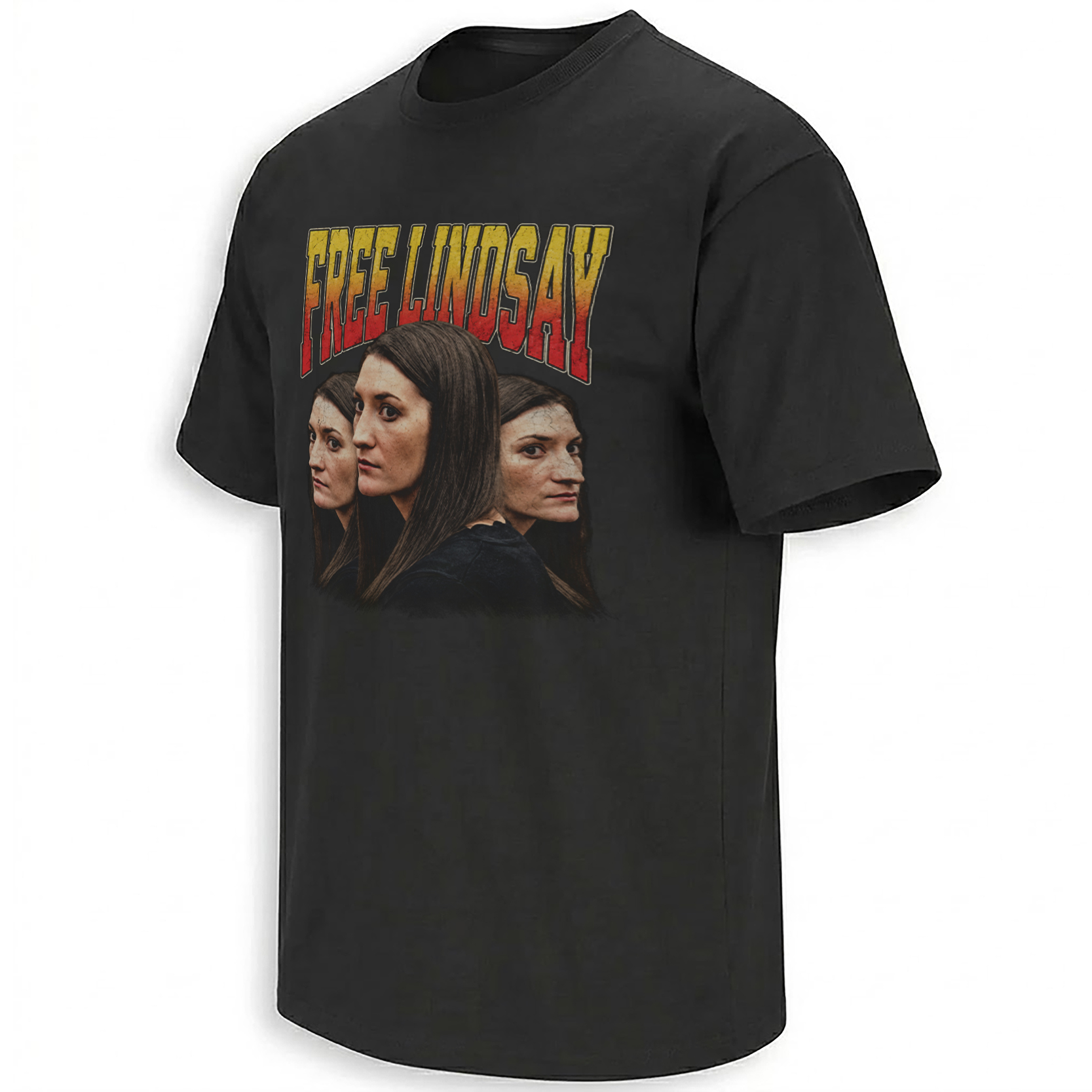
Distressed yellow-to-red headline lettering sits above three courtroom-style portraits, giving the design the visual language of a campaign poster rather than a neutral trial record.
View the advocacy graphic →The visual is not subtle. “FREE LINDSAY” is the largest element, rendered in tall distressed lettering that moves from yellow into red. Beneath it, three portraits of Clancy overlap against black, creating the feel of a protest poster or true-crime-era advocacy graphic.
That means the design itself takes a position. It should not be described as neutral reporting, and it should not be presented as if a court has ordered Clancy’s release. As of September 5, no such result had occurred.
The wording is also stronger than the phrases AP documented at the August rally. “Peace For Lindsay” and “She Needed Help” can express sympathy or focus on mental-health-system failures without specifying a legal outcome. “Free Lindsay” explicitly calls for freedom.
Why the Mistrial Makes Accuracy More Important, Not Less
A mistrial can easily be misread online as a victory for one side. Legally, however, it means the jury did not return a unanimous verdict. The prosecution may seek another trial, the parties could pursue other legal resolutions, and defense attorneys may raise additional arguments about whether a retrial can proceed.
Reuters: What happens after the September 4 mistrial? → Reuters reported that prosecutors had not yet decided whether to retry the case and that Clancy remained in custody at a psychiatric facility while the legal process continued.That uncertainty is precisely why cultural objects made during an active court case need a timestamp. The product captures a position held by a segment of the public in September 2026. Future legal developments may change the context around it.
The Story Is Also Larger Than One Defendant
Much of the national attention has centered on postpartum psychosis and the boundaries between psychiatric diagnosis and legal criminal responsibility. Those are related questions, but they are not identical. A medical diagnosis does not by itself determine the legal verdict; the court applies a specific legal standard.
That distinction prevents both sides of the public conversation from becoming too simple. One can take postpartum mental-health care seriously while also acknowledging the deaths of three children. One can describe the defense’s argument without declaring it proven, and describe the prosecution’s theory without pretending a jury accepted it.
Ellie Shirt does not need an invented legal-case collection for this piece. The verified Newest collection is therefore the appropriate broader internal link, while the Lindsay Clancy search archive connects directly to any other designs centered on the case.
Frequently Asked Questions
Was Lindsay Clancy acquitted in September 2026?
No. The trial ended in a mistrial because the jury could not reach a unanimous verdict. A mistrial is not an acquittal or a conviction, and the charges remain unresolved.
Why did the Lindsay Clancy trial end in a mistrial?
After seven days of deliberations, the jurors remained unable to agree on a unanimous verdict, leading Judge William Sullivan to declare a mistrial on September 4, 2026.
What does “Free Lindsay” mean in the design?
It is an advocacy slogan calling for Clancy’s freedom. It represents a public position around the case and should not be interpreted as a court ruling or statement of established legal innocence.
Was there a real public support movement for Lindsay Clancy?
Yes. The Associated Press reported roughly 300 supporters outside Plymouth Superior Court on August 20, many dressed in pink and carrying messages focused on Clancy and postpartum mental-health care.
What happens next in the Lindsay Clancy case?
As of September 5, prosecutors had not announced whether they would seek a retrial. The next scheduled court hearing is September 29, 2026.
The Free Lindsay design belongs specifically to the public debate surrounding the 2026 trial and mistrial. Its meaning should remain attached to that timestamp rather than treated as a substitute for the court record.
Free Lindsay Shirt captures the public advocacy surrounding Lindsay Clancy’s 2026 trial through distressed campaign-style lettering and courtroom portraits. The design emerged within a case that ended in a September 4 mistrial without a conviction or acquittal.