
The Knicks Starting Five: Five Faces That Ended 53 Years of Waiting
Jalen Brunson, Josh Hart, Mikal Bridges, OG Anunoby and Karl-Anthony Towns were not five versions of the same basketball player. They were five sharply different identities arranged into the lineup that finally carried New York from possibility to the 2026 NBA championship.
The final image in San Antonio contained the entire argument. The Knicks had erased another double-digit deficit, beaten the Spurs 94–90 in Game 5 and completed a 4–1 NBA Finals victory. Jalen Brunson held the Finals MVP trophy, but the championship photograph belonged to a group whose differences had become its strength.
Brunson provided control. Hart created disorder. Bridges supplied length and calm. Anunoby changed possessions at both ends. Towns gave the lineup size, shooting and a second offensive center of gravity.
New York had spent years searching for one superstar capable of repairing everything. The 2026 team found a different answer: one star surrounded by four starters whose roles became clearer when placed beside him.
New York did not win because all five starters played the same way. It won because each player solved a different problem.
The Lineup New York Learned by Face
Championship starting fives eventually become a form of visual memory. Fans may forget the exact substitution pattern from a January game, but they remember who stood together during introductions and who occupied each position when the season reached its largest moments.
Brunson, Hart, Bridges, Anunoby and Towns became recognizable not only through their statistics but through their silhouettes and emotional roles. Brunson’s compact posture signaled control. Hart appeared permanently in motion. Bridges carried the long frame of a wing defender. Anunoby looked built for contact. Towns gave the lineup the scale of a modern center who could operate beyond the paint.
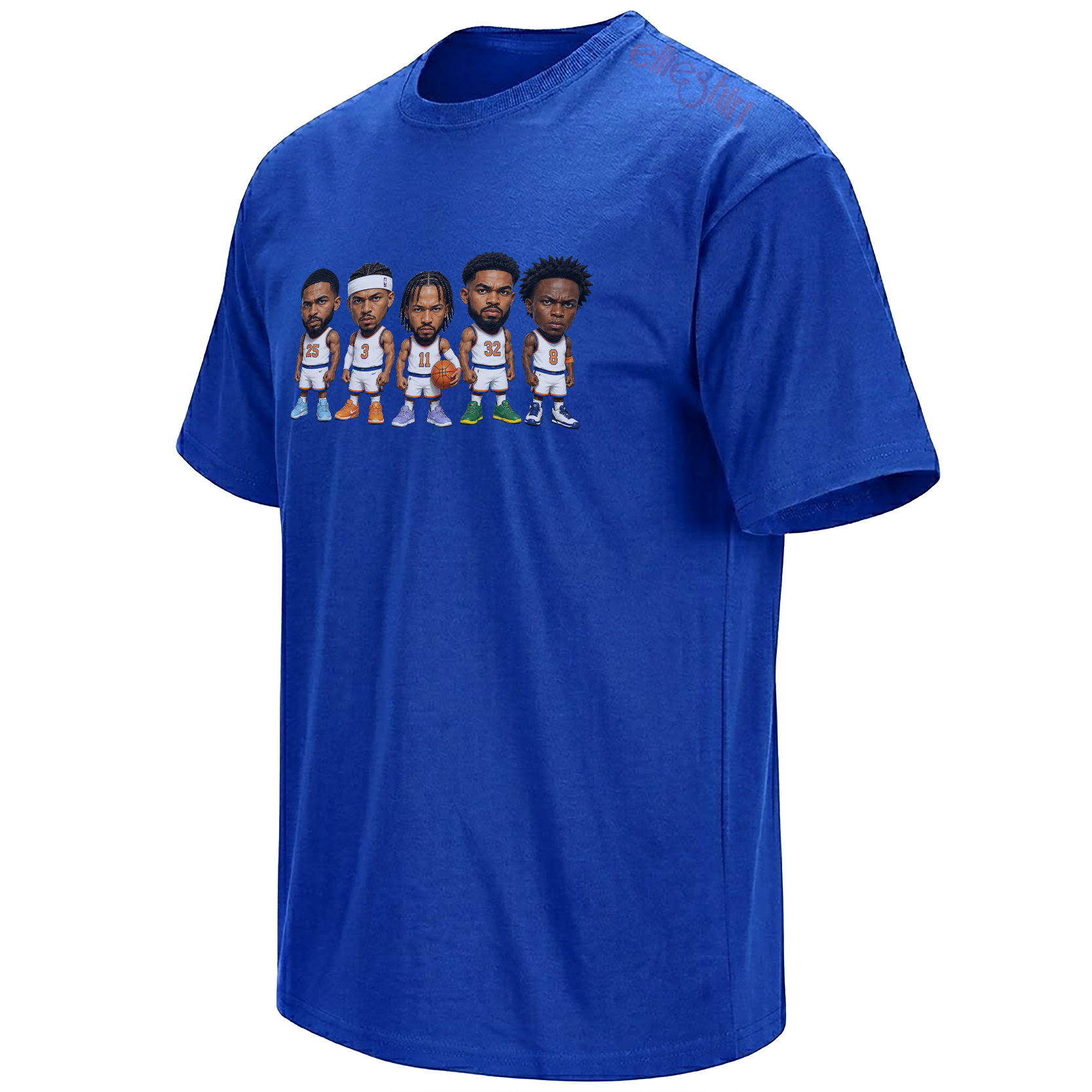
That visual clarity is why the “big head lineup” format fits the group. Caricature removes the complexity of live action and exaggerates the details fans already associate with each player. Five bodies become five personalities before the viewer studies a single number.
Why This Starting Five Actually Fit
Collections of talent do not automatically become functioning lineups. The difficult part is distributing responsibility without reducing anyone to a decorative name.
New York’s five worked because the hierarchy was visible. Brunson was the primary creator and emotional center. Towns could produce as a scorer, passer and rebounder without needing every possession to begin with him. Bridges and Anunoby could defend major wing assignments while contributing offense. Hart could influence the game without waiting for a play to be called.
The result was not perfect balance in every individual game. Some nights one starter struggled or encountered foul trouble. The balance existed across the lineup. When one part became unavailable, another skill remained.
That became especially important in the title-clinching game. Towns finished with only two points and eventually fouled out. Anunoby dealt with five fouls and an inefficient shooting night. Bridges and Hart combined for 27 points while Brunson produced 45. The lineup’s strength was not that every starter dominated simultaneously; it was that the structure survived uneven performances.
Primary creation from Brunson, spacing and size from Towns, wing coverage from Bridges and Anunoby, and possession pressure from Hart gave New York several ways to remain alive when the preferred version of the offense disappeared.
Why the Big-Head Style Feels Like a Collectible
The oversized-head style belongs to a long tradition of sports caricature. Bobbleheads, stadium giveaways, newspaper cartoons, trading-card illustrations and locker-room graphics all use exaggeration to make players immediately recognizable.
A realistic team photograph documents appearance. A caricature documents personality.
Brunson’s role can be communicated through the centrality of his figure and the confidence of his expression. Hart’s energy can be increased until it feels almost impossible to contain within the lineup. Bridges and Anunoby can be presented as the long defensive arms of the group, while Towns provides the physical scale that completes the composition.
The format also removes the emotional distance of a formal championship portrait. Instead of presenting the five players as untouchable icons, it makes them feel like a set—a group fans can identify, name and arrange mentally like figures from the same championship collection.
Oversized faces, compressed bodies and a tightly packed lineup create the feeling of a championship bobblehead set or illustrated trading-card series. Knicks orange and royal blue keep the humor anchored in team identity, while “2026 Champions” turns the characters into a record of one completed season.
Jalen Brunson: The Lineup’s Organizing Principle
Brunson was not simply one member of the five. He was the reason the other four roles could remain stable.
His ability to create half-court offense allowed Hart to influence games through movement instead of forcing him into conventional point-guard responsibility. It allowed Bridges and Anunoby to attack secondary advantages rather than manufacturing every shot. It allowed Towns to become a complementary offensive star instead of carrying the burden of every late possession.
Brunson’s Game 5 performance became the clearest expression of that responsibility. He scored 45 points, including 13 consecutive Knicks points in the fourth quarter, and set a franchise record for scoring in an NBA Finals game.
Yet his importance to the starting five extended beyond volume. Brunson gave the lineup emotional order. During the Finals, New York repeatedly trailed by double digits. His pace suggested that the deficit did not require panic.
The Finals MVP trophy identified the series’ central player. The team portrait identifies the structure that allowed that player to finish the journey.
Josh Hart: The Starter Who Refused to Stay in One Role
Hart’s position has always been less useful than his behavior. He can be listed as a guard or wing, but his impact regularly resembles that of a rebounder, transition initiator and emergency responder.
He attacks moments after the initial play has broken down. A missed shot becomes a rebound. A rebound becomes a push. A loose ball becomes another possession. The defense may have completed its assignment and still discover that Hart has kept the sequence alive.
That quality made him the lineup’s disruptive element. Brunson controlled games through precision; Hart changed them through refusal.
His connection to Brunson and Bridges also gave the lineup a layer of history. The three former Villanova teammates became the first trio of teammates to win both an NCAA championship and an NBA championship together.
Inside the big-head design, Hart belongs as the face most likely to break the formality of the portrait. His public personality, humor and restless playing style prevent the starting five from appearing overly polished.
Mikal Bridges: The Quiet Link Between Every Part
Bridges’ value often becomes clearest when considering lineup continuity. He can guard across the perimeter, run the floor, space the offense and score without demanding that every possession announce his involvement.
That flexibility helped connect New York’s primary creators to its defensive identity. Bridges could share major wing assignments with Anunoby, reduce Brunson’s defensive burden and still provide enough offense to punish opponents for ignoring him.
His role in Game 5 illustrated the usefulness of that steadiness. Bridges scored 14 points while Towns struggled and Brunson carried the largest offensive load. He did not need to become the story to help the story reach its ending.
The Nova Knicks connection added another emotional layer. Bridges joined Brunson and Hart as part of a college relationship that had somehow survived different NBA paths and reassembled on a championship stage.
In the lineup graphic, he becomes the bridge in both name and function: a player whose calm two-way presence connects the more visibly dramatic identities around him.
OG Anunoby: The Two-Way Force Behind the Defining Image
Anunoby entered the Finals as the only player on New York’s postseason roster who had previously been part of an NBA championship team. He had been injured during Toronto’s 2019 Finals run, but the experience still separated him from teammates encountering the stage for the first time.
His 2026 contribution was impossible to treat as background. Anunoby guarded difficult assignments, added size and strength to the wing and supplied the tip-in that completed the largest comeback in NBA Finals history in Game 4.
That touch transformed him from essential two-way starter into the author of the postseason’s defining Knicks image. New York had trailed by 29 points. The comeback ended with Anunoby redirecting the ball at the rim as time expired.
His Game 5 scoring was less efficient, but the starting five portrait does not represent five box scores from one night. It represents the accumulated work required to reach the title.
Anunoby’s place in that accumulation is secure. Without the Game 4 tip-in, the series and the mythology surrounding it would look entirely different.
Karl-Anthony Towns: The Size That Changed the Geometry
Towns gave the lineup something New York had spent years trying to find: a center-sized offensive threat capable of stretching the floor, attacking mismatches, passing and rebounding.
His presence altered defensive decisions before he touched the ball. Opposing centers could not simply remain near the rim. Smaller defenders could not comfortably absorb him in the post. The spacing created larger operating areas for Brunson and more movement lanes for Hart.
Towns’ Finals included productive nights and difficult ones. He scored 18 points with 12 rebounds in Game 1 and recorded 21 points with 13 rebounds in Game 2, helping New York take control of the series in San Antonio.
In Game 5, foul trouble reduced his scoring impact, but his earlier work had helped place the Knicks in position to close the series. That is another reason the starting five image matters: championship narratives often become too focused on the final game and forget the contributions that created the opportunity.
Towns completed the physical outline of the group. Brunson could control, Hart could chase, Bridges and Anunoby could cover the wings, and Towns could stretch the entire structure vertically and horizontally.
Primary shot creation, pace management and the ability to make New York’s most pressured possessions feel organized.
Rebounds, transition attacks and repeated extensions of possessions that opponents believed were already finished.
Wing defense, spacing and adaptable offense capable of fitting beside several different lineup combinations.
Strength, defensive versatility and the Game 4 tip-in that turned the comeback into championship mythology.
Center size combined with shooting, passing and rebounding that expanded the floor around Brunson’s creation.
The Comeback Knicks Needed Five Different Kinds of Belief
New York trailed by double digits in all four of its Finals victories. The championship therefore cannot be explained only by conventional lineup balance. It also required a group capable of responding to the scoreboard in different ways.
Brunson responded by slowing the moment down. Hart responded by increasing physical activity. Bridges continued making the next correct play. Anunoby remained capable of producing the single touch that changed the ending. Towns gave the team a second major scoring and rebounding threat.
The five starters did not experience pressure identically, and that helped the team. A lineup made entirely of emotional accelerators might have panicked. A lineup made entirely of calm technicians might not have generated enough disruptive force.
New York had both. Its starting five contained control and chaos, finesse and strength, familiar Villanova trust and newly assembled star power.
That mixture made the comeback identity repeatable. It was not one miraculous game. It became the method through which the Knicks won the Finals.
Why Fans Remember Lineups Differently After a Championship
Before a championship, a starting lineup is debated through optimization. Fans argue about spacing, minutes, defensive matchups and which player should finish games.
After a championship, the same names become historical order.
Brunson, Hart, Bridges, Anunoby and Towns no longer represent only one possible arrangement of the roster. They represent the opening image of the team that ended the drought.
Future Knicks lineups may win more games, contain younger players or produce different statistical strengths. The 2026 group will retain a separate status because it reached the threshold first.
That is why illustrated team graphics matter. They preserve not only the names but the feeling of seeing those five faces together before the result became certain.
The Difference Between a Team Photograph and a Fan Artifact
An official championship photograph attempts to include everyone and document the ceremony accurately. A fan artifact is allowed to choose a sharper emotional focus.
The starting-five graphic isolates the players who formed the public face of the lineup. It does not claim that only five people won the championship. New York needed Deuce McBride, Mitchell Robinson, Landry Shamet, Jordan Clarkson, José Alvarado and the rest of the rotation. Mike Brown and the coaching staff shaped the structure around them.
The five-player portrait works because it gives the viewer an immediate doorway into the larger roster. These were the faces called during introductions and the combination around which the championship identity was organized.
Caricature strengthens that doorway. The image feels less like evidence submitted to a historical record and more like a page from the city’s unofficial championship scrapbook.
A Starting Five Inside New York’s Larger Championship Archive
The 2026 title produced several different visual centers. Brunson’s Finals MVP graphics preserve individual greatness. Anunoby’s tip-in captures the defining comeback. Nova Knicks designs preserve the college connection. Statue of Liberty imagery turns the title into a citywide symbol.
The starting-five graphic performs another job. It preserves structure.
It shows the five identities New York regularly placed together at the beginning of games and asks viewers to remember the championship as a collaboration of contrasting skills.
That group belongs inside Ellie Shirt’s New York Knicks Shirts collection , where player portraits, Finals moments, city slogans and championship graphics form a running visual record of the season.
The broader NBA Shirts collection follows the same cultural process across basketball: lineups become identities, players become illustrated characters and championships turn temporary rotations into permanent memory.
Frequently Asked Questions
Who were the Knicks’ primary starting five during the 2026 championship season?
The primary starting lineup featured Jalen Brunson, Josh Hart, Mikal Bridges, OG Anunoby and Karl-Anthony Towns.
When did the Knicks win the 2026 NBA championship?
New York clinched the championship on June 13, 2026, by defeating the San Antonio Spurs 94–90 in Game 5 and winning the Finals series 4–1.
How long had the Knicks waited for another championship?
The Knicks’ previous NBA title came in 1973, making the 2026 victory the end of a 53-year championship drought.
What was Jalen Brunson’s role in the starting five?
Brunson was New York’s primary scorer, playmaker and late-game organizer. He scored 45 points in the title-clinching Game 5 and won the NBA Finals MVP award.
Why was Josh Hart important to the lineup?
Hart added rebounding, transition pressure, energy and extra possessions, often influencing games without needing conventional plays called for him.
What did Bridges and Anunoby provide?
Bridges and Anunoby gave New York two versatile wings capable of defending difficult assignments while contributing spacing, strength and secondary offense.
How did Karl-Anthony Towns change the lineup?
Towns added center size, perimeter shooting, passing and rebounding, expanding the floor around Brunson and giving New York another major offensive threat.
Why does the design use a big-head caricature style?
The exaggerated heads make each player instantly recognizable and give the lineup the feeling of a championship bobblehead set, illustrated trading-card collection or fan-made team portrait.
The Knicks Starting Five championship graphic preserves Brunson, Hart, Bridges, Anunoby and Towns as a collectible big-head lineup, while the wider Knicks championship archive follows the comebacks, player moments and citywide imagery that surrounded New York’s 2026 title.
Knicks Starting Five Shirt presents Jalen Brunson, Josh Hart, Mikal Bridges, OG Anunoby and Karl-Anthony Towns as a collectible big-head lineup celebrating New York’s 2026 NBA championship.