
Kazuma Okamoto’s Toronto Arrival Is Becoming an Anime in Real Time
The Japanese slugger’s first Blue Jays season is unfolding across home-run clips, cultural translation and the visual language of manga — a style capable of making every new at-bat feel like the next panel in an international baseball story.
Kazuma Okamoto arrived in Toronto carrying two careers at once. One was already complete enough to command respect: six Japanese All-Star selections, 248 NPB home runs and a place on Japan’s 2023 World Baseball Classic championship team. The other began in 2026, beneath a Blue Jays helmet and the pressure of translating that power into Major League Baseball.
By early summer, the translation was producing images Toronto fans could immediately understand. A 423-foot home run against the Yankees in June gave his power a clean North American measurement. Days later at Wrigley Field, a late three-run homer against the Cubs supplied the kind of dramatic frame that makes a new player feel suddenly embedded in a season.
The important story is not that Okamoto has become a fictional hero. It is that Japanese visual culture already provides a language for expressing what his move represents: a celebrated slugger leaving one baseball system, entering another and allowing every adjustment, mistake and breakthrough to function like a new chapter.
Each Toronto home run feels like a new panel because the audience is watching an established Japanese star become an MLB character in real time.
The Pressure Behind the New Beginning
International transitions are often flattened into a simple storyline: a star dominates abroad, signs a major contract and immediately begins proving that the talent will travel. Actual baseball rarely moves so cleanly.
Okamoto entered the Blue Jays organization with a four-year agreement reportedly worth $60 million and a history of sustained home-run production in Japan. That résumé created excitement, but it also created a constant comparison between the player Toronto had acquired and the player still learning how MLB pitchers would attack him.
Breaking balls, velocity sequencing, unfamiliar ballparks and the daily rhythm of a new league all became part of the story. That tension is exactly why his successful moments carry weight. A home run is not merely another total; it becomes visible evidence that the adjustment process is moving forward.
Why Anime Is the Right Visual Language
Anime and manga sports imagery work through compression. A single pose can contain anticipation, force, biography and emotion. Speed lines can make a swing feel faster. A close-up expression can transform concentration into conflict. Layered typography can place a name, location and identity within the same frame.
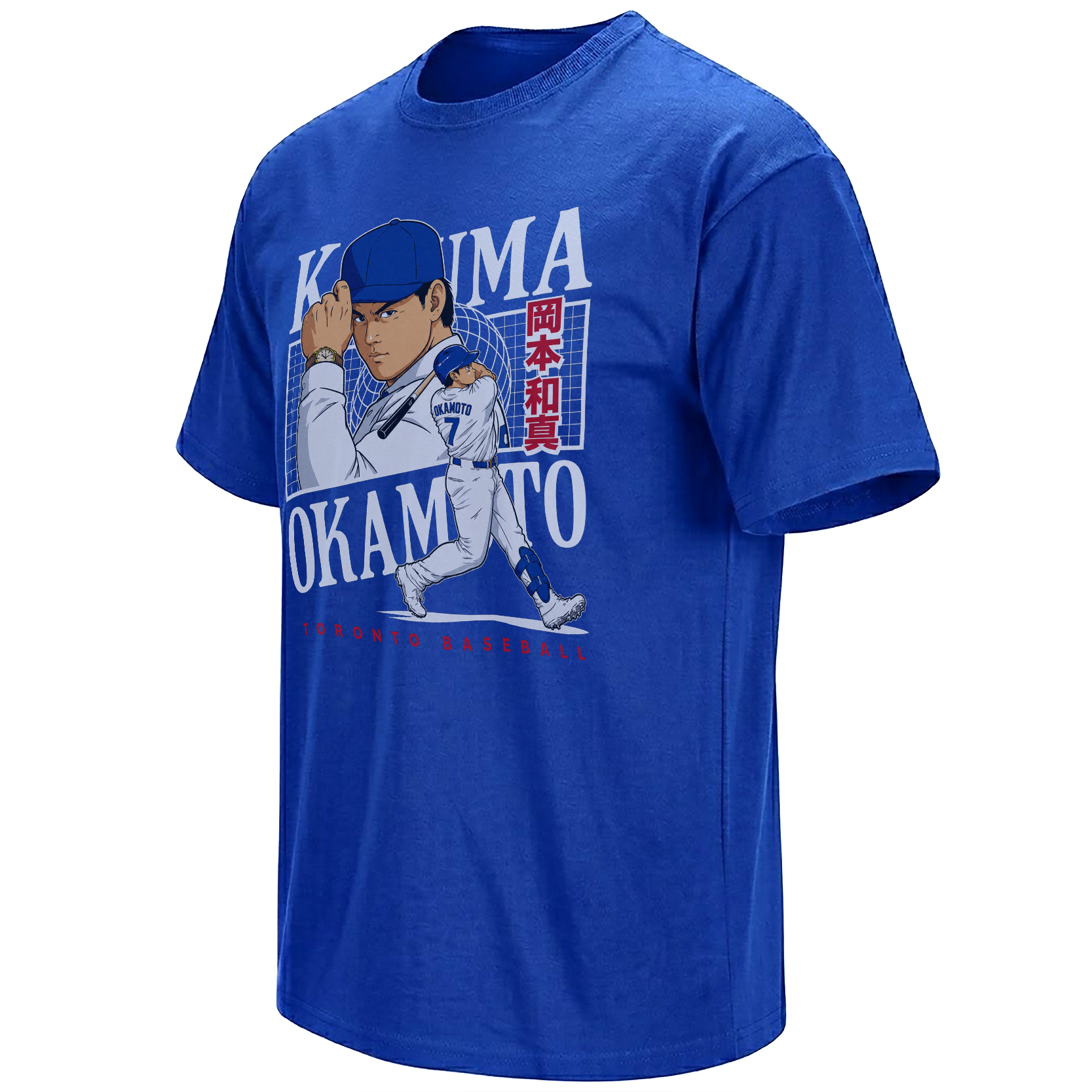
The Kazuma Okamoto graphic uses that vocabulary rather than presenting a standard photographic collage. One illustration emphasizes the right-handed swing. Another brings the viewer closer to the player’s face. Japanese lettering sits beside Toronto baseball language, allowing both sides of his career to occupy the design at once.
His No. 7 uniform becomes the visual anchor. The number connects the player seen in current Blue Jays highlights with the manga-styled figure, preventing the artwork from drifting into a generic anime baseball character.
Royal Blue and Black Tell Different Versions of the Story
On royal blue, the graphic feels fully absorbed into Toronto. The base color extends the uniform beyond the printed frame, creating the impression that Okamoto’s Japanese poster language has been placed directly inside the Blue Jays’ visual world.
On black, the same composition behaves more like a manga cover or night-game poster. The player illustrations emerge with sharper contrast, while the royal, white and red elements feel like printed ink laid over a dramatic background.
Reads as Toronto-first: brighter, more immediate and closely connected to the team palette surrounding Okamoto’s first MLB season.
Reads as poster-first: stronger contrast, a late-night baseball mood and greater emphasis on the Japanese anime composition.
Toronto Fans Are Learning the Player Through Moments
New international players rarely arrive with the same emotional history as homegrown stars. Toronto supporters did not spend years watching Okamoto develop through the minor leagues. Their relationship began through introductions, translated interviews, early at-bats and the first collection of highlights capable of becoming shared memory.
That is why individual moments matter so much during a first season. The long home run against New York, the late swing at Wrigley and the recurring sight of No. 7 stepping into the box become reference points. Fans are building a vocabulary for Okamoto one event at a time.
The broader Toronto Blue Jays collection functions as a running map of those relationships, bringing together established Toronto figures, new arrivals and the phrases that emerge around a season. The wider MLB collection places Okamoto’s story inside baseball’s expanding international visual culture.
From Japanese Slugger to Toronto Character
“Character” does not mean performance or fiction here. It means recognizability. A player becomes a cultural character when fans can identify the posture, number, phrase and emotional role associated with him before reading the full caption.
Okamoto’s developing Toronto identity already contains those ingredients: the red protective gear, the right-handed power swing, No. 7, the Japanese background and the sense that every important hit answers another question about how his game will travel.
The anime treatment does not attempt to predict the ending of his first MLB season. It preserves the energy of the beginning — the period when every chapter still feels open and every home run can change the tone of the story.
Frequently Asked Questions
Who is Kazuma Okamoto?
Kazuma Okamoto is a Japanese power hitter who built his reputation with the Yomiuri Giants, earned six NPB All-Star selections and joined the Toronto Blue Jays for the 2026 MLB season.
Why is Kazuma Okamoto associated with No. 7 in Toronto?
Okamoto wears No. 7 for the Blue Jays, making the number one of the clearest visual identifiers in artwork and fan imagery tied to his first Toronto season.
Why does the design use anime and manga styling?
The style connects Okamoto’s Japanese baseball background with Toronto’s current season while using expressive portraits, layered typography and action poses to turn his MLB transition into a visual narrative.
What is the difference between the royal-blue and black versions?
Royal blue strengthens the immediate Toronto team identity, while black creates a higher-contrast manga-poster effect that emphasizes the illustration and Japanese lettering.
Why are Okamoto’s early Blue Jays home runs culturally important?
They provide Toronto fans with shared reference points during his first MLB season and transform an international signing into a player connected to specific local baseball memories.
The Kazuma Okamoto anime graphic captures the beginning through No. 7, Japanese poster typography and the power swing Toronto is learning to recognize. More evolving player stories appear throughout the Blue Jays visual archive.
Kazuma Okamoto Shirt frames the Japanese slugger’s first Toronto Blue Jays season as an anime baseball chapter through his No. 7 uniform, Japanese typography, manga portraits and right-handed power swing.