Jyn Erso Meets Che Guevara
How Viva La Rebelión transforms a Rogue One heroine into a revolutionary-poster icon, connecting Star Wars resistance, the visual legacy of Alberto Korda, and a new wave of interest in the Rebellion.
One of the most recognizable portraits in modern visual history has found an unexpected new face: Jyn Erso. The heroine of 2016’s Rogue One: A Star Wars Story appears in a black revolutionary beret, her expression serious, with a red Rebel Alliance insignia replacing the star associated with Che Guevara’s famous portrait. Below her, the Spanish words VIVA LA REBELIÓN complete the transformation.
It is a pop-culture crossover that depends on two different kinds of recognition. Star Wars viewers know Jyn as the woman who helped make the original Death Star mission possible. Students of photography and graphic design recognize the unmistakable composition of Alberto Korda’s 1960 portrait of Che Guevara, later circulated under the name Guerrillero Heroico.
The timing gives the visual another layer. As Rogue One approaches its tenth anniversary in December 2026, the story remains in conversation following Andor’s 2025 conclusion and Marvel’s June 2026 Jyn Erso comic. The renewed context makes it worth looking again at how the fictional Rebellion is represented visually—and why this particular mashup feels so immediately legible.
Who Is Jyn Erso in Rogue One?
Jyn Erso, portrayed by Felicity Jones, enters Rogue One as a deeply guarded survivor. Her father, Galen Erso, was forced to help construct the Galactic Empire’s Death Star. Her childhood was marked by family separation and her complicated relationship with Saw Gerrera’s resistance movement.
Unlike characters who begin their stories already committed to a heroic cause, Jyn must make a difficult personal transition. She begins by distrustfully protecting herself, then recognizes that the information surrounding her father’s work may give the Rebel Alliance an opportunity to challenge an apparently invincible weapon.
Her eventual decision to join Cassian Andor and the team that travels to Scarif makes her central to the events preceding the original Star Wars film. The mission to retrieve the Death Star plans comes at an enormous personal cost, but it creates the opening that the Rebellion needs.
StarWars.com’s official character profile emphasizes her defiant personality and willingness to put individual survival aside for a greater purpose. That characterization helps explain why a revolutionary portrait treatment works for this character rather than simply serving as a random costume swap.
“Rebellions are built on hope.”
Jyn Erso · Rogue One: A Star Wars StoryWhat Does Viva La Rebelión Mean?
The phrase translates from Spanish as “Long live the rebellion.” In the design, it operates as an imagined rallying cry against the Galactic Empire. It is not established as an official Jyn Erso movie quotation, nor does the artwork represent an official collaboration between Star Wars and a historical political movement.
That distinction matters because the phrase is doing several jobs simultaneously. It creates the rhythm of a revolutionary slogan, signals the Spanish-language tradition of political poster rhetoric, and connects that atmosphere to Star Wars’ fictional struggle against Imperial rule.
The artwork therefore works as visual parody. It references a familiar historical image without suggesting that Jyn Erso and Che Guevara share identical biographies, beliefs, actions, or political legacies.
Why Does the Portrait Resemble Che Guevara?
On March 5, 1960, Cuban photographer Alberto Korda photographed Che Guevara during a memorial ceremony in Havana. The resulting image, Guerrillero Heroico, became one of the twentieth century’s most reproduced political portraits. Its visual structure is remarkably simple: a close-up face, intense eyes, dark hair, and a beret against a restrained background.
The photograph’s later circulation transformed it into a familiar symbol in posters, murals, graphic design, and commercial popular culture. Reproductions frequently simplified its tonal range, creating bold areas of black, white, and red that could be recognized even from a distance.


Placed together, the references explain the mashup. Jyn’s face supplies the fictional identity; the borrowed beret and high-contrast composition supply the art-historical reference. The distinctive Rebel Alliance starbird replaces the traditional star, allowing the image to remain recognizable within the Star Wars universe.
How Andor Changed the Meaning of Rogue One
Andor’s second and final season, released in 2025, expanded the story of how the Rebel Alliance took shape. It traced divisions among resistance groups, the personal sacrifices of ordinary people, and the political machinery of the Empire. The series led directly into Rogue One, giving familiar scenes from the film additional emotional and historical weight within the fictional universe.
StarWars.com specifically revisited the idea that rebellions are built on hope, explaining the phrase’s connection between Cassian Andor and Jyn Erso. The words take on greater significance when viewed against the broader struggles shown in Andor.
Jyn’s story also received new attention with Marvel’s Star Wars: Rogue One – Jyn Erso #1, published June 3, 2026. The comic returns to her imprisonment on Wobani and explores her life before the events of the film. That recent expansion provides another reason for fans to revisit the character as Rogue One’s tenth anniversary approaches.
How Does the Viva La Rebelión Artwork Reinterpret Both Icons?
The Viva La Rebelión graphic uses a strikingly limited palette of red, black, and pale ivory. Instead of placing Jyn among spaceships or blaster fire, it isolates her as the subject of a revolutionary portrait.
The face is framed by strong black shadows and a beret bearing the red Rebel Alliance emblem. A dark scarf and angular shoulders create a broad triangular silhouette. Beneath the portrait, small VIVA LA lettering introduces the larger word REBELIÓN, complete with its accented Ó.
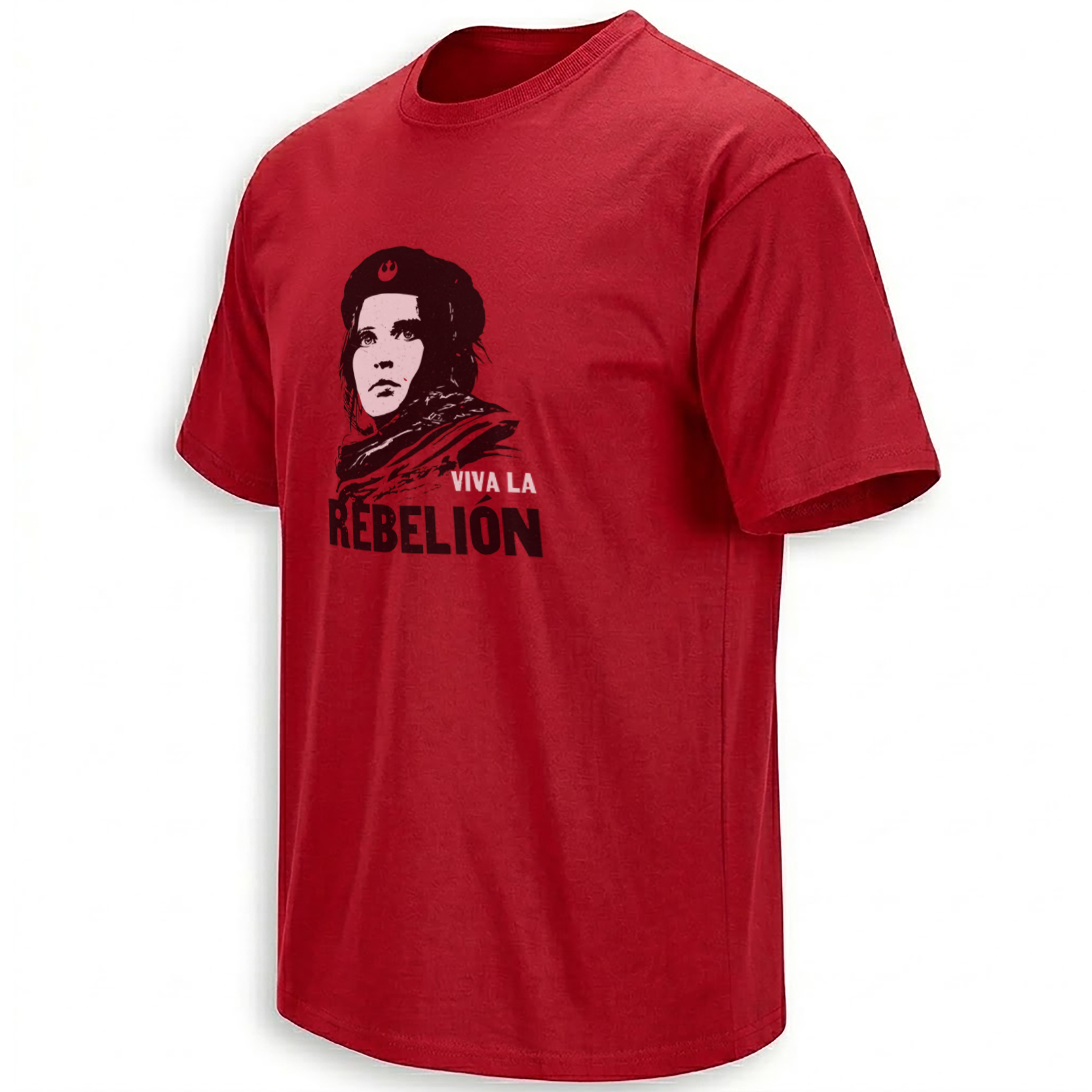
The absence of elaborate scenery makes the reference stronger. The viewer is asked to recognize a face, a symbol, and an artistic tradition. Where the original Rogue One costumes favor practical military textures, this illustration deliberately turns Jyn into an emblem.
The beret is a creative addition for the parody, not Jyn Erso’s documented Rogue One costume. The design references Korda’s famous portrait without establishing historical or political equivalence between its subjects.
Why Does This Crossover Resonate With Star Wars Culture?
Star Wars has always encouraged visual reinterpretation. Characters move from cinema into comics, illustrated posters, street art, and fan-made compositions. The strongest crossovers retain enough of the source material to be recognized while inviting viewers to see familiar stories through a different artistic language.
Jyn Erso works especially well because Rogue One focuses on collective sacrifice rather than a single invulnerable hero. Her determination gives the portrait emotional weight, while the revolutionary design vocabulary makes the image understandable beyond traditional film-poster aesthetics.
Readers can explore more character imagery in EllieShirt’s Star Wars collection, other film-inspired artwork in the Movies Shirts collection, or the Jyn Erso design archive.
Frequently Asked Questions
Who is the woman in the Viva La Rebelión design?
The portrait depicts Jyn Erso, portrayed by Felicity Jones in Rogue One: A Star Wars Story.
What does Viva La Rebelión mean?
The Spanish phrase means “Long live the rebellion.” It is used as a thematic slogan in this parody, not as a verified movie quotation.
Is the portrait inspired by Che Guevara?
Yes. The beret and high-contrast composition reference Alberto Korda’s 1960 Che Guevara portrait, Guerrillero Heroico.
What symbol appears on Jyn Erso’s beret?
The symbol is the Rebel Alliance starbird, replacing the star associated with the historical portrait.
Why is Jyn Erso connected to Andor?
Andor explores the formation of the rebellion and leads into Rogue One, where Jyn and Cassian undertake the mission to obtain the Death Star plans.
The Viva La Rebelión portrait brings two recognizable visual worlds together. Its appeal lies in how quickly a single image can evoke Jyn Erso’s story, the cultural memory of a famous photograph, and the poster traditions that turn characters into symbols.
Viva La Rebelión reimagines Rogue One’s Jyn Erso in the style of Alberto Korda’s iconic Che Guevara portrait. The red-and-black parody connects Rebel Alliance symbolism, vintage revolutionary-poster aesthetics, and the enduring cultural influence of Star Wars.