
Straight Outta Double-A: Josue De Paula Skipped a Level and Went Deep
Los Angeles did not send Josue De Paula to Triple-A first. The Dodgers took one of baseball’s highest-ranked prospects directly from Tulsa to the Major Leagues — and his first big-league hit landed 416 feet away.
“Straight Outta Double-A” sounds like somebody wrote the punchline first.
In Josue De Paula’s case, Los Angeles supplied the setup.
The Dodgers promoted the 21-year-old directly from Double-A Tulsa in September, bypassing Triple-A entirely. MLB Pipeline had De Paula ranked as the No. 1 outfield prospect and No. 6 prospect in all of baseball. Even he admitted the route caught him by surprise; before manager Eric Wedge delivered the news, De Paula said he did not realize skipping Triple-A was really on the table.
Then came the part that makes the promotion feel scripted. Two days after his MLB debut, his first Major League hit was not a soft single or a ball that found a hole. He turned on a 98 mph Eury Pérez fastball and drove it into the second deck in right field at loanDepot park.
Three runs. 108.2 mph off the bat. A 39-degree launch angle. Roughly 416 feet. First hit, first homer and first RBI all inside the same swing.
“Straight Outta Double-A” stopped being prospect hype the instant De Paula’s first Major League hit landed in the second deck.
The First Hit Was the Exact Swing Prospect Watchers Had Imagined
De Paula had already shown patience in his first Major League plate appearances. He reached base on walks before collecting a hit, an encouraging detail for a 21-year-old suddenly facing big-league pitching without the usual Triple-A bridge.
When the first hit finally came on September 13, patience gave way to violence.
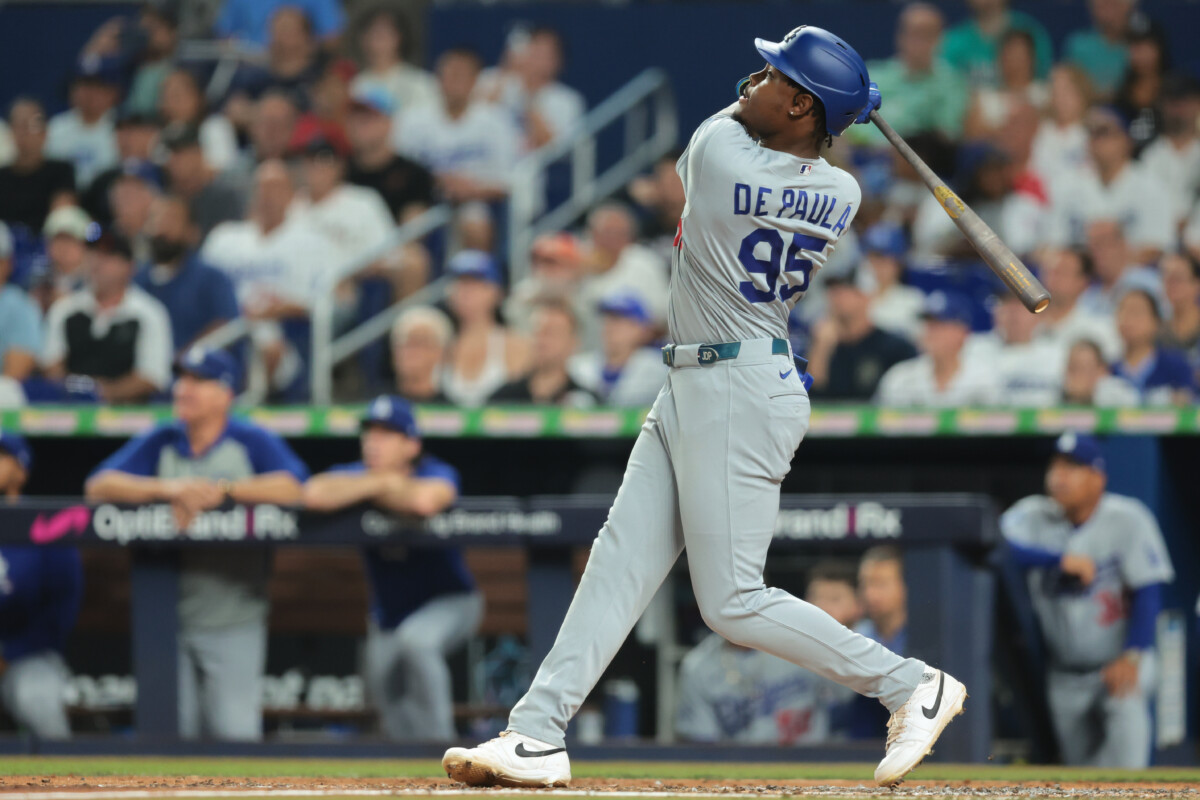
De Paula followed the homer with a double and also drew a walk, finishing the day 2-for-2. Los Angeles eventually lost 6–4, but his performance immediately complicated the usual September prospect question. The discussion was no longer only whether he belonged on a Major League roster; it became how much opportunity the Dodgers could realistically give him as postseason decisions approached.
Skipping Triple-A Is the Entire Cultural Hook
MLB’s own prospect coverage framed the promotion as unusual. Since Andrew Friedman took over baseball operations in Los Angeles in 2014, the Dodgers had not moved a position player from Double-A directly into the Major Leagues this way.
Historically, Yasiel Puig is an important reminder that De Paula is not the first Dodgers position player ever to bypass Triple-A, so the cleanest way to understand the moment is not as an unprecedented franchise first. It is as an extremely rare developmental shortcut for the modern Dodgers organization.
That distinction actually makes “Straight Outta Double-A” better. The phrase does not need a false record attached to it. The route itself is unusual enough.

Royal blue keeps the connection to Los Angeles immediate, while distressed red initials and compact white typography borrow from bootleg music graphics and street posters. The shirt does not illustrate the home run; it captures the swagger of the route that put De Paula in position to hit it.
Double-A Had Already Stopped Looking Big Enough
De Paula’s promotion did not come from a brief hot streak. He spent the 2026 season attacking Double-A pitching.
Across 124 games for Tulsa, he produced a .948 OPS with 27 home runs and 104 RBI. Other season totals included a .303 average, a .401 on-base percentage, 37 doubles and 31 stolen bases — a combination of on-base ability, extra-base damage and athleticism that made a conventional late-season Triple-A audition feel less necessary.
The Dodgers were also dealing with an opening in the lineup while Shohei Ohtani went to the injured list. De Paula’s call-up therefore came at the intersection of development and immediate Major League need.
The Social Reaction Was Exactly as Simple as the Shirt
Los Angeles did not need a paragraph when the homer landed. The official Dodgers account posted the image with four words: “JOSUE DE PAULA IS HERE.”
That reaction fits the product concept almost perfectly. Prospect culture loves complicated ranking systems, future grades and developmental timelines. The homer made all of that briefly unnecessary. He was in Double-A. Then he was in the Majors. Then a 98 mph pitch disappeared into the seats.
J.D.P. Has Moved From Prospect Archive to Dodgers Timeline
De Paula-specific releases can now live inside the Josue De Paula product archive, while the broader Los Angeles Dodgers collection tracks how a September call-up intersects with a veteran roster preparing for October.
The MLB collection gives the moment an even wider context: 2026 has been full of top prospects arriving, but very few have compressed the phrase “welcome to the show” into one swing as cleanly as De Paula.
Frequently Asked Questions
Did Josue De Paula really skip Triple-A?
Yes. The Dodgers promoted De Paula directly from Double-A Tulsa to the Major League roster in September 2026 without sending him through Triple-A first.
What was Josue De Paula’s first MLB hit?
His first Major League hit was a three-run home run against Miami on September 13, 2026.
How far did De Paula’s first home run travel?
Statcast measured the homer at approximately 416 feet with a 108.2 mph exit velocity and a 39-degree launch angle.
How highly ranked was Josue De Paula when the Dodgers called him up?
MLB Pipeline ranked De Paula as the No. 1 outfield prospect and No. 6 overall prospect in baseball at the time of the September call-up.
What does “Straight Outta Double-A” mean?
The phrase directly references De Paula’s unusual route from the Double-A Tulsa Drillers to the Dodgers’ Major League roster without a Triple-A stop.
The J.D.P. Straight Outta Double-A graphic captures the route that made the call-up unusual, while the Dodgers archive can follow what happens now that one of baseball’s highest-ranked young hitters has officially arrived.
J.D.P. Straight Outta Double-A Shirt captures Josue De Paula’s direct jump from Tulsa to the Los Angeles Dodgers and the 416-foot three-run homer that became his first Major League hit.