
Jalen Brunson’s Three Rings Shirt Turns Villanova Glory and Knicks Redemption Into One Timeline
The power of the three-ring Brunson graphic is that it does not treat the Knicks championship as a sudden miracle. It places New York’s title beside the Villanova years, turning Brunson’s career into a clean visual argument: this was always the profile of a winner.
Jalen Brunson’s Knicks championship did not erase his Villanova past. It activated it. Once New York finally reached the top again, the old college résumé stopped feeling like background trivia and started looking like the first two chapters of the same champion story: 2016, 2018, then 2026.
That is why the “three rings” idea feels so natural in Knicks culture right now. Brunson was already the guard who turned Madison Square Garden tension into late-clock control, the Finals MVP who carried the city through the last step, and the face of a team that ended a 53-year title wait. But the Villanova connection gives the moment a deeper rhythm. He had been in championship rooms before New York ever crowned him.
The shirt’s meaning comes from that timeline. It is not only saying Brunson won in college and won in the NBA. It is saying the Knicks’ title made the full pattern visible. The same player who learned winning inside Villanova’s program became the adult version of that habit in New York.
The third ring did not start Brunson’s champion story. It made the whole timeline impossible to ignore.
Why the Villanova Years Matter Again
Villanova is not a throwaway line in Brunson’s basketball biography. It is where his public winning language first became visible. He was part of the 2016 national championship team as a freshman, then returned as the central leader of the 2018 group that completed one of the most authoritative title runs in recent college basketball memory.
By 2018, Brunson had become the kind of college guard whose game felt unusually settled. He controlled pace, punished switches, posted smaller defenders, made disciplined reads and became the national player of the year. The awards mattered, but the more important thing was the shape of the player: calm under pressure, physical for his size, and comfortable being the adult in the room.
That profile is exactly what New York eventually received. Knicks fans did not get a different Brunson. They got the fully scaled version of what Villanova had already revealed.
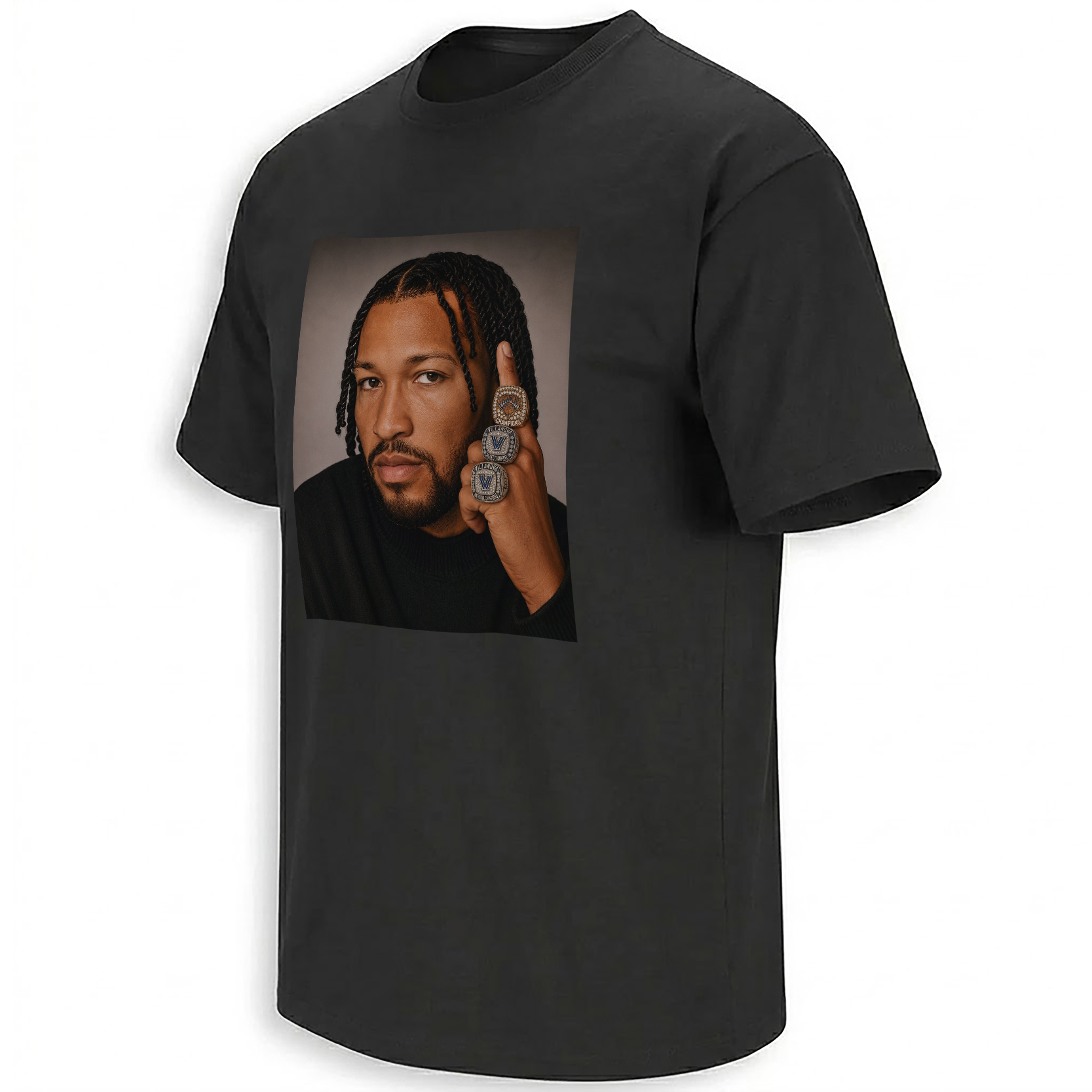
The Design Works Because It Reads Like a Career Receipt
The graphic does not need to overcomplicate the idea. Brunson stands as the central figure, while the ring language does the storytelling around him. The visual appeal comes from how quickly the viewer understands the point: this is not a one-season victory lap. It is a résumé in ring form.
The composition gives Brunson a poster-like authority, but the stronger detail is the way the championship markers create a bridge between college and professional basketball. Villanova is not treated as a separate nostalgia block. It is folded into the same visual field as the Knicks title, which makes the design feel like a complete timeline rather than two disconnected chapters.
Blue carries the Villanova memory. Orange pulls the image back to New York. Gold gives the rings their obvious championship weight. Together, the colors create a three-part basketball identity: college foundation, city pressure, title proof.
The central Brunson portrait, ring-count logic, Villanova-to-Knicks color bridge and gold championship accents turn the artwork into a visual receipt. It records not only what he won, but how long the winning pattern had been building.
From College Champion to New York’s Point Guard
The leap from Villanova star to Knicks Finals MVP is not simple, and that is part of why fans value it. Brunson’s NBA path was never framed like a preordained superstar coronation. He had to outgrow draft-slot skepticism, role-player assumptions, contract discourse and the constant question of how much of his college command would translate against NBA size and speed.
New York became the place where the answer got loud. Brunson did not merely become productive. He became the emotional organizer of the franchise. He gave the Knicks a late-game identity, a reliable pressure valve and a guard whose pace seemed to slow the entire city down when the stakes got loudest.
Once the championship arrived, the Villanova past felt newly relevant because it helped explain why the moment looked so natural on him. Brunson had been building a winner’s muscle memory long before the Garden started chanting his name.
Why Knicks Fans Love the “Winner Before New York” Angle
New York fandom often tests players by pressure. A player can arrive with credentials and still need to prove whether those credentials survive the city. Brunson’s story is different because the championship now allows fans to look back and say the signs were always there.
The Villanova rings become part of that proof. They remind fans that Brunson had already been trusted in systems built around execution, accountability and championship standards. The Knicks did not discover an unknown winner. They gave an existing winner the keys to a city desperate for one.
That makes the “three rings” phrasing emotionally efficient. It turns a long argument into a short visual statement. College title, college title, NBA title. The design does not need a paragraph of persuasion because the ring count carries its own rhythm.
The meme-friendly power of the design is simple: Brunson’s Knicks title made his Villanova rings feel newly current. Fans could suddenly read his whole career as a champion timeline rather than separate college and NBA chapters.
The Nova Knicks Subtext
Brunson’s Villanova connection also matters because it was not isolated. The Knicks’ title-era identity has been shaped by the presence of former Wildcats, including Brunson, Josh Hart, Donte DiVincenzo and Mikal Bridges in the larger New York conversation. That shared background gave fans a ready-made language: Nova Knicks.
For Knicks fans, that phrase became more than a roster note. It suggested trust, chemistry and a college-basketball spine inside an NBA championship team. Villanova’s culture of spacing, toughness, guard play and late-game discipline suddenly had a New York afterlife.
The Three Rings design sits inside that context, even when it centers Brunson alone. The shirt is about his rings, but the emotional backdrop is broader: a Knicks era where Villanova memory became part of Madison Square Garden identity.
Where the Graphic Fits in the Knicks Archive
The wider New York Knicks Shirts archive has become a running map of this championship era: Finals MVP mythology, Garden moments, Brunson jokes, player tributes, comeback language and city-wide celebration graphics. The Three Rings design belongs there because it explains why Brunson’s title felt historically loaded rather than merely current.
The broader NBA Shirts collection gives the piece its professional frame: the Finals MVP, the championship run, the star guard who changed a franchise’s emotional temperature. But the college layer matters too, which is why the NCAA Shirts collection is the right wider path for the Villanova side of the story when no confirmed Villanova-specific collection is available.
That internal-link structure mirrors the design itself: Knicks present, NBA achievement, NCAA foundation. Brunson’s career does not fit neatly into one category anymore. The rings connect the categories.
The Shirt as a Champion-Timeline Artifact
Some championship shirts celebrate one night. This one celebrates accumulation. It treats Brunson’s 2026 Knicks title as the newest proof in a longer pattern of winning. That is why the three-ring idea feels cleaner than a standard Finals graphic. It does not only remember the ending. It explains the path.
The artifact quality comes from how the design compresses time. A freshman title at Villanova, a national player-of-the-year season with another title, then a professional championship in New York — three points on the same line. The shirt turns that line into a visual object.
For Knicks fans, the result is especially satisfying because it frames Brunson as both new and proven. He delivered the city’s long-awaited title, but the champion DNA was never invented by the Garden lights. The Garden simply revealed it to a much louder world.
Frequently Asked Questions
What is the Brunson Three Rings Shirt about?
It is a Jalen Brunson champion-timeline shirt connecting his two Villanova national titles with his Knicks championship, using three-ring imagery to frame his career as a continuous winning story.
Why are Villanova and the Knicks both important to the design?
Villanova represents Brunson’s championship foundation, while the Knicks title represents the professional chapter where he became New York’s Finals MVP and franchise-defining guard.
What do the three rings represent?
The three rings reference Brunson’s two NCAA championship seasons at Villanova and his NBA championship with the New York Knicks, turning the design into a compact winner’s résumé.
Why does the shirt feel connected to Knicks championship culture?
It connects Brunson’s current New York title run with the earlier Villanova proof that he had already been shaped by championship pressure before becoming the Knicks’ leader.
Why does the Villanova background matter to Knicks fans?
Brunson’s Villanova history adds context to his poise, leadership and winning habits, making the Knicks championship feel like the next chapter in a long-established pattern rather than a one-year breakthrough.
The Brunson Three Rings Shirt turns Villanova foundation and Knicks championship mythology into one clean visual timeline, while the Knicks archive keeps tracking the Finals-era graphics, Brunson moments and New York fan language that made this title feel bigger than one season.
Brunson Three Rings Shirt connects Jalen Brunson’s Villanova championship roots with his Knicks title run, using three-ring imagery, New York orange, Villanova blue and champion-timeline storytelling.