
Jac Caglianone Is Taking No. 14 Into Baseball’s Power Showcase
The Royals’ young left-handed slugger enters the 2026 Home Run Derby with 14 home runs, exceptional average distance and a swing built to make the dimensions of Citizens Bank Park feel temporary.
Jac Caglianone announced on July 8 that he would join the 2026 Home Run Derby field in Philadelphia, giving Kansas City a second consecutive summer built around one of baseball’s most visually explosive young hitters. The invitation did not arrive only because he had reached 14 home runs. It arrived because of how far those home runs tended to travel.
Among hitters with at least ten homers, Caglianone entered the event leading the majors in average home-run distance. That distinction captures the essential appeal of his rookie power: the swing does not simply clear fences. It creates trajectories that immediately turn ordinary at-bats into measurements.
For Royals fans, the Derby invitation changes the meaning of No. 14. The number is no longer attached only to a highly regarded prospect learning major-league pitching. It now belongs to a young slugger invited onto baseball’s largest isolated stage for raw power.
Caglianone’s home runs feel different because the crowd begins measuring them before the ball has finished climbing.
The Derby Invitation Made the Power Official
Every major-league prospect with power is described through projection. Scouts discuss future home-run totals, expected exit velocity and how strength might translate against advanced pitching. The Derby invitation interrupts that future tense.
Caglianone is not being invited because baseball hopes he may one day hit the ball far. He is being invited because he already does. His six-home-run stretch across five June games converted the scouting reputation into a major-league spectacle.
The invitation also places him in a distinctive Kansas City lineage. Previous Royals Derby participants include Bo Jackson and Bobby Witt Jr., whose 2024 run reached the final. Caglianone therefore enters an event where raw power and franchise memory already overlap.
Why His Left-Handed Swing Looks Built for Distance
Caglianone’s power begins with physical strength, but the visual appeal lies in how quickly that strength becomes barrel speed. His lower half opens with force, the hands follow through a compact path and the finish rises naturally toward right and right-center field.
That combination produces the kind of high, sustained flight that keeps outfielders looking upward long after they have stopped moving. A 437-foot home run against Baltimore in April supplied an early example, leaving the bat at 109.7 mph.
The Derby removes the tactical complexity of normal plate appearances and isolates the movement itself. There will be no need to protect against breaking balls or manage the strike zone. The entire event asks one question: how repeatedly can the swing create distance?
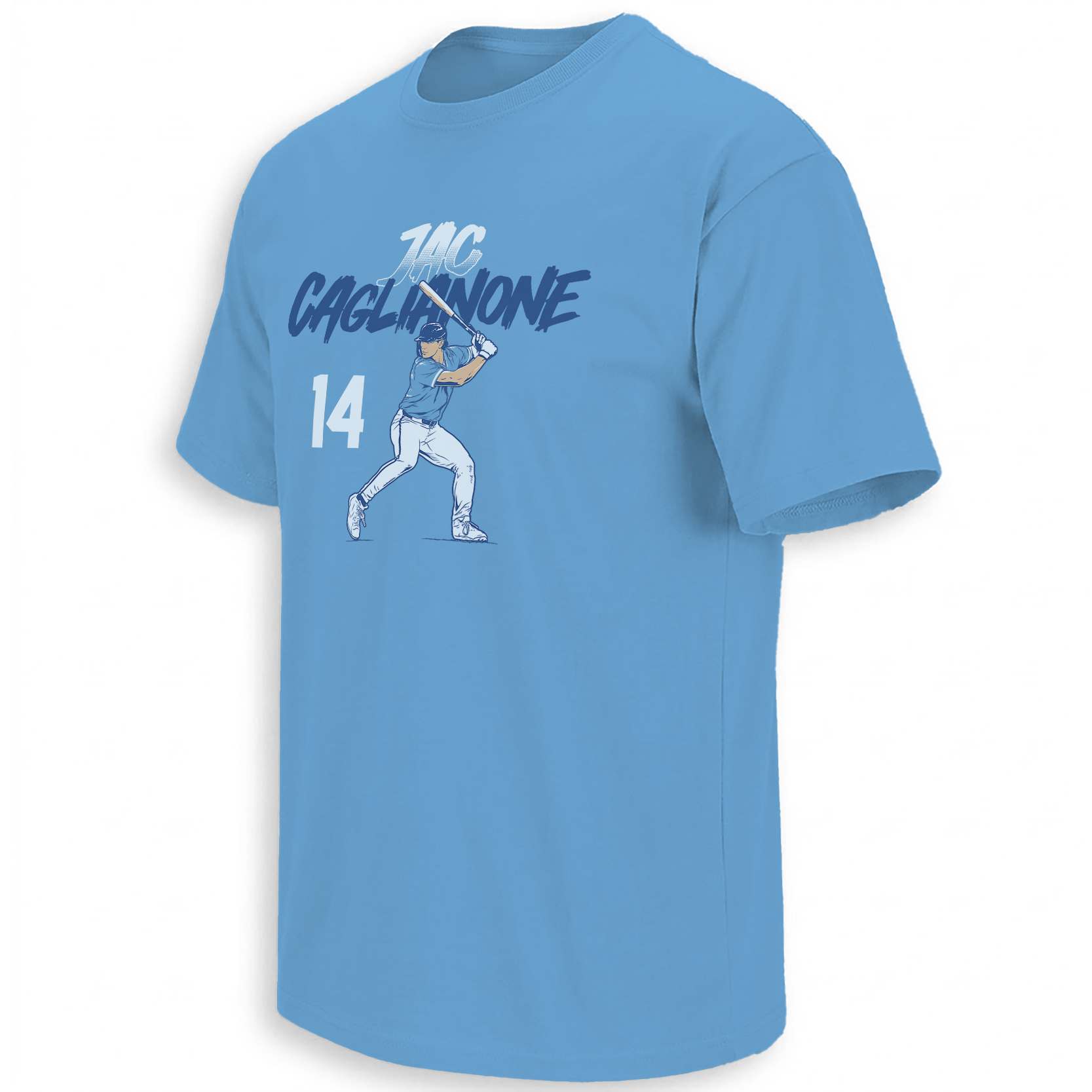
The batting pose provides diagonal momentum, while the large number stabilizes the composition behind it. Royals blue keeps the image tied to Kansas City, and the brighter accents resemble the flash of a baseball leaving the barrel under event lighting.
From Florida Two-Way Mythology to Royals Slugger
Caglianone entered professional baseball with an identity larger than a standard hitting prospect. At the University of Florida, he was known for both pitching and producing extraordinary home-run totals.
Kansas City’s developmental task was to turn that unusual college mythology into a sustainable major-league role. The current version is increasingly clear: a middle-of-the-order left-handed bat capable of changing the geometry of a game.
That does not mean the development is complete. His approach, defense and ability to adjust against major-league sequencing remain active parts of the story. The significance of 2026 is that the power has already survived the transition.
A two-way Florida star whose home-run totals and pitching role made him one of amateur baseball’s most unusual figures.
Advanced pitching demanded faster decisions and made every adjustment more visible.
A No. 14 slugger whose distance has already earned a place on the Derby stage.
Why the Number Became Part of the Moment
Caglianone changed to No. 14 in April, giving the 2026 power surge its own clean visual marker. Uniform numbers often become meaningful only after fans have enough images to attach to them.
No. 14 now appears at the end of long follow-throughs, during slow home-run trots and across the highlights that turned his Derby participation into an obvious decision.
The design belongs specifically to that moment. It does not attempt to summarize every stage of his development. It records the summer when the number became associated with measurable, repeatable distance.
Kansas City’s Young Core Needed Another Source of Scale
Bobby Witt Jr. gives the Royals speed, all-around brilliance and a nationally recognizable franchise center. Caglianone adds a different kind of spectacle.
His appeal is based on scale. The ball travels farther. The swing looks larger. A single plate appearance can briefly transform the stadium into a distance contest.
That contrast gives Kansas City a more varied young identity. Witt can affect every dimension of the game, while Caglianone creates the possibility that one pitch will leave no defensive solution at all.
The Derby Is a Performance, Not a Forecast
Home Run Derby results do not determine the future of a hitter. Winning does not guarantee a great second half, and an early exit does not reduce the significance of reaching the field.
The cultural value lies in visibility. For one night, Caglianone’s swing will be shown without interruption, surrounded by distance graphics, crowd reactions and direct comparisons with the league’s other power hitters.
That makes the event a perfect setting for a player whose reputation already depends on flight. The larger season will continue afterward. The Derby provides a concentrated image of why the season has become interesting.
The Wider MLB Power Archive
Statcast allows modern fans to remember power through exact numbers: exit velocity, launch angle and projected distance. Yet the emotional reaction remains instinctive. Contact occurs, the sound changes and everyone looks up.
The Jac Caglianone No. 14 design preserves that upward expectation, while the broader MLB Shirts collection follows the Derby moments, breakout sluggers and player identities shaping baseball in 2026.
Frequently Asked Questions
Will Jac Caglianone compete in the 2026 Home Run Derby?
Yes. Caglianone announced that he would participate in the July 13 Home Run Derby at Citizens Bank Park in Philadelphia.
How many home runs did Caglianone have entering Derby week?
He had 14 home runs during his 2026 season when his participation was announced.
What number does Caglianone wear for Kansas City?
Caglianone wears No. 14 for the Kansas City Royals.
Why is his power considered unusual?
His combination of strength, left-handed bat speed and average home-run distance produces some of the longest flights in Major League Baseball.
What does the Jac Caglianone 14 design represent?
The graphic captures his transition from elite prospect to major-league power attraction through his swing, Royals colors and Derby-era No. 14 identity.
The Jac Caglianone 14 piece records the swing behind his first Derby invitation, while the broader MLB visual archive follows the home-run moments and young stars defining the summer.
Jac Caglianone 14 Shirt captures the Kansas City Royals slugger’s 2026 Home Run Derby moment through his powerful left-handed swing, signature number and reputation for extraordinary distance.