
I Was There, Dude, and It Ruled: How Bart Simpson Became the Knicks’ Cartoon Championship Witness
A yellow animated troublemaker wears Brunson’s No. 11, stands beside the trophy and delivers the simplest possible review of New York’s historic title: he was there, dude—and it ruled.
New York’s 2026 championship is already moving from breaking news into memory. The Knicks defeated San Antonio in five games, ended a 53-year title wait and carried the Larry O’Brien Trophy through Lower Manhattan while generations of supporters packed the Canyon of Heroes.
Jalen Brunson completed the run as Finals MVP after scoring 45 points in the title-clinching Game 5. Teammates who had spent the postseason solving pressure together became the faces of a citywide parade filled with orange, blue, handmade signs and championship shirts.
The “I Was There, Dude, and It Ruled” design captures a different part of that history. It does not present the title as a formal museum display. It imagines Bart Simpson as one more excited witness—wearing No. 11, standing beside the trophy and reacting with the language of someone who has just experienced the greatest day of summer.
Formal history records the score. Fan culture records the feeling: I was there, dude—and it ruled.
The Phrase Turns Championship History Into a Personal Memory
“The Knicks won the 2026 NBA championship” is the official statement. It belongs in record books, banners and future introductions of the team.
“I was there” belongs to the fan.
It can mean being inside the arena, standing along the parade route, watching with family or stepping outside into a neighborhood that suddenly sounded different after the final buzzer.
The phrase makes the wearer part of the event rather than only an observer studying the result afterward.
“Dude, and it ruled” removes the distance normally created by historical language. The title does not need to be described through polished sports vocabulary. It can be remembered through the kind of immediate reaction someone gives before the emotion has had time to become formal.
“I was there” places the speaker inside the championship experience and transforms a team achievement into personal memory.
Casual slang keeps the message playful and makes the celebration sound like a story being retold between friends.
The final words reduce an enormous historical event to one enthusiastic review that requires no further explanation.
The Front Design Makes Bart a Knicks Fan From the Championship Timeline
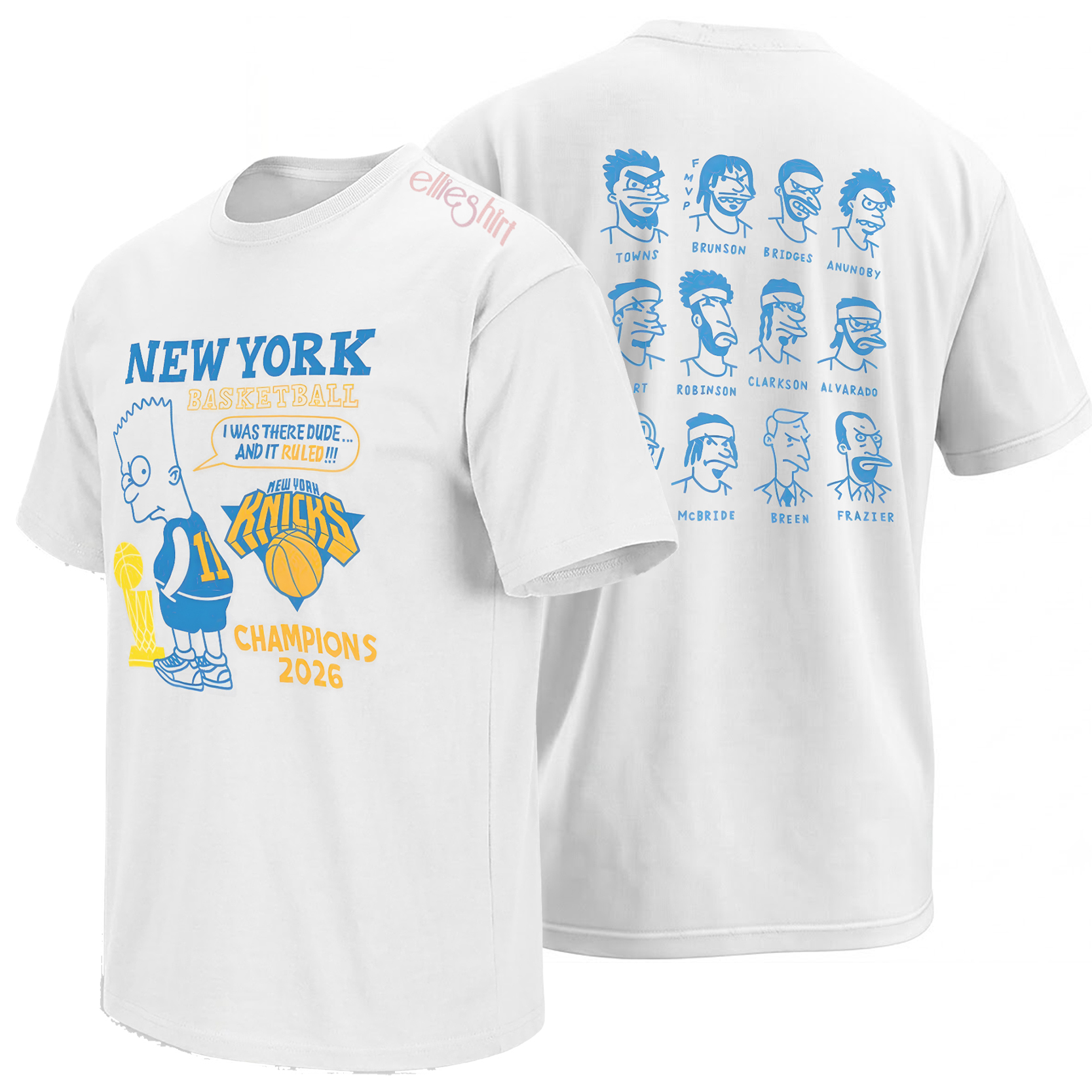
The I Was There, Dude, and It Ruled design places Bart in a blue basketball uniform with No. 11 across the chest.
That number connects the cartoon figure directly to Brunson, the point guard who became the emotional and competitive center of the championship run.
Bart stands beside a gold trophy rather than performing a basketball action. The championship has already happened. His role is to witness it, enjoy it and tell everyone else that the experience lived up to the wait.
Above him, “New York Basketball” creates the city context. Beside him, orange-and-blue Knicks lettering establishes the team. Below, “Champions 2026” fixes the memory to a specific season.
The speech bubble completes the character. Without it, Bart would be a mascot-like figure inside a championship graphic. With it, he becomes the narrator.
Why No. 11 Is the Correct Number for the Cartoon Witness
A character crossover becomes stronger when the number carries meaning beyond decoration.
No. 11 belongs to Brunson, the captain and Finals MVP whose control gave the Knicks a reliable answer through the most difficult possessions of the postseason.
Placing that number on Bart does not attempt to recreate Brunson physically. It allows the character to represent the fan who identifies with the player.
Children wear the number. Adults wear the number. Fans who never played organized basketball wear the number because jerseys allow supporters to borrow part of an athlete’s public identity.
Bart is doing the same thing. He is not presented as the champion who scored 45 points. He is presented as the mischievous fan who chose the jersey of the championship hero.
The number represents leadership, clutch scoring, Finals MVP recognition and the player New York trusted with its most important possessions.
The same number becomes fan identification, turning the animated character into one more supporter celebrating the title through Brunson’s jersey.
The Trophy Beside Bart Changes the Entire Scene
Bart Simpson normally appears in situations shaped by rebellion, boredom or mischief. A championship trophy introduces an unusual object of permanence.
The trophy says that this is not simply a generic Knicks parody. The design belongs after the title.
Its gold color creates the brightest vertical form on the front, balancing Bart’s blue uniform and the orange wordmark.
The character looks relaxed beside it, as though standing near the trophy has become completely normal after the parade. That casual relationship produces the humor.
New York waited more than half a century for the object. Bart reacts as though he wandered into the celebration, looked around and immediately understood that everything ruled.
The Design Captures the Difference Between Winning and Remembering
Players create a championship through months of competition. Fans create its cultural memory through stories, photographs, jokes and objects connected to where they were.
A trophy graphic records winning. The phrase “I was there” records remembering.
That distinction matters because most supporters did not stand on the court when the series ended. Their experience occurred in homes, bars, streets, subway cars and crowded public spaces.
Those locations become part of the title. A person may remember who sat beside them, which block erupted first or how long it took before the city’s noise began to feel real.
The shirt turns that personal recollection into a portable sentence.
The Back Print Expands One Character Into a Championship Community
The front belongs to one fictional witness. The back belongs to the group surrounding the championship.
Twelve blue line-art portraits appear in a three-row arrangement. Each face is exaggerated through the same animated visual vocabulary, allowing players and familiar New York basketball voices to occupy one shared cartoon world.
Towns, Brunson, Bridges and Anunoby form the first row. Hart, Robinson, Clarkson and Alvarado fill the second. Shamet, McBride, Mike Breen and Walt Frazier complete the lower row.
Brunson receives the “FMVP” marker, preserving his Finals MVP status inside the lineup.
Including Breen and Frazier expands the roster beyond the players who occupied the court. Championship memory also belongs to the voices who described the season and connected the current team to earlier generations of Knicks history.
Why Caricature Is More Appropriate Than Formal Portraiture
A formal roster collage would emphasize accuracy, intensity and the official appearance of the championship team.
Caricature emphasizes personality.
Hair, facial expressions, headbands, beards and recognizable features become simplified into visual shorthand. Fans identify each figure through the details they have learned over the season.
The drawing style also creates consistency between real athletes and the animated character on the front.
Without that shared visual language, Bart might feel attached to an unrelated team poster. The caricature back allows the entire design to operate as one cartoon universe.
The front gives the championship a cartoon witness. The back gives that witness an entire orange-and-blue cast.
The Roster Back Makes the Shirt a Season Archive
A front-only graphic can preserve one phrase or image. A roster back transforms the piece into a record of the people associated with the run.
This is especially important after a championship because rosters change quickly. Trades, free agency, injuries and new roles can make one season’s group feel unique almost immediately.
The caricature wall freezes the 2026 celebration before those changes begin.
Years later, individual faces may recall different games: a Brunson scoring run, an Anunoby defensive play, a Towns rebound, a Hart hustle sequence or a Robinson possession controlled above the rim.
Breen and Frazier recall the sound of the season—the commentary, catchphrases and historical comparisons accompanying each breakthrough.
The back print does more than name a team. It preserves the cast surrounding one specific New York season before time separates those players, voices and memories into different chapters.
Bart Simpson Fits New York’s Championship Personality
Bart is not a polished ceremonial figure. He is impatient, sarcastic and more interested in whether an experience was exciting than whether it followed proper etiquette.
That attitude fits the emotional release surrounding the Knicks’ title.
New York did not celebrate quietly. Fans filled the streets, climbed onto available viewpoints, transformed subway rides into chants and treated the parade like a citywide interruption of ordinary life.
A formal mascot might say that the championship represented excellence. Bart says it ruled.
The second description may be less sophisticated, but it feels closer to the immediate emotion of a supporter who has waited too long to remain composed.
The Design Connects Adult Nostalgia With Younger Fans
Bart Simpson has existed across multiple generations of popular culture. Adults who watched the character years ago now share sports fandom with children encountering similar animated imagery for the first time.
That makes the design naturally intergenerational.
Older supporters recognize the cartoon attitude and the significance of a championship arriving after decades of disappointment.
Younger supporters see the bright yellow character, trophy, blue jersey and simplified team colors.
The same graphic can therefore carry two forms of nostalgia: memory of the animated character and memory of the championship season being created in real time.
- The character creates recognition. Bart supplies a familiar animated personality before the complete basketball context is read.
- No. 11 connects the image to Brunson. The jersey turns the character into a fan of the Finals MVP.
- The trophy establishes the historical moment. “Champions 2026” ensures the design belongs to the completed title run.
- The back roster expands the memory. Players and broadcast figures become the full cast of the championship story.
Blue Line Art Gives the Back a Yearbook Feeling
The back portraits use one primary blue rather than full-color illustrations.
That limitation creates visual unity and resembles the quick portraits found in school yearbooks, fan zines and hand-drawn team programs.
The effect is appropriate because the roster represents a graduating class of champions. Each face occupies its own small space, but the arrangement becomes meaningful only when viewed as a complete group.
The white garment base keeps the blue linework clean and allows the front’s yellow and orange details to remain the strongest color surprise.
The result feels intentionally informal: less like corporate championship merchandise and more like something designed by a fan immediately after the parade.
“I Was There” Can Mean More Than Physical Attendance
Championship language often creates anxiety over who was literally present. Not every supporter could enter the arena or find a position along the parade route.
Yet fandom experiences major events collectively across distance.
A viewer watching from another state, another country or a late-night screen can still remember the exact moment the result became final.
“I was there” can therefore mean participation in the cultural moment rather than possession of one ticket.
The front-and-back Knicks championship piece allows the wearer to claim that memory in the same playful voice as the character.
The Phrase Will Grow Stronger as the Championship Becomes History
Immediately after a title, almost every image feels current. The trophy, parade and roster remain part of the present tense.
Over time, “I was there” changes.
It becomes a claim of generational memory. Supporters who experienced the season can tell younger fans what the city felt like when the Knicks finally returned to the top.
The phrase gains emotional value because future seasons cannot reproduce the first end of the drought. Another championship may create another parade, but it will not recreate the precise moment when 53 years of waiting ended.
The shirt therefore becomes more than an immediate celebration. It becomes a statement from someone who remembers the original release.
The Back Print Includes the Voices of Knicks History
Mike Breen and Walt Frazier appear beside the player caricatures because Knicks culture is communicated through voices as much as highlights.
Breen connects local New York basketball language with national broadcasting history. His calls transform important shots into phrases repeated long after the game ends.
Frazier carries the authority of a former Knicks champion while describing the modern team through rhythm, vocabulary and visual style completely his own.
Their inclusion makes the back feel like a broader championship community rather than a strict active-player list.
The team won on the court, but generations of fans experienced the journey through the people explaining it.
The Wider Knicks Championship Archive
The Bart Simpson front-and-back piece belongs beside the other visual languages created during New York’s title run: serious trophy graphics, player portraits, parade jokes, five-borough slogans and nostalgic cartoon parodies.
The New York Knicks Shirts collection preserves those different perspectives through championship artwork centered on the team, its players and the culture surrounding the city.
The 2026 NBA Finals Champions collection focuses on the exact postseason when Brunson and the Knicks converted decades of belief into a trophy and parade.
Inside the broader NBA Shirts collection , this piece represents basketball memory at its most playful: a championship summarized by a cartoon witness, a No. 11 jersey and a back full of exaggerated familiar faces.
Frequently Asked Questions
What does “I Was There, Dude, and It Ruled” mean on the shirt?
The phrase presents Bart Simpson as a playful witness to the Knicks’ 2026 championship, giving the historic victory an informal and enthusiastic fan reaction.
Why is Bart wearing number 11?
Number 11 connects the cartoon character to Jalen Brunson, the Knicks captain and 2026 NBA Finals MVP.
What appears on the front of the design?
The front features Bart in a blue No. 11 basketball uniform beside a gold trophy, Knicks-inspired lettering, “Champions 2026” and the “I Was There, Dude, and It Ruled” speech bubble.
What appears on the back of the shirt?
The back displays twelve blue caricature portraits representing Knicks players and familiar New York basketball voices from the championship era.
Who is shown in the caricature roster?
The artwork names Towns, Brunson, Bridges, Anunoby, Hart, Robinson, Clarkson, Alvarado, Shamet, McBride, Mike Breen and Walt Frazier.
Why is Brunson marked “FMVP” on the back?
The marker recognizes Jalen Brunson’s 2026 NBA Finals MVP award after he led New York to the championship.
Why does the shirt use a front-and-back format?
The front delivers the character, trophy and championship quote, while the back expands the story into a collectible caricature roster of the title-era Knicks.
The I Was There, Dude, and It Ruled front-and-back piece transforms New York’s 2026 championship into a colorful cartoon memory built around Brunson’s No. 11, the trophy and a complete caricature cast.
I Was There, Dude, and It Ruled Shirt celebrates the Knicks’ 2026 championship with Bart Simpson wearing Brunson’s No. 11 beside the trophy. The back features a blue caricature lineup of players and New York basketball voices, creating a playful front-and-back roster souvenir from the historic title run.