I Have Three Moods: Plath, Woolf and Shelley as Literary Personalities
Three extraordinary women, three sharply different literary worlds, and one deceptively simple joke about the emotional contradictions of being a reader.
There is a particular kind of humor that only makes sense after spending too much time with books. It turns a novelist into a personality trait, transforms a complicated literary reputation into an instantly recognizable expression, and allows readers to laugh at themselves without explaining the entire reference.
The phrase “i have three moods” belongs to that world of bookish internet humor. In this version, the three moods are not happy, sad, and angry. They are Sylvia Plath, Virginia Woolf, and Mary Shelley: three writers whose works took different routes into the most difficult questions of imagination, identity, and human experience.
The pairing feels especially natural within the continuing appeal of dark academia, where historic portraits, vintage typography, literary references, and melancholy aesthetics become a shared visual language. Yet the joke works beyond any fashion trend. It rewards the reader who understands why these three names were chosen.
“Poetically unhinged. Lost in thought. Creating monsters. A miniature reading list disguised as a personality test.”
Why These Three Women Belong in the Same Conversation
Plath, Woolf, and Shelley did not belong to the same literary generation. Mary Shelley published Frankenstein in 1818. Virginia Woolf helped transform the modern novel during the early twentieth century. Sylvia Plath became one of the defining voices associated with confessional poetry.
Their techniques, circumstances, and ambitions differed enormously. What connects them in this design is not a single artistic movement but their willingness to explore experiences that polite cultural expectations could leave unspoken: intense feeling, private consciousness, alienation, creative ambition, and the unsettling possibilities of the imagination.
The three-panel structure makes that historical distance disappear for a moment. Instead of organizing these authors chronologically, it places them inside a contemporary emotional vocabulary. Literature becomes a way of describing an ordinary Tuesday.

Archival portrait.
Source: Wikimedia Commons

George Charles Beresford, 1902.
Source: Wikimedia Commons

Richard Rothwell, 1840.
Source: Wikimedia Commons
Sylvia Plath: Poetically Unhinged
The first caption borrows the exaggerated vocabulary of contemporary online humor. “Poetically unhinged” suggests emotions so immense that ordinary conversation cannot contain them. Poetry becomes both the form of expression and the joke.
Plath’s work, including Ariel and The Bell Jar, examined identity, social pressure, private conflict, and the difficult relationship between outward expectations and inner experience. Her writing has remained compelling because it refuses easy emotional simplification.
The caption is not an authentic quotation from Plath, nor is it a diagnosis or a fair summary of her life. It is playful literary shorthand. Understanding the distinction matters: her artistic achievement deserves more attention than the tragic mythology that sometimes surrounds her biography.
Virginia Woolf: Lost in Thought
If Plath represents emotional intensity, Woolf represents the astonishing complexity of thought itself.
In Mrs Dalloway, To the Lighthouse, and The Waves, consciousness is not simply a background feature of storytelling. Memories, impressions, unfinished thoughts, and shifting perceptions shape the structure of the narrative.
“Lost in thought” becomes a surprisingly precise modern joke about Woolf’s artistic interests. Anyone who has ever disappeared into an elaborate internal conversation can recognize the feeling, even without having read an entire modernist novel.
The famous 1902 Beresford portrait reinforces that association visually. Her profile conveys an atmosphere of introspection, although the photograph itself cannot tell us what she was thinking.
Mary Shelley: Creating Monsters
Then the final panel delivers the unexpected turn.
Mary Shelley wrote Frankenstein; or, The Modern Prometheus, a novel that became foundational to Gothic fiction and later science-fiction traditions. Its story concerns Victor Frankenstein, a scientist whose creation exposes questions about responsibility, ambition, isolation, and the consequences of abandonment.
The distinction between Frankenstein and his unnamed creature is familiar territory for literary readers. So is the humor of assigning the author the casual activity of “creating monsters.”
Shelley brings a darker, stranger energy to the sequence. After poetic emotion and endless thinking comes the possibility of bringing something extraordinary, and perhaps disastrous, into existence.
The three captions are modern interpretations of the authors’ literary identities. They are not documented quotations from Plath, Woolf, or Shelley.
How Dark Academia Turned Literary History Into Visual Culture
Dark academia draws much of its appeal from the material atmosphere of reading: old books, handwritten pages, subdued colors, historic architecture, and photographs that appear to belong to another intellectual era.
Its cultural language can be serious, romantic, ironic, or all three simultaneously. Readers enjoy the feeling of belonging to an imaginary library, but they also recognize the comedy of becoming emotionally attached to difficult fictional worlds.
A black-and-white portrait collage fits this aesthetic without requiring elaborate decoration. The faces carry the cultural recognition; the captions supply the contemporary voice. The result resembles a fragment of a literary archive that has been unexpectedly annotated by the internet.
The Graphic as a Three-Part Literary Joke
The I Have Three Moods Shirt uses restrained serif lettering above three historical portraits. Its heather-gray background and monochrome imagery deliberately avoid the visual noise associated with many conventional meme graphics.
Reading left to right, the artwork progresses from an exaggerated emotional description to introspection and finally Gothic invention. The humor grows through contrast, while the balanced alignment gives each writer equal visual importance.
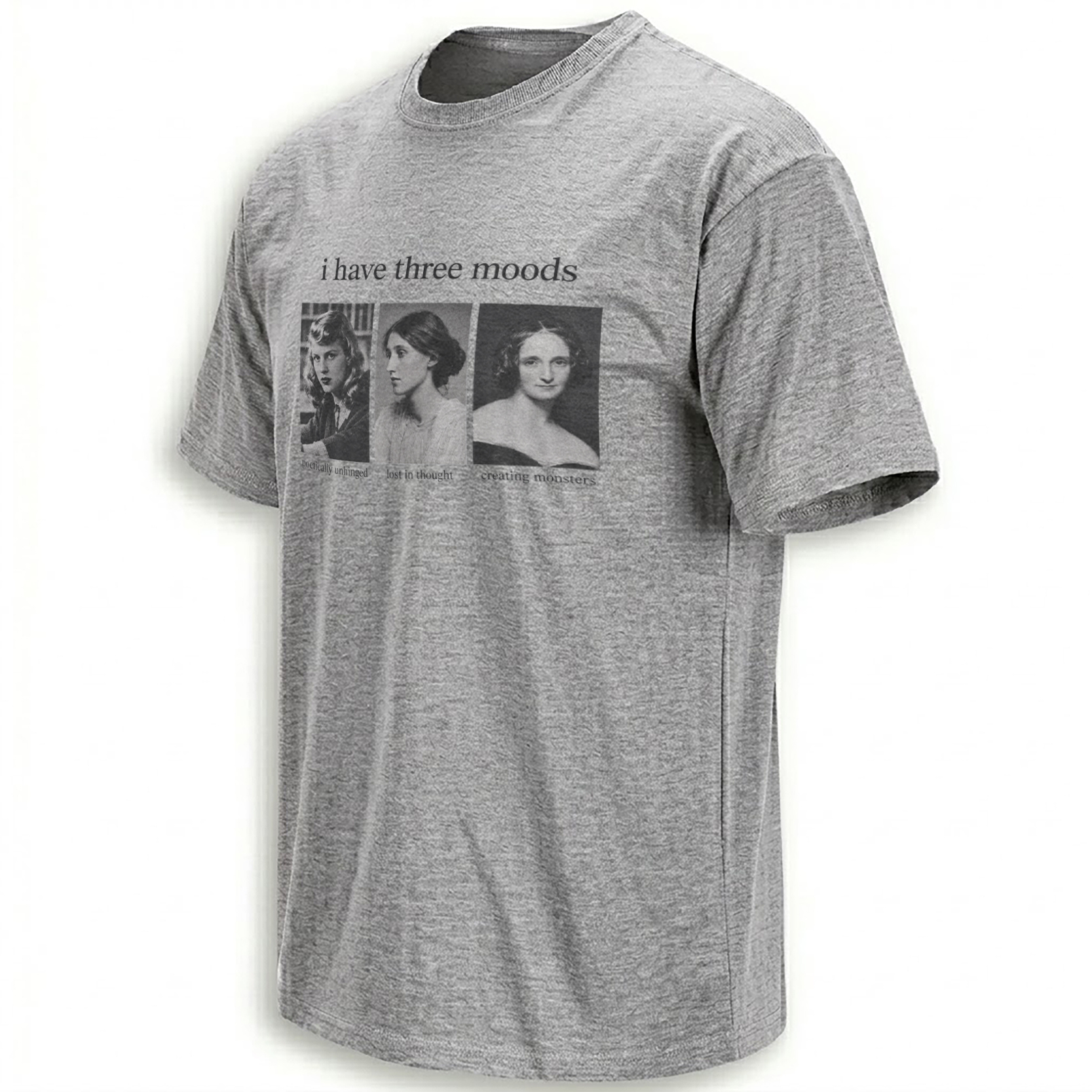
Three authors, three captions, and an unexpectedly funny conversation between literary history and modern reader culture.
View the literary graphic →The wider context is the enduring fascination with women who changed literature while challenging the expectations of their respective periods. That history is worth approaching with care, especially when internet humor reduces complicated lives to memorable labels.
For readers interested in related cultural designs, Ellie Shirt’s Feminism and Women’s Rights collection provides a broader point of connection. Individual author searches also offer more focused paths through designs referencing Sylvia Plath, Virginia Woolf, and Mary Shelley.
Frequently Asked Questions
What does I Have Three Moods mean?
It is a literary mood meme that uses Sylvia Plath, Virginia Woolf, and Mary Shelley to represent intense emotion, introspection, and Gothic imagination.
Who are the three women in the design?
Sylvia Plath was an American poet and novelist, Virginia Woolf was a British modernist writer, and Mary Shelley was the author of Frankenstein.
Are the three captions real author quotations?
No. “Poetically unhinged,” “lost in thought,” and “creating monsters” are contemporary humorous descriptions, not authenticated quotations.
Why does the design connect with dark academia?
Its historical portraits, restrained typography, literary references, and monochrome presentation echo the archival aesthetic associated with dark academia.
The lasting charm of the I Have Three Moods graphic comes from recognizing that great literature can be intellectually demanding and wonderfully funny when viewed through the language of contemporary readers.
I Have Three Moods brings Sylvia Plath, Virginia Woolf, and Mary Shelley together in a dark academia portrait collage inspired by poetry, introspection, Gothic fiction, and literary humor.