Hugs for Dubs: How Boston’s Outfield Turned Wins Into a Ritual
Jarren Duran, Wilyer Abreu and Ceddanne Rafaela do not need a choreographed dance or complicated prop. Their victory image is simpler: find each other after the final out and close the distance.
Baseball wins rarely end with every player standing in the same place. The pitcher and catcher meet near the mound. Infielders move toward the center of the diamond. Outfielders begin hundreds of feet away, carrying the final result back toward the rest of the team.
That distance creates one of the sport’s smallest victory rituals. When the final out settles into an outfielder’s glove, the players nearest the warning track often turn toward each other first. A hand slap becomes an embrace, the embrace becomes a photograph, and the photograph becomes the visual punctuation at the end of another win.
“Hugs for dubs” gives that image its Boston caption. “Dubs” is shorthand for wins, but the phrase works because it replaces the harder language of competition with something openly affectionate. The game may require collisions, diving catches and ninety-mile-per-hour throws. The ending can still be three teammates smiling together.
The hug does not create the win. It gives the win a human ending fans can recognize before the scoreboard disappears.
Boston’s 2026 outfield is deeper than these three players, with Roman Anthony and others also receiving important roles. The design focuses specifically on Duran, Abreu and Rafaela as a recognizable defensive and cultural trio rather than claiming they are Boston’s only outfield combination.
Why the Outfield Hug Feels Different From a Dugout Celebration
A dugout celebration is crowded by design. Players pour over the railing after home runs, walk-offs and dramatic innings. The energy arrives from every direction, and the athlete responsible for the play may disappear beneath helmets, towels and teammates.
The outfield hug is quieter. It occurs in open grass, often before the television broadcast cuts back toward the infield. The players are briefly isolated from the larger team, creating a three-person ceremony before everyone joins the handshake line.
Duran, Abreu and Rafaela make the image especially readable because each brings a different form of movement. Duran plays with visible acceleration. Abreu combines a powerful throwing arm with right-field instincts. Rafaela covers center field with the kind of range that can make difficult plays appear routine.
When those differences collapse into the same postgame embrace, the photograph communicates something that defensive statistics cannot. Three separate responsibilities have produced one shared result.
A Phrase Boston Fans Already Understand
“Hugs for dubs” belongs to the informal language teams develop on social media. It is short enough to caption a photograph, playful enough to survive repetition and specific enough that fans know exactly which part of the game it describes.
The Red Sox have used versions of the phrase across multiple seasons and different outfield combinations. That history matters because it shows that the slogan is larger than one isolated night. Players change, roles shift and new prospects reach Fenway, but the postgame image continues.
The current design gives the phrase a 2026 identity by attaching it to Duran, Abreu and Rafaela. Their shared frame arrives during a season when Boston’s outfield depth has become one of the roster’s defining characteristics.
Rafaela and Abreu entered the season carrying Gold Glove recognition at center and right field. Duran remained a source of speed, pressure and left-handed energy. Together, the trio could represent defense, athleticism and emotional visibility even when Boston rotated other outfielders into the lineup.
The Dodgers Sweep Gave the Image Fresh Energy
The phrase felt particularly timely after Boston’s first sweep of the Dodgers since 2010. On August 2, the Red Sox completed the series with a four-home-run performance that included major contributions from the same names appearing in the design.
Duran hit his fourteenth home run of the season. Abreu launched a 431-foot drive. Rafaela produced two home runs and extended a surge strong enough to earn American League Player of the Week recognition the following day.
Those performances gave Boston fans several different reasons to celebrate: speed at the top of the order, power from right field and a center fielder becoming increasingly dangerous at the plate. The sweep also demonstrated why the outfield’s value could not be reduced to defense alone.
“Hugs for dubs” became a useful summary. It did not need to list four home runs or explain the history of the series. The phrase preserved the atmosphere after the work had already been completed.
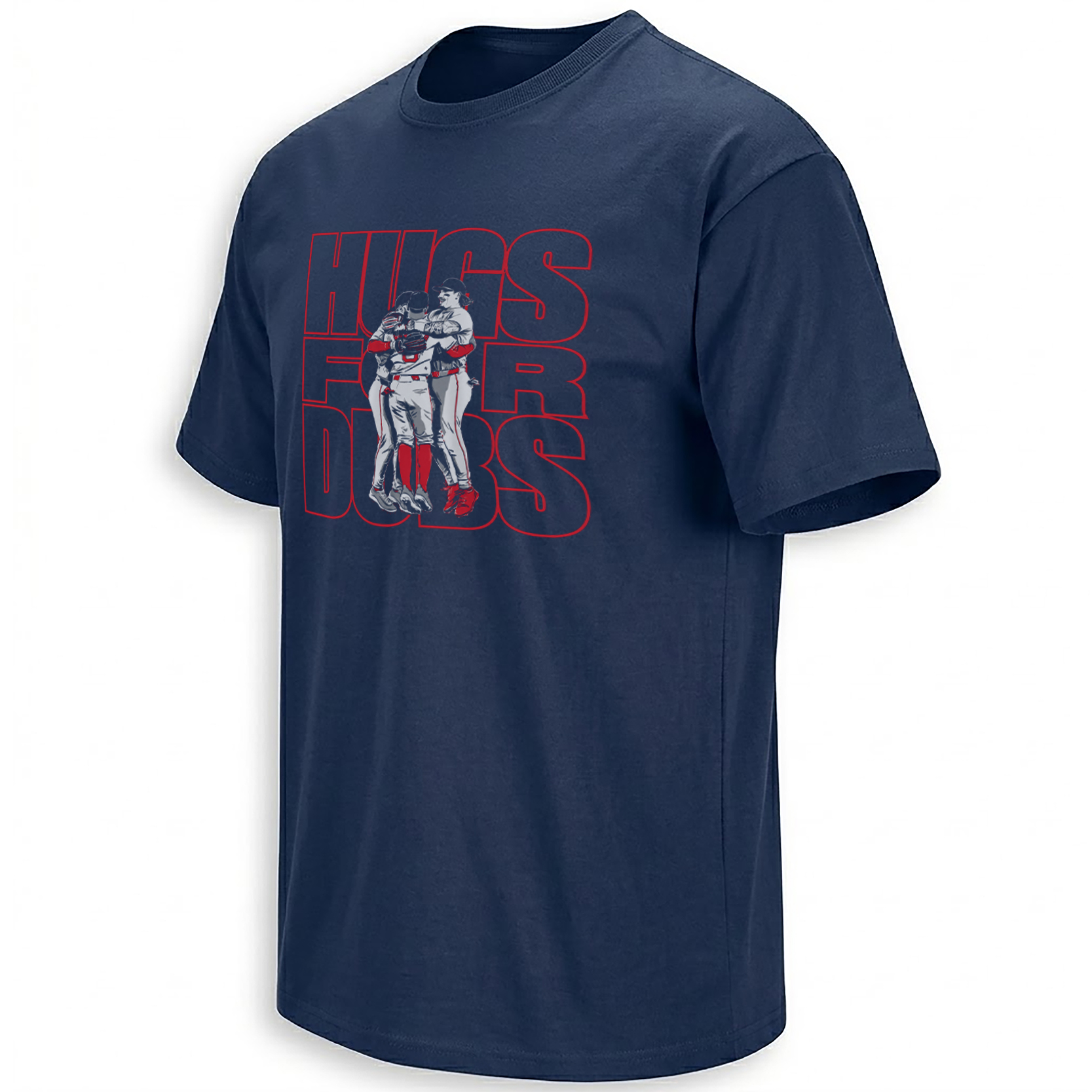
The three-player composition uses body language rather than an individual batting pose. Red, navy and white maintain Boston identity, while the embrace places warmth at the center of a sport usually visualized through power, speed and confrontation.
Why Chemistry Becomes Part of Fan Memory
Fans cannot directly measure clubhouse relationships, and public celebrations never reveal everything happening inside a team. Yet repeated gestures still become meaningful because baseball is built from repetition. The same players stand near each other across 162 games, travel together and respond to thousands of shared situations.
Small rituals help supporters organize that long season. A home-run celebration can identify one lineup. A bullpen gesture can define a playoff run. An outfield hug can make an ordinary Tuesday victory feel connected to the games before and after it.
The trio format is also important. A single-player graphic celebrates individual achievement. A three-player image asks the viewer to think about relationships: who covers the gap, who communicates on a deep fly ball and who arrives first when the final catch is made.
In that sense, the embrace becomes a defensive image even though no glove appears in motion. It represents the trust required before the hug is possible.
A Running Record of the Current Red Sox
The Hugs for Dubs design preserves an emotional pattern rather than one box-score line. It can recall the Dodgers sweep, a defensive win at Fenway or any night when the three outfielders finished the game by moving toward one another.
Within the Boston Red Sox collection, the artwork joins player moments, clubhouse jokes and Fenway imagery that function as a running archive of the team’s current personality.
The wider MLB collection places the ritual alongside walk-off baths, dugout celebrations and other forms of team-specific language that help fans remember not only who won, but how the victory looked afterward.
Frequently Asked Questions
What does “Hugs for Dubs” mean?
“Dubs” is slang for wins, so the phrase describes the celebratory hugs Red Sox outfielders exchange after securing a victory.
Who appears in the Hugs for Dubs design?
The graphic features Boston outfielders Jarren Duran, Wilyer Abreu and Ceddanne Rafaela together in a postgame embrace.
Is Hugs for Dubs an official player quotation?
It is better understood as a recurring Red Sox social caption and fan phrase than as a verified quotation belonging to one specific player.
Why are Abreu and Rafaela important defensively?
Both entered the 2026 season with recent American League Gold Glove recognition, Abreu in right field and Rafaela in center field.
Why was the design timely in August 2026?
Boston had just swept the Dodgers, while Duran, Abreu and Rafaela all contributed prominent home-run moments during the series finale.
The Hugs for Dubs piece captures the warmth behind Boston’s wins, while the Red Sox archive follows the player moments, Fenway rituals and clubhouse language defining the team’s 2026 season.
Hugs for Dubs Shirt captures Jarren Duran, Wilyer Abreu and Ceddanne Rafaela turning Boston Red Sox victories into a joyful outfield ritual built around defense, chemistry and the final-out embrace.