Hating Taylor Swift Doesn’t Make You Deep
A six-word statement challenges one of pop culture’s most persistent assumptions: that rejecting whatever millions of people enjoy automatically proves superior taste.
“Hating Taylor Swift doesn’t make you deep” works because it does not demand that everyone become a Swiftie. It asks a more uncomfortable question: when did disliking a popular musician become evidence of intellectual depth?
Taylor Swift has occupied an unusually large space in modern pop culture. Her songs, tours, public relationships, business decisions and fan community all generate discussion far beyond ordinary album reviews.
That visibility naturally produces disagreement. Listeners can reasonably dislike her songwriting, production choices, celebrity presence or the scale of attention surrounding her. Serious criticism remains part of a healthy musical culture.
The slogan targets something different. It addresses the performance of dislike—the moment criticism stops being about the music and becomes a shortcut for announcing that one is smarter, more original or less easily impressed than everyone else.
Disliking a famous artist is a preference. Turning that dislike into proof of superiority is a performance. The distinction behind the statement
The sentence is not asking everyone to agree
The strongest interpretation of the phrase is not “Taylor Swift must never be criticized.” That reading would replace one form of uncritical fandom with another.
Instead, the statement separates musical judgment from personal status. Someone can dislike Swift’s music without being shallow, just as someone can enjoy it without being naïve. Taste alone does not establish intelligence, authenticity or moral seriousness.
Why enormous popularity attracts identity-level rejection
Mass popularity creates a cultural problem for people who build identity around discovery and distinction. When an artist becomes nearly impossible to avoid, rejecting that artist can feel like a way to recover individuality.
This response is older than Taylor Swift. Extremely successful acts have long attracted audiences who treat opposition as a badge of sophistication. The more enthusiastic the fandom becomes, the more tempting it is for outsiders to define themselves against it.
Social media intensifies the pattern because calm indifference travels poorly. “I do not listen to her” is unlikely to produce a major argument. A sweeping claim about Swift, her talent or the intelligence of her fans is much more likely to generate replies, reposts and outrage.
Platforms therefore reward the most absolute versions of both fandom and anti-fandom. Nuance disappears between declarations that she is beyond criticism and declarations that anyone who likes her has been culturally manipulated.
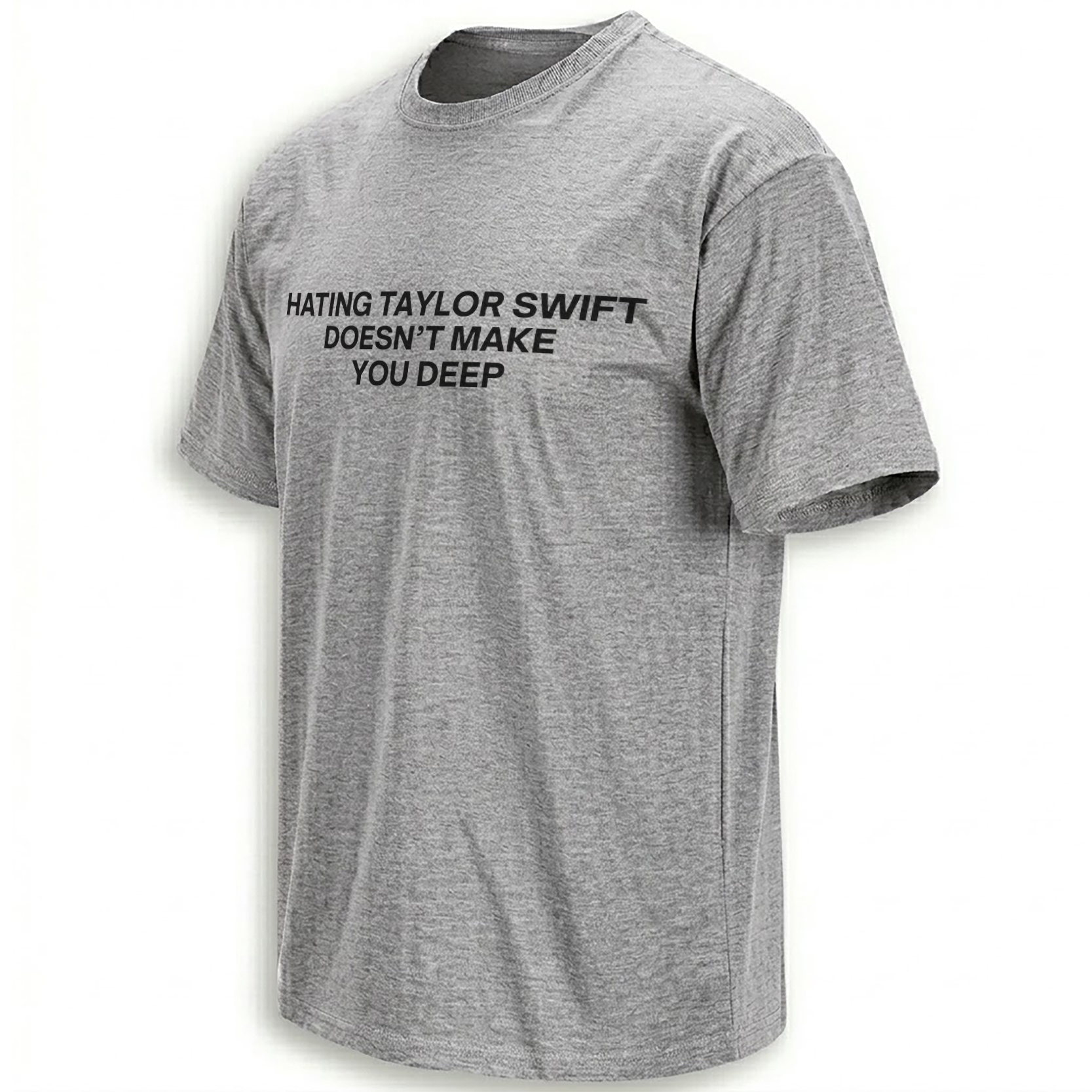 A minimalist response to maximalist pop-culture arguments
The design uses plain typography because the force comes from the sentence itself, not from album references, portraits or elaborate Swiftie iconography.
A minimalist response to maximalist pop-culture arguments
The design uses plain typography because the force comes from the sentence itself, not from album references, portraits or elaborate Swiftie iconography.
When criticism of women becomes a personality test
Not every criticism of a famous woman is misogynistic. Treating all disagreement that way would make meaningful discussion impossible.
Yet the language used against extremely visible female performers often moves beyond criticism of their work. Commentary can become fixated on whether they are annoying, calculating, overexposed, emotionally excessive or undeserving of the enthusiasm they inspire.
Male performers can be commercially ambitious, cultivate mythology and write repeatedly about relationships without those choices automatically being treated as evidence of cultural fraud. Female stars are more frequently required to defend not only what they create, but why so many people care.
The contempt can also extend to the audience. A fandom made highly visible by women and girls is easily described as hysterical, unserious or incapable of independent judgment. This pattern has appeared across generations of popular music.
The slogan does not prove that every negative opinion about Taylor Swift is sexist, uninformed or performative. It challenges the assumption that hostility toward her—or contempt for her audience—is inherently more thoughtful than enthusiasm.
Pop music can be popular and still reward close reading
A familiar form of gatekeeping treats accessibility as the opposite of complexity. If millions of listeners understand or enjoy a song, the reasoning goes, it cannot require serious attention.
That assumption confuses obscurity with depth. A work can use an accessible melody while creating meaning through narrative perspective, recurring symbols, structural choices, vocal performance and its relationship with an artist’s larger catalog.
Swift’s listeners have built an extensive interpretive culture around lyrical parallels, rerecordings, shifting perspectives and connections among different eras of her career. One does not have to agree with every interpretation to recognize that the audience is doing more than passively consuming a chorus.
Popularity also creates its own valuable questions. Why do certain stories travel across generations? How does a performer turn autobiographical writing into collective identification? How do fans transform releases into communal events? Dismissing the subject entirely can close off those questions rather than answer them.
Anti-fandom can demand as much attention as fandom
Some anti-fans monitor a celebrity almost as closely as devoted supporters. They follow releases, appearances, chart results and fan reactions because each development offers another opportunity to restate opposition.
This creates one of online culture’s strangest loops: a person claims that an artist receives too much attention while repeatedly helping to keep that artist at the center of discussion.
Why minimalist typography is the right visual language
The artwork does not rely on a portrait, tour costume, album title or lyric. That absence is important because the message is not limited to one Taylor Swift era.
Its plain typography resembles a note, placard or caption posted in the middle of an argument. The sentence appears without decorative evidence because it is intended as the argument.
This also allows the design to work on two levels. Swifties can read it as a defense of something meaningful to them. Other viewers can read it more broadly as a rejection of the idea that contempt for mainstream culture automatically makes anyone more interesting.
The gray and white presentations reinforce that restraint. Instead of competing with the words, the neutral backgrounds give the statement the visual calm of an observation that should have been obvious all along.
A statement about taste, not compulsory fandom
The healthiest musical culture leaves room for admiration, indifference and informed criticism. It does not require universal agreement, but it also does not confuse cruelty with insight.
“Hating Taylor Swift doesn’t make you deep” survives as a strong cultural statement because it refuses an easy hierarchy. A rare playlist does not automatically make its owner smarter. A mainstream playlist does not make its owner less thoughtful.
The sentence ultimately asks listeners to explain what they hear instead of using taste as a substitute for personality. That challenge applies far beyond Taylor Swift.
The Hating Taylor Swift Doesn’t Make You Deep Shirt preserves the idea as a clean, wearable response to performative pop-culture contempt.
More newly added music, internet-culture and statement designs can be explored through Ellie Shirt’s verified Newest collection.
Taylor Swift statement FAQ
What does “Hating Taylor Swift doesn’t make you deep” mean?
It means that disliking a highly popular musician is a personal preference, not automatic proof of intelligence, originality or cultural sophistication.
Does the statement mean Taylor Swift cannot be criticized?
No. Specific, informed criticism remains valid. The statement challenges performative contempt and the use of dislike as a claim of personal superiority.
Is the phrase an official Taylor Swift lyric?
No. It is a pop-culture statement associated with online fan and anti-fan discourse, not a Taylor Swift song lyric.
Why does Taylor Swift attract such intense anti-fandom?
Her enormous visibility, passionate audience and dominance of online conversation make opposition to her an easy way for some people to express cultural distinction.
Is all criticism of Taylor Swift misogynistic?
No. However, criticism can become gendered when it attacks her or her largely female fan community through stereotypes not applied equally to male performers.
Why is the shirt design so minimalist?
The design allows the sentence to carry the entire argument without depending on a specific album, photograph, tour or visual era.
Where can shoppers find more newly added statement designs?
New music and pop-culture designs are available at https://ellieshirt.com/collections/newest/.
See the minimalist Swiftie statement design created for listeners who know that mainstream taste and thoughtful taste are not opposites.
A minimalist pop-culture statement challenging the idea that performative hatred of Taylor Swift—or any widely loved artist—is proof of superior taste.