
Gotham Five
Brunson, Bridges, Anunoby, Towns and Hart did more than end the Knicks’ championship drought. They became the five faces of a New York basketball story that finally found its ending.
Every championship team eventually becomes a photograph. Long after the final score fades, supporters remember the players standing together—the captain, the scorers, the defenders, the rebounders and the teammates whose individual strengths became inseparable from one another.
For the 2026 New York Knicks, that championship portrait has five central figures.
Jalen Brunson. Mikal Bridges. OG Anunoby. Karl-Anthony Towns. Josh Hart.
Together, they formed a lineup large enough to control the glass, skilled enough to attack from every level and versatile enough to survive the changing demands of the postseason. More importantly, they gave New York a group whose personalities felt as distinct as the boroughs celebrating them.
They became the Gotham Five.
New York closed the Finals with a 94–90 victory in San Antonio, earning its third NBA championship and ending a 53-year wait that began after the 1973 title.
A Championship Portrait for a City That Waited 53 Years
The Knicks had produced memorable teams during the decades between championships. Patrick Ewing’s clubs defined the physical intensity of the 1990s. The 1999 team made an improbable run from the eighth seed to the NBA Finals. Carmelo Anthony briefly restored Madison Square Garden as one of the league’s most electric stages.
None of those teams finished the journey.
The 2026 Knicks did.
Their title was secured on June 13 in San Antonio, where Brunson scored 45 points in the decisive fifth game and received the Bill Russell Trophy as Finals MVP. The Knicks defeated the Spurs 4–1 and claimed their first championship since Willis Reed, Walt Frazier and the 1973 team ruled Madison Square Garden.
The victory transformed an excellent starting lineup into a permanent piece of New York history. These five players will no longer be remembered only through regular-season averages, contracts or trade evaluations. Their names now share one defining word.
Champions.
New York waited more than half a century for another championship five. Brunson, Bridges, Anunoby, Towns and Hart became the answer.
Meet the Gotham Five
The name works because the group never felt like five versions of the same player.
Each member occupied a recognizable role. Brunson controlled the endings. Bridges absorbed difficult perimeter assignments and stretched defenses with his movement. Anunoby supplied the physical two-way force that could change a possession without needing the ball. Towns created impossible size-and-skill matchups. Hart attacked rebounds, loose balls and emotional momentum with the same aggression.
Their differences became the system.
Jalen Brunson: The Man in Front
Every five-man story needs a figure standing at its center.
For the Knicks, that figure was Brunson.
New York had already made him its captain before the title arrived. The 2026 postseason completed the transformation from celebrated free-agent signing to championship icon.
Brunson averaged 32.6 points during the Finals and repeatedly delivered in closing moments. When the Knicks needed one final performance to end the drought, he scored 45 points in Game 5—the highest-scoring Finals game in franchise history.
His greatness did not depend on unusual height, overwhelming speed or spectacular above-the-rim athleticism. It came from balance, footwork, patience and the ability to create a usable angle even after the defense appeared to remove every option.
Brunson became the perfect lead figure for Gotham because his rise reflected the way New York prefers to imagine itself: underestimated, stubborn and unwilling to leave before the job is finished.
Mikal Bridges: The Price Became the Proof
Bridges entered New York carrying the pressure of everything the Knicks surrendered to acquire him.
The trade was evaluated through draft picks, expectations and the question of whether a talented complementary player could justify a superstar-level price. Every difficult stretch invited the criticism back.
The championship changed the argument.
Bridges became an essential part of a lineup that could defend across positions without sacrificing spacing. He chased guards, switched onto larger wings, ran the floor and found open spaces around Brunson and Towns.
His journey also gave the championship group another layer. Brunson, Hart and Bridges had already won together at Villanova. In New York, their shared history became part of a professional title run large enough to define an entire city.
OG Anunoby: The Possession Changer
Anunoby’s impact was often visible before the box score explained it.
He could remove an opponent’s preferred scorer, blow up an action before it developed or convert one defensive rotation into a transition opportunity. On offense, he cut into open space, punished mismatches and gave Brunson another strong finisher along the baseline.
His most famous championship moment came during the historic Game 4 comeback against San Antonio.
The Knicks trailed by 29 points before producing the largest comeback in NBA Finals history. Anunoby completed the rally with the late go-ahead tip-in and followed it with a massive defensive play at the other end.
In a few seconds, the entire Anunoby experience became visible: strength, timing, length, composure and the ability to make a championship-level play without demanding that the possession begin with him.
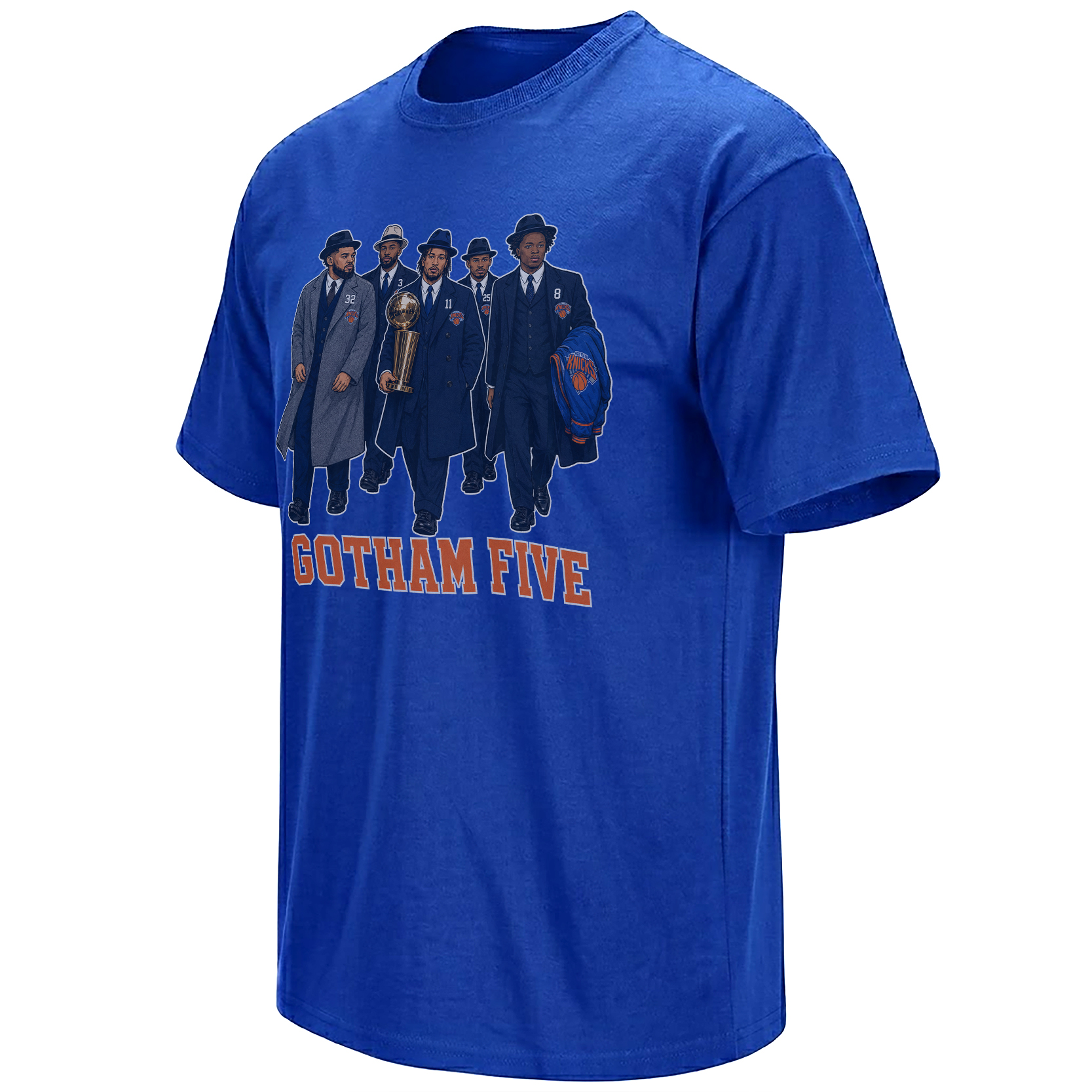
Gotham Five Shirt
The artwork reimagines Brunson, Bridges, Anunoby, Towns and Hart as a sharply dressed Gotham crew—a championship lineup presented with the visual language of a New York crime-film poster.
Dark suits, controlled expressions and a tightly grouped composition turn the starting five into something larger than a basketball roster. They appear as the men who took control of the city’s most guarded dream and refused to give it back.
View the shirtKarl-Anthony Towns: The Matchup That Changed the Floor
Towns gave the Knicks something few championship teams can easily reproduce: a true center whose shooting range altered the geography of the court.
Defenders could not simply wait near the rim. Towns could step beyond the arc, attack a closeout or use his size against a smaller matchup. His presence stretched the space available to Brunson while still giving the Knicks an elite defensive rebounder.
During the Finals, Towns spent significant stretches near the top of the MVP conversation. His scoring and rebounding helped New York control stretches of the series even while San Antonio’s Victor Wembanyama presented one of basketball’s most unusual challenges.
Towns’ role within the Gotham Five was not simply to become another scorer. He made the other four players more difficult to contain because his skill forced defenders into decisions that rarely had a clean answer.
Josh Hart: The Player Who Refused to Let a Possession End
Hart may be the easiest member of the group to understand emotionally.
He chased everything.
Missed shots became opportunities. Loose balls became personal challenges. Defensive possessions continued until Hart had secured the rebound, pushed the ball into transition or created one more chance for a teammate.
That relentlessness made him a natural representative of New York’s championship personality. Hart did not always require a designed play, a favorable matchup or a clean statistical category. His influence appeared through repeated acts of effort.
Within a lineup filled with specialized strengths, Hart supplied connective energy. He rebounded like a forward, initiated offense like a guard and competed with the urgency of a player who believed every possession might decide the season.
Why the Five-Man Image Matters
Championship culture naturally creates individual heroes. Brunson received the Finals MVP trophy. Anunoby authored the defining play of the comeback. Towns produced star numbers. Bridges justified a massive trade. Hart became the emotional favorite.
The Gotham Five artwork resists separating them.
All five figures stand together because the championship required their skills to overlap.
Remove one element and the shape of the team changes.
Without Brunson, there is no reliable late-game creator. Without Bridges and Anunoby, the defense loses its range. Without Towns, the floor becomes smaller and the rebounding weaker. Without Hart, possessions begin to feel ordinary.
Together, they created the balance that championship basketball demands.
Why the Gangster-Lineup Concept Fits New York
The shirt does not present the players in uniforms or traditional basketball poses.
It dresses them like the cast of a Gotham crime drama.
That visual decision changes the meaning of the group. Suits suggest organization, authority and a shared purpose beyond the court. The lineup resembles a crew arriving after the job has already been completed.
It is less about literal gangster imagery than the mythology of New York cinema: controlled entrances, sharply defined characters, dark streets and groups whose reputation reaches the room before they do.
Brunson occupies the role of the quiet leader. Bridges and Anunoby become the disciplined operators. Towns provides imposing size. Hart carries the unpredictable edge.
The concept gives each player a cinematic identity while preserving the visual strength of the five standing together.
“Gotham” connects the lineup to New York’s darker comic-book and crime-film mythology. “Five” identifies the championship core. Together, the phrase transforms the Knicks’ starting lineup into a fictional crew whose territory is Madison Square Garden and whose completed job was ending the city’s 53-year championship wait.
Game 4 Proved Why It Had to Be All Five
No game explained the Knicks’ collective identity better than Game 4 of the Finals.
San Antonio built a 29-point advantage and appeared prepared to reduce New York’s series lead. The Spurs had controlled the game, silenced the crowd and placed the Knicks in a deficit that no team had previously overcome in Finals history.
New York did not escape through one uninterrupted individual performance.
The comeback required stops, rebounds, created shots and repeated moments of belief. Brunson stabilized possessions. Towns supplied scoring and size. Bridges and Anunoby disrupted San Antonio’s rhythm. Hart kept the game moving through effort.
Anunoby’s winning tip-in became the final image, but the comeback belonged to the lineup.
That victory gave the Knicks a 3–1 series advantage and turned an extraordinary postseason into something that felt destined to end with a parade.
The Gotham Five did not look invincible because they never trailed. They looked invincible because even 29 points were not enough to make them disappear.
A Lineup Built From Patience, Risk and Relationships
The championship five was not assembled through one obvious plan.
Brunson arrived as a free agent whose ceiling was still being debated. Hart became a trade addition whose chemistry with Brunson immediately mattered. Anunoby cost valuable players and draft assets because the Knicks believed his two-way impact could change their postseason ceiling.
Towns arrived through a franchise-altering trade that sacrificed continuity for a different kind of offensive possibility. Bridges required one of the largest draft-pick investments in team history.
Every move carried risk.
Together, those moves produced a lineup in which several players already understood one another. The Villanova relationships connected Brunson, Bridges and Hart. Towns had a previous relationship with coach Mike Brown. Anunoby’s low-maintenance game allowed him to fit beside other high-level talent without shrinking anyone’s role.
The Knicks did not simply collect names. They collected compatible habits.
From Madison Square Garden to Every Borough
A Knicks championship cannot remain inside the arena.
The team’s history belongs to subway platforms, neighborhood courts, bars, apartments and generations of families who inherited Knicks loyalty without inheriting a championship.
When the final seconds expired in San Antonio, celebrations spread across New York. The title connected supporters who remembered 1973 with younger fans who had experienced only the drought.
The Gotham Five became a shorthand for that collective release.
Brunson represented Manhattan’s spotlight. Hart carried the restless energy of the streets. Bridges and Anunoby reflected the defensive toughness New York has always valued. Towns supplied the size of the stage itself.
None of those associations need to be literal. Championship culture is built from the stories fans attach to the players who finally deliver the moment.
A Shirt About the Team, Not Only the Trophy
Many championship graphics naturally place the trophy at the center.
The Gotham Five design makes another choice.
It places the people at the center.
The trophy confirms the result, but the five players explain how the result happened. Their lineup became the repeatable structure behind the playoff run—the group supporters could picture entering the floor when the game became serious.
That makes the shirt more than a declaration that the Knicks won in 2026. It becomes a lineup portrait for the specific era that returned New York basketball to the top of the league.
Years from now, the faces will immediately recover the memory.
Brunson controlling the fourth quarter. Bridges extending a possession with defense. Anunoby rising for the tip-in. Towns pulling a center away from the rim. Hart tearing down another rebound that appeared to belong to someone else.
The Gotham Five After the Championship
A title permanently changes the way a lineup is evaluated.
Questions that once sounded urgent become historical footnotes. The cost of the Bridges trade is no longer discussed without the championship it helped produce. The Towns gamble is no longer theoretical. Brunson’s ability to lead a team to the highest level has already been demonstrated.
The next challenge will be different.
New York must defend a championship while managing contracts, depth and the physical demands placed on a heavily used core. Opponents will spend the offseason searching for ways to disrupt the combinations that carried the Knicks through 2026.
None of that can alter the achievement already completed.
Whatever happens next, these five players belong to the championship chapter.
Explore More Knicks Championship Culture
The Gotham Five design belongs to a larger collection documenting New York’s return to the top: Brunson’s Finals MVP performance, Anunoby’s historic tip-in, the Game 4 comeback, the parade and the citywide symbols that emerged after the final buzzer.
Explore more Knicks player graphics and 2026 championship designs through the collections below.
Championship teams eventually become history, but history does not remember every lineup equally.
Some groups are remembered because their names immediately reconstruct the style, emotion and identity of the season.
Brunson. Bridges. Anunoby. Towns. Hart.
Five players. One completed job. One city returned to the top.
The Gotham Five.
Gotham Five Knicks FAQ
Who are the Gotham Five?
The Gotham Five are Jalen Brunson, Mikal Bridges, OG Anunoby, Karl-Anthony Towns and Josh Hart—the central five-man lineup associated with the New York Knicks’ 2026 NBA championship.
Did the New York Knicks win the 2026 NBA championship?
Yes. The Knicks defeated the San Antonio Spurs 4–1 in the 2026 NBA Finals to win their first championship since 1973 and the third title in franchise history.
Who won the 2026 NBA Finals MVP award?
Jalen Brunson won the Bill Russell NBA Finals MVP Trophy after averaging 32.6 points per game and scoring a Knicks Finals-record 45 points in the championship-clinching Game 5.
Why is the lineup called the Gotham Five?
“Gotham” connects the lineup to New York’s dark cinematic mythology, while “Five” refers to the five core players. The phrase presents the Knicks champions as a tightly organized New York crew.
What is featured on the Gotham Five Shirt?
The artwork features Brunson, Bridges, Anunoby, Towns and Hart posed together in dark formal clothing with a dramatic gangster-film-inspired presentation celebrating the Knicks’ 2026 championship.
What was the Knicks’ biggest moment in the 2026 NBA Finals?
One of the defining moments was the Game 4 comeback from 29 points down against San Antonio. OG Anunoby completed the rally with a late tip-in as New York won 107–106.
When did the Knicks last win a championship before 2026?
Before the 2026 title, the Knicks had last won the NBA championship in 1973, creating a 53-year wait between titles.
Is the Gotham Five design only about Jalen Brunson?
No. Brunson appears as the championship leader, but the design deliberately celebrates all five members of the lineup and the different roles they played in the title run.