
Forever Young
Cole Young’s smooth left-handed swing has moved from prospect projection to major-league production—and Seattle suddenly has a phrase that fits both the player and the moment.
Cole Young did not need a long speech to explain what happened in Anaheim on June 30. Two swings told the story. The Seattle infielder drove two balls out of the park, supplied the first multi-homer game of his major-league career and helped the Mariners end a short losing stretch with a 6–2 win over the Angels.
The performance arrived at exactly the right time for a young hitter whose value has often been described through projection: advanced bat-to-ball skill, mature strike-zone judgment, middle-infield versatility and the possibility that more power would emerge as his body and approach developed.
On this night, the future did not need to be imagined. It appeared in two complete left-handed swings—and suddenly “Forever Young” felt less like a familiar phrase and more like a natural Seattle baseball headline.
Young produced the first multi-homer game of his major-league career.
Seattle defeated Los Angeles and returned to winning form.
The Mariners selected Young 21st overall out of high school.
Young reached Seattle less than three years after being drafted.
Why the Two-Homer Game Felt Bigger Than One Box Score
A two-home-run game always attracts attention, but the context made Young’s performance especially meaningful. Seattle had gone through an extended stretch of low-scoring games, placing additional pressure on every hitter who stepped into the lineup.
Young’s first home run helped reverse a game that had begun with the Angels in front. His second created separation and transformed a narrow contest into one of Seattle’s clearest offensive statements of the week.
The significance was not simply that a young player hit two home runs. It was that both swings reinforced the specific type of hitter the Mariners believe he can become: controlled, balanced, selective and capable of doing damage without abandoning the compact mechanics that made him a highly regarded prospect.
The Shirt Freezes the Best Part of the Swing
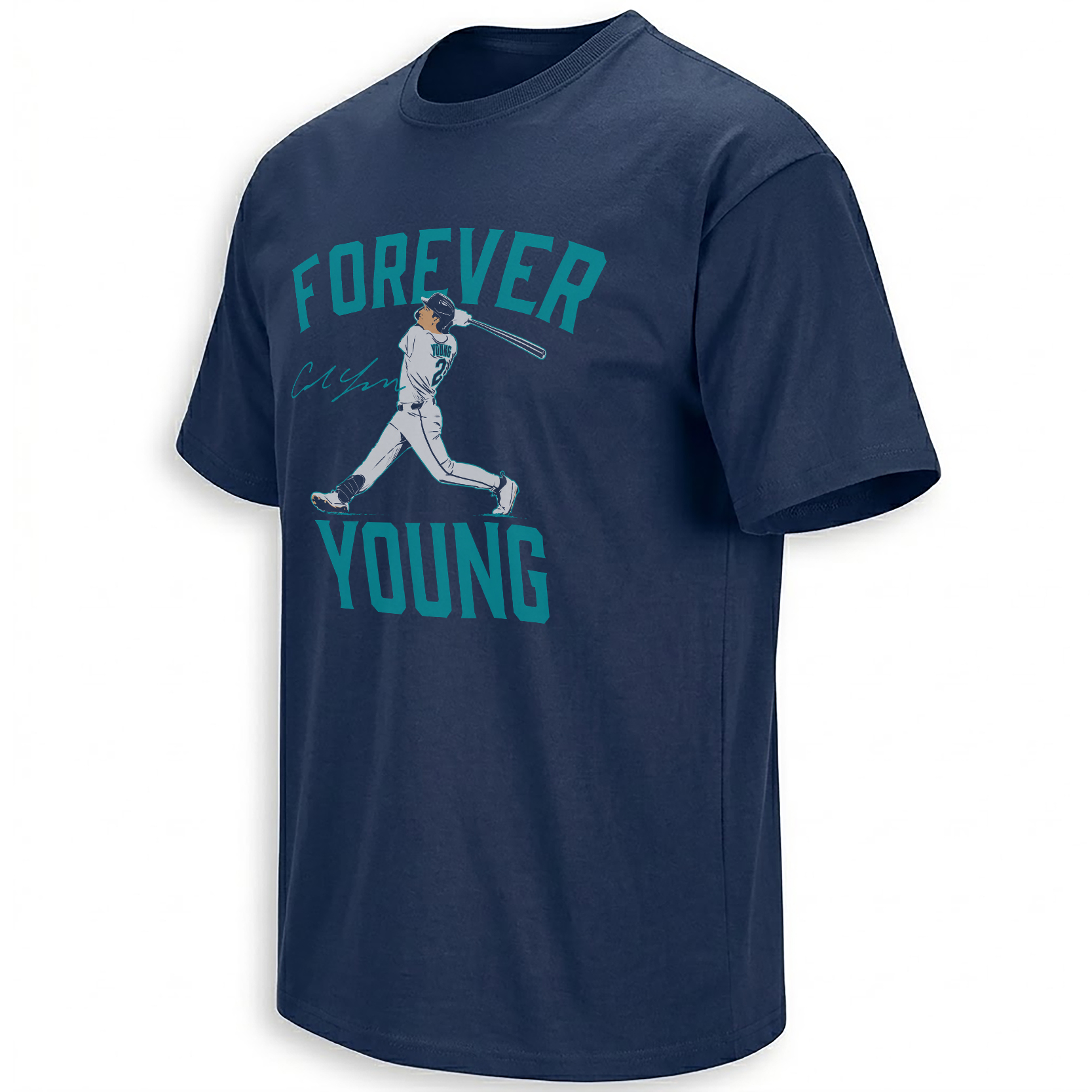
The featured design centers Young at the completion of a left-handed swing. His front side has opened toward the field, his back foot has released from the ground and the bat extends behind his shoulder in a long, clean finish.
It is not a static batting stance. The figure captures the instant after contact—the point when the hitter has already committed, the ball has left the bat and everyone in the stadium is beginning to follow its flight.
The jersey number 2 is visible on the back, while the player’s surname anchors the figure clearly enough to connect the illustration to Cole Young. Teal line accents around the bat emphasize the speed and continuation of the swing without making the composition feel crowded.
Forever Young Shirt
A navy-and-teal baseball graphic built around Cole Young’s left-handed follow-through, with oversized “Forever Young” lettering, a subtle script signature element and the number 2 visible on the illustrated jersey.
Why the “Forever Young” Phrase Fits Cole Young So Naturally
Sports slogans are strongest when they operate on more than one level. “Forever Young” begins as wordplay on the player’s surname, but the phrase gains depth because Cole Young is still near the beginning of his major-league career.
The words suggest youth, possibility and the kind of optimistic projection attached to a first-round draft pick. At the same time, they carry a timeless quality. Baseball fans have always been drawn to the image of a young player arriving with a polished swing and an entire career still unwritten.
In Seattle, that emotional structure matters. The franchise has repeatedly built hope around waves of young talent, from homegrown stars to prospects asked to help shape the next competitive window. Young’s name makes that expectation unusually easy to express.
The slogan is not only about age. It is about preserving the feeling of the beginning—the first big home run, the first walk-off hit, the first season when every successful swing appears to reveal another part of the future.
From First-Round Draft Pick to Seattle’s Infield
Seattle selected Young with the 21st overall pick after his high-school career in Pennsylvania.
His minor-league profile combined contact, plate discipline, middle-infield instincts and developing power.
Young made his major-league debut on May 31 and began turning prospect reports into real Seattle moments.
Young’s path through professional baseball moved quickly without feeling rushed. The Mariners drafted him for the quality of his at-bats and the belief that his offensive foundation would hold up as he faced better pitching.
He developed as both a shortstop and second baseman, giving Seattle flexibility as its infield evolved. The defensive versatility mattered, but the swing remained the central attraction. Young consistently showed an ability to recognize pitches, stay through the strike zone and use the field.
By the time he reached Seattle in 2025, the question was no longer whether the organization valued his approach. The question was how quickly that approach would produce impact against major-league pitching.
The Broken-Bat Walk-Off That Introduced His Calm
The two-homer performance was not Young’s first defining moment of the 2026 season. On June 1, he delivered a walk-off single in the 10th inning against the New York Mets, giving Seattle a 3–2 victory and extending the Mariners’ winning streak to seven games.
The hit was not a perfect line drive. Young broke his bat, fought the pitch into shallow territory and placed the ball where the defense could not make a play. Randy Arozarena scored from third, and the Mariners poured out of the dugout.
That sequence revealed a different kind of value from the two-home-run night. The Anaheim game showed what happens when Young drives the baseball. The walk-off showed what happens when he competes through an imperfect swing and still finds a way to complete the at-bat.
The walk-off single showed contact, calm and situational awareness. The two-homer game showed the emerging power that can turn the same controlled swing into a much larger offensive weapon.
The Left-Handed Swing Gives the Artwork Its Shape
Some player graphics depend on facial detail. This one depends on body movement. The image is recognizable because of the long finish, the open front shoulder and the direction of the bat through the follow-through.
The oversized teal word “FOREVER” arches over the player, while “YOUNG” creates a strong visual base beneath him. Together, the two words frame the swing almost like the top and bottom of a vintage baseball card.
A loose script line across the center adds contrast to the heavy block typography. That combination keeps the artwork from feeling too rigid: the large letters communicate confidence, while the script introduces the personal quality of a player signature.
The navy shirt base is especially effective because it connects immediately to Seattle baseball while allowing the brighter teal lettering and white uniform illustration to stand forward. The color balance gives the design enough clarity to work from a distance without losing the finer swing details up close.
Why Young’s Role Matters to Seattle’s Larger Plan
The Mariners have spent years searching for a sustainable formula around elite pitching, athletic defense and enough offense to survive long stretches of close games. A productive young infielder can influence every part of that equation.
Young does not need to become the loudest personality or the most powerful hitter in the lineup to matter. His value can come through quality plate appearances, contact against difficult pitching, defensive flexibility and the gradual growth of extra-base power.
That is why the two-homer game resonated. It suggested that a player already appreciated for discipline and control might also develop into someone capable of changing a game with one swing.
For Seattle, that kind of growth is especially important because homegrown production creates lineup stability. A young regular who can occupy a middle-infield spot and continue improving allows the organization to build around him rather than constantly search for replacement answers.
The Difference Between Prospect Hype and Major-League Memory
Prospects are discussed through rankings, scouting grades and imagined ceilings. Major leaguers are remembered through moments.
Before reaching Seattle, Young was known as a first-round pick with an advanced offensive approach. After his debut, that language began to change. Fans could now point to a go-ahead triple, a diving defensive stop, a walk-off hit and a two-home-run night.
Each event makes the player less abstract. The name moves away from prospect lists and into the lived history of a season. A fan may not remember every scouting report, but they remember where they were when the rookie delivered the winning hit or when the second home run disappeared into the seats.
A Design for the Beginning, Not the End
Many sports shirts commemorate something completed: a title, a record, a retirement or a legendary career. The Forever Young design works differently because its energy comes from what is still unfolding.
The swing illustration does not present Young as a finished icon. It captures motion, development and the possibility that the ball leaving the bat is only the first of many important outcomes.
That makes the shirt especially connected to the present 2026 season. It belongs to the stage when Seattle fans are still learning the shape of Young’s major-league game and deciding which moments will eventually define him.
Years from now, the phrase may carry nostalgia. Today, it carries anticipation.
How the Shirt Fits Seattle Baseball Style
The navy foundation and teal typography make the design easy to connect with Seattle game-day colors. It pairs naturally with denim, neutral shorts, white sneakers or a light gray outer layer.
Because the artwork already contains a large player figure and oversized lettering, simple styling works best. The shirt does not need additional loud graphics around it. The swing itself provides the movement.
It can function as a T-Mobile Park shirt, a casual summer baseball piece or a player-specific graphic for fans who enjoy following the next stage of Seattle’s young core.
Explore more Seattle baseball: Visit the Seattle Mariners collection for more player and team-inspired artwork, or browse the wider MLB shirts and apparel collection.
What Comes After the First Two-Homer Game?
One game does not determine a career, and the next phase of Young’s development will still include adjustments. Major-league pitchers will study the locations he handles best, change their sequencing and test whether he can maintain the same approach over a full season.
That process is exactly why the moment matters. The two-home-run night is not proof that every projection has been fulfilled. It is evidence that the tools exist—and that on the right night, against major-league pitching, they can already take over a game.
Seattle fans now have a new image to attach to Cole Young: number 2 finishing a left-handed swing, watching the flight and beginning his trip around the bases.
The player is still young. The season is still moving. The story is still being written. For the moment, the phrase fits perfectly.
Frequently Asked Questions
Why is the shirt called Forever Young?
The phrase is a play on Cole Young’s surname and his status as one of Seattle’s emerging young infielders. It also reflects the optimism surrounding the early stages of his major-league career.
What happened in Cole Young’s two-home-run game?
Young hit two home runs as the Seattle Mariners defeated the Los Angeles Angels 6–2 on June 30, 2026. It was the first multi-home-run game of his major-league career.
What does the Forever Young Shirt artwork show?
The design shows Cole Young completing a left-handed swing in a white Seattle-style uniform, with number 2 visible on his back and large teal “Forever Young” lettering surrounding the figure.
When did Cole Young make his MLB debut?
Cole Young made his major-league debut for Seattle on May 31, 2025.
Where was Cole Young selected in the MLB Draft?
The Mariners selected Young with the 21st overall pick in the first round of the 2022 MLB Draft.
What positions does Cole Young play?
Young has developed as a middle infielder and has played second base and shortstop in professional baseball.
Did Cole Young have a walk-off hit in 2026?
Yes. On June 1, Young delivered a broken-bat walk-off single in the 10th inning to give Seattle a 3–2 victory over the New York Mets.