Flopper City Became The Spurs vs OKC Meme For A Series Drowning In Whistles
San Antonio’s Game 6 win gave Spurs fans the scoreboard release they needed, but “Flopper City” captured the messier emotional story: a Western Conference Finals series where foul-baiting, refball arguments, and SGA free-throw discourse became their own internet language.
Before Game 6 turned into a Spurs blowout, Spurs vs OKC had already become something bigger than a normal playoff series. It had become a nightly argument about contact. Every drive seemed to carry a second broadcast inside the broadcast: was that craft, was that a flop, was that a foul, was that refball, was that just playoff basketball?
Then San Antonio won 118-91, forced Game 7, and turned the noise into celebration. Victor Wembanyama answered with 28 points, 10 rebounds, and 3 blocks. Shai Gilgeous-Alexander was held to 15 points. The Spurs’ 20-0 third-quarter run cracked open the game and gave San Antonio the emotional release that had been building through days of whistle frustration.
But the internet does not only remember who won. It remembers the language fans invented while trying to survive the series. For Spurs fans, that language had a name: Flopper City.
The Meme Came From Free-Throw Fatigue
Shai Gilgeous-Alexander is one of the league’s most difficult players to guard because he turns small mistakes into points. His pacing, footwork, midrange patience, and contact control make defenders feel like they are always one lean or reach away from sending him to the line.
That skill is exactly what makes him so polarizing in playoff discourse. Thunder fans see craft. Spurs fans, especially during this series, saw exhaustion. The criticism around SGA’s foul-drawing had already moved beyond normal basketball talk and into parody, with “unethical hoops” jokes, foul-baiting debates, and broader online frustration becoming part of the series atmosphere.
“Flopper City” does not need to be read as a literal official accusation about every possession. It works as fan language. It is the emotional nickname for a series where San Antonio supporters felt like every OKC drive could become a whistle, every whistle could become an argument, and every argument could become another meme.
Why The Word “City” Makes The Joke Hit Harder
The phrase is funny because it turns a behavior into a whole location. “Flopper City” sounds like a place on the playoff map — a fictional destination built out of exaggerated contact, frustrated defenders, dramatic falls, and fans yelling at the screen before the referee even raises an arm.
That kind of naming matters in sports culture. Fans create places all the time: heartbreak cities, refball arenas, cursed buildings, revenge tours, fraud zones. The city metaphor gives the joke architecture. It suggests this was not one isolated play. It was a mood that kept showing up.
For Spurs fans, the phrase also worked because it flipped the emotional power of the series. Instead of sounding helpless about the whistle, the fan base turned the frustration into branding. If the game was going to feel like a foul-baiting carnival, then the timeline was going to give it a name.
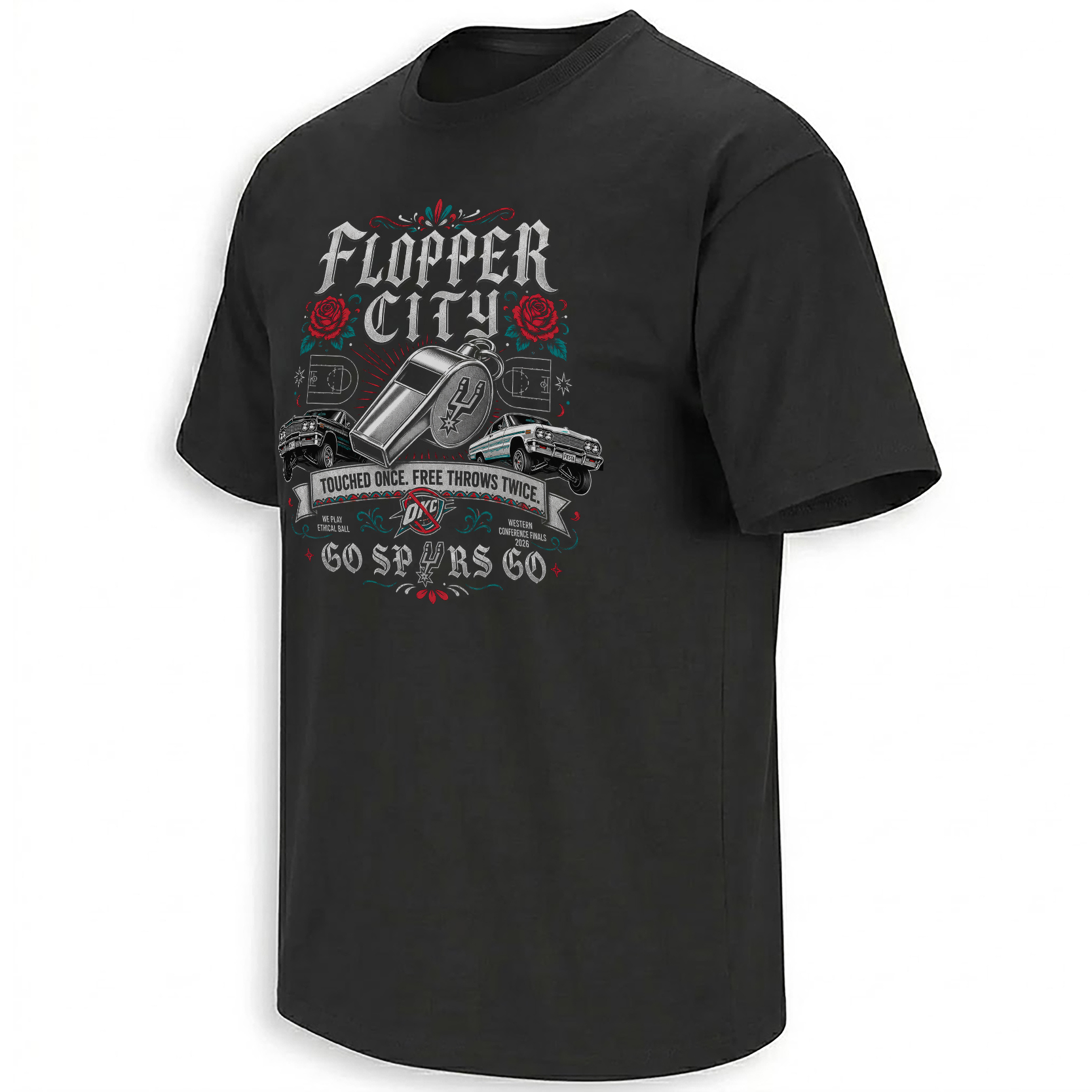
The Design Feels Like A Fake Tourism Poster For Refball
The Flopper City Shirt works because the concept is immediately visual. It does not simply say “bad calls” or “free throws.” It imagines an entire cartoon world where flopping is the local economy and the whistle is the city anthem.
That is why the design lands closer to internet satire than standard playoff merch. The phrase has the rhythm of a city slogan, but the context makes it petty. It reads like a fan-made postcard from the most annoying part of the series: Greetings from Flopper City, population everyone who has ever yelled “he barely touched him” at a television.
The strongest visual choice is the way the graphic turns complaint into humor. Spurs fans were angry about whistles, but anger alone gets repetitive. The design gives that anger a shape, a name, and a joke that can survive longer than the individual foul calls.
Game 6 Changed The Mood From Complaint To Celebration
A refball meme feels different after your team wins by 27. Before Game 6, “Flopper City” lived in the frustration zone. After San Antonio’s 118-91 response, it became a victory-lap joke. The Spurs did not merely complain about the whistle. They played through the noise, held SGA down, and forced the Thunder back to Oklahoma City for Game 7.
That result gave the meme more oxygen. The 20-0 run in the third quarter became the basketball headline, but the foul-baiting jokes remained the emotional subtitle. Spurs fans could now say the thing they had been saying all series with a little more swagger. The scoreboard gave the sarcasm permission.
In playoff culture, that shift matters. The same joke can feel bitter after a loss and hilarious after a win. Game 6 turned “Flopper City” into a piece of celebratory pettiness.
SGA Discourse Is Bigger Than One Series
The reason this angle keeps spreading is that SGA’s style already sits inside a larger NBA conversation. Fans around the league argue about foul-drawing constantly: what counts as skill, what counts as manipulation, what counts as flopping, and whether the modern game rewards players who know how to turn contact into free throws.
That makes Spurs vs OKC a perfect container for the debate. SGA is talented enough that the criticism cannot simply erase his game. At the same time, the free-throw discourse is loud enough that neutral fans and opposing fan bases keep turning it into jokes. The tension between those two truths is exactly where “Flopper City” lives.
In plain terms, this is a San Antonio Spurs playoff meme tied to Oklahoma City, Shai Gilgeous-Alexander foul-baiting discourse, Western Conference Finals refball frustration, Game 6 emotional release, and the online language fans used to process a series that kept returning to the whistle.
The phrase is not trying to be an official ruling. It is trying to sound like the group chat after the fourth questionable whistle — funny, annoyed, exaggerated, and instantly understood by the people watching the same game.
Why “Flopper City” Belongs In The Spurs Playoff Archive
The wider San Antonio Spurs collection now reads like a running archive of this series’ emotional phases: Wembanyama belief, Game 6 eruption, Carter Bryant contact memes, and refball frustration turned into visual jokes.
Inside the broader NBA collection, “Flopper City” fits a very specific kind of playoff artifact. It is not the official version of Spurs vs OKC. It is the fan-side version — the one built from clips, reply sections, sarcastic captions, and the language people use when the game keeps making them feel insane.
That is why the phrase has staying power. The Spurs forced Game 7 on the floor. Online, their fans turned the frustration that came before it into a place called Flopper City.
FAQ: Flopper City, Spurs vs OKC, And Refball Meme Culture
What does “Flopper City” mean in the Spurs vs OKC context?
“Flopper City” is fan-made meme language for the frustration Spurs fans felt around foul-baiting, free throws, and refball discourse during the Western Conference Finals against Oklahoma City.
Why did the phrase connect with Spurs fans?
It connected because the series had already become emotionally tied to whistles and contact debates. The phrase gave fans a funny, repeatable way to describe that fatigue.
Is “Flopper City” an official claim about the Thunder?
No. It works as fan interpretation and meme language. The phrase reflects how many Spurs fans processed the series online, not an official league ruling about every play.
How did Game 6 affect the meaning of the meme?
San Antonio’s 118-91 win turned the joke from frustrated complaint into celebratory sarcasm. After forcing Game 7, Spurs fans could use the phrase with more confidence and less bitterness.
Why does this design fit the current playoff conversation?
The design captures the fan-side language of Spurs vs OKC. It turns whistle fatigue, SGA free-throw discourse, and refball jokes into a visual timestamp of the series.
As Spurs vs OKC heads toward Game 7, the Flopper City piece sits inside the series archive as a fan-made map of the whistle discourse — sarcastic, specific, and unmistakably born from this playoff moment.