
Dre Greenlaw vs Seattle: A 32–29 Win, an Ejection and a Rivalry on Edge
The undefeated San Francisco 49ers escaped Seattle with a 32–29 victory on October 11, 2026. Yet one of the game’s defining images was linebacker Dre Greenlaw leaving the field after a heated confrontation with Seahawks defender Ernest Jones IV.
San Francisco and Seattle have played plenty of football games that felt personal. Their latest NFC West confrontation may be remembered as one of the most chaotic. On October 11, 2026, the 49ers survived a tense afternoon at Lumen Field, beating the defending Super Bowl champion Seahawks 32–29 to preserve their unbeaten start.
There were turnovers, dramatic possessions and repeated momentum shifts. San Francisco capitalized on Seattle mistakes, while the Seahawks kept fighting back. Eddy Piñeiro’s late 44-yard field goal ultimately provided the decisive points. But the scoreboard was only one part of the conversation.
In the second quarter, 49ers linebacker Dre Greenlaw became the center of an explosive sideline confrontation involving Seattle quarterback Sam Darnold and linebacker Ernest Jones IV. Greenlaw was ejected after striking the helmetless Jones with his own helmet. The incident immediately generated arguments about player safety, provocation and the emotional volatility of one of football’s fiercest divisional matchups.
What Happened Between Dre Greenlaw and the Seahawks?
The confrontation developed when Sam Darnold scrambled toward the Seattle sideline during the second quarter. Greenlaw hit the quarterback after he had stepped out of bounds, drawing a personal-foul penalty. Several Seahawks players confronted the San Francisco defender, and the exchange escalated near Seattle’s bench.
Ernest Jones IV approached Greenlaw during the argument. Greenlaw, still wearing his helmet, delivered a headbutt to Jones, who was without his helmet. The NFL subsequently ejected Greenlaw. Associated Press reporting confirmed the disciplinary action, and the league published video footage of the confrontation.
The distinction is important: this was not simply normal football trash talk. The dangerous contact occurred outside an ordinary tackling play and involved an unprotected player. Recognizing that fact is essential to understanding why the incident provoked criticism even among supporters who appreciate Greenlaw’s aggressive defensive style.

The NFL’s official video of the ejection provides the clearest visual record of the moment. The difference between that footage and later fan artwork matters: one documents the actual incident, while the other interprets the wider emotional rivalry.
Why Was the 49ers’ 32–29 Victory So Significant?
San Francisco entered Seattle at 4–0, facing the team that had beaten the 49ers twice in the previous season, including a playoff meeting that ended San Francisco’s postseason run. The October game therefore carried meaning beyond a routine early-season divisional matchup.
Despite losing Greenlaw, the 49ers found enough defensive plays to survive. Seattle committed four turnovers, and those mistakes helped San Francisco create 21 points. Mike Evans supplied 113 receiving yards, while quarterback Brock Purdy threw two touchdown passes. Seattle responded repeatedly but could not overturn the final margin.
The result strengthened San Francisco’s early control of the NFC West, while leaving Seattle at 3–2. For the Faithful, winning in a hostile divisional environment after a controversial ejection became another reason to celebrate. For Seahawks fans, it was a painful missed opportunity mixed with anger over the sideline incident.
The scoreboard said San Francisco won. The argument about what happened on Seattle’s sideline was far from over.
What Does “F Seattle” Mean in 49ers Fan Culture?
“F Seattle” is deliberately confrontational rivalry language. In the context of San Francisco football, the abbreviated insult expresses opposition to the Seahawks rather than describing a particular tactical play or offering a conventional motivational message.
It should not be presented as a verified direct quotation from Dre Greenlaw during the October 11 confrontation. The artwork uses the phrase as a fan-facing statement, combining the player’s recognizable image with the rivalry’s existing intensity.
That distinction gives the graphic a specific cultural identity. It is not an official team campaign or a literal transcript of sideline dialogue. It belongs to the territory of rivalry posters, exaggerated fan memes and blunt football humor, where a short phrase communicates allegiance instantly.
How Does the F Seattle Graphic Represent the Rivalry?
The design is built around confrontation. Distressed red lettering reading “F SEATTLE” appears above a face-to-face composition featuring Greenlaw in San Francisco’s white No. 57 uniform and an opposing Seattle figure wearing No. 12.
The number on the Seattle figure is especially important. No. 12 refers to the Seahawks’ familiar “12s” fan identity, making the opposing character a symbolic representation of Seattle rather than a verified portrait of Ernest Jones IV. The design should not be mistaken for a frame-by-frame recreation of the sideline incident.
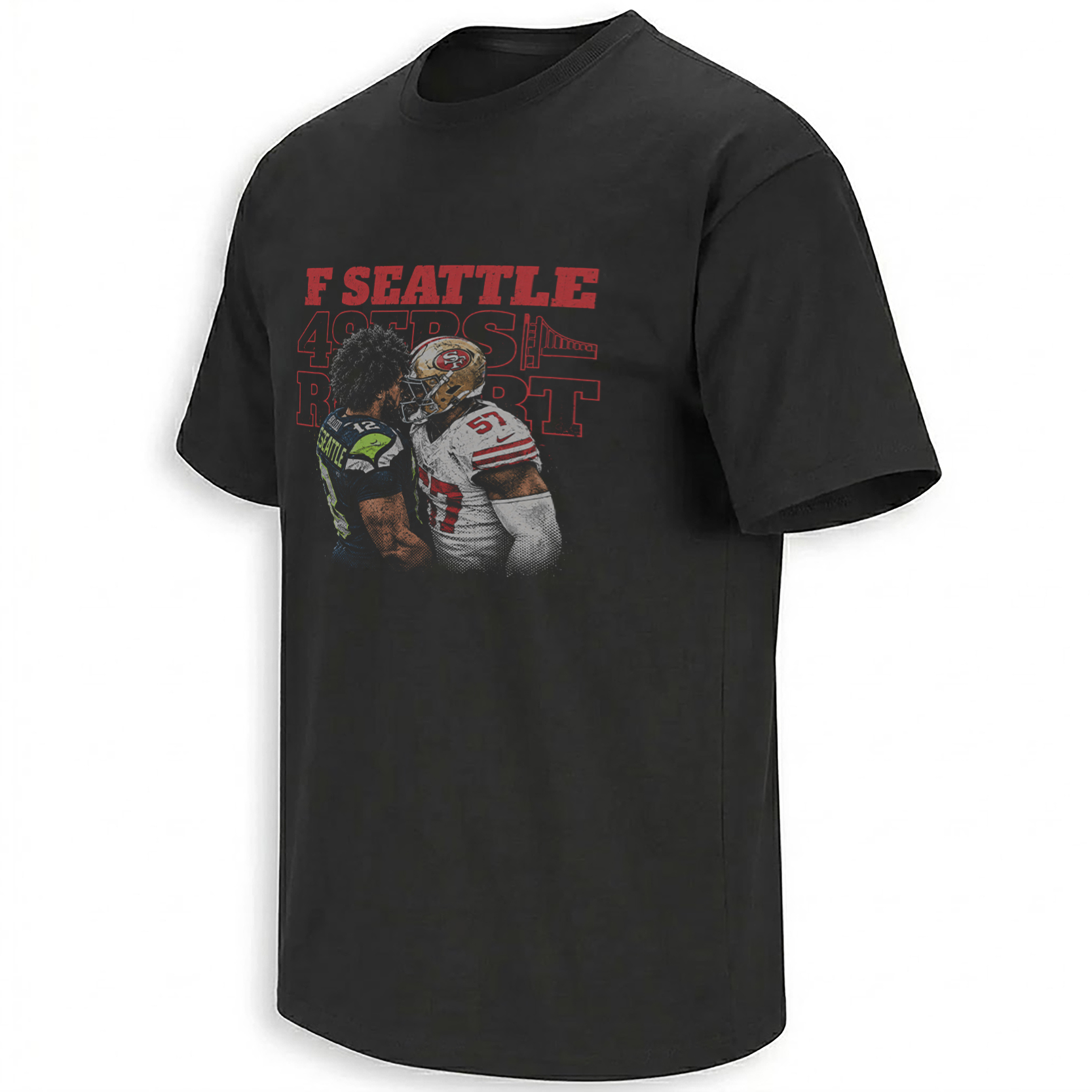
Behind the figures, outlined 49ERS lettering and a red Golden Gate Bridge illustration anchor the image in San Francisco. The landmark functions as a geographical symbol, while the contrasting navy and neon-green Seattle elements separate the teams visually.
Roughened textures reinforce the feeling of a vintage rivalry poster. Unlike polished championship graphics, the composition deliberately preserves friction: aggressive proximity, imperfect edges and typography designed to look shouted rather than calmly printed.
The distressed red headline, white No. 57 uniform, Seattle No. 12 symbolism and Golden Gate Bridge reference combine into a San Francisco rivalry statement. The artwork is an interpretation of fan emotion, not an official photographic record or endorsement of unsafe conduct.
Why Are 49ers Fans Divided Over Dre Greenlaw’s Ejection?
The reaction in 49ers fan communities demonstrates how complicated Greenlaw’s public football identity has become. Many supporters view his emotional intensity as inseparable from the aggression that makes him an effective linebacker. Others argue that the same intensity can damage the team when it turns into unnecessary penalties or disqualifications.
In an October 12 Reddit discussion about teammate Fred Warner’s reaction to the incident, fans debated whether Seattle’s sideline provoked Greenlaw and whether he should have maintained control regardless. The discussion included both appreciation for his competitive personality and frustration over the possibility of further discipline.
The opposing viewpoint is equally visible in Seattle’s fan communities, where supporters focused on the danger to Jones and criticized Greenlaw’s decision to strike a helmetless player. These reactions should not be flattened into a single claim that everybody loved or condemned the incident. The argument itself is part of the story.
Why Is Greenlaw’s Return to San Francisco Part of the Story?
Greenlaw’s presence in the 2026 matchup also carries a comeback narrative. After playing for the 49ers from 2019 through 2024, he spent the 2025 season with the Denver Broncos before returning to San Francisco on a one-year agreement in March 2026.
That return restored a familiar defensive personality to the 49ers’ locker room. His relationship with the team, fellow linebacker Fred Warner and the rivalry with Seattle all give this moment deeper meaning than an isolated personal-foul headline.
The wider San Francisco 49ers collection reflects the team’s evolving mix of current players, franchise memories and divisional rivalry graphics. The Seattle Seahawks collection represents the other side of the rivalry, while the broader NFL collection connects this conflict with football culture across the league.
For fans specifically following No. 57, the Dre Greenlaw design search provides a direct route to related interpretations. This particular F Seattle graphic belongs to the October 2026 rivalry conversation, when a dramatic road victory and a controversial ejection became intertwined.
Frequently Asked Questions
Why was Dre Greenlaw ejected against the Seahawks?
Greenlaw was ejected on October 11, 2026, after headbutting Seattle linebacker Ernest Jones IV, who was not wearing a helmet, during a sideline confrontation.
Did the 49ers beat Seattle on October 11, 2026?
Yes. San Francisco defeated Seattle 32–29 at Lumen Field and improved to 5–0.
What does F Seattle mean on the shirt?
It is an abbreviated, confrontational rivalry phrase expressing anti-Seahawks sentiment from a San Francisco fan perspective.
Did Dre Greenlaw actually say F Seattle during the game?
The design uses the phrase as fan-style trash talk. It should not be attributed to Greenlaw as a verified direct quote from the confrontation.
Who is the Seattle No. 12 figure in the artwork?
The figure represents Seattle’s well-known 12s fan identity and should not be presented as a verified portrait of Ernest Jones IV.
Why is the Golden Gate Bridge included?
The bridge is a recognizable San Francisco landmark that strengthens the graphic’s connection with the 49ers’ city identity.
When did Dre Greenlaw return to the 49ers?
Greenlaw returned to San Francisco in March 2026 after playing the 2025 season with the Denver Broncos.
The 49ers left Seattle unbeaten, but the intensity of their latest divisional meeting did not disappear with the final whistle. The F Seattle graphic preserves the antagonistic language of the rivalry while the actual game remains a reminder that competitive emotion and on-field discipline are not always the same thing.
The F Seattle Shirt interprets the San Francisco 49ers–Seahawks rivalry through Dre Greenlaw’s No. 57 uniform, a symbolic Seattle No. 12 and distressed red lettering. Its October 2026 relevance follows San Francisco’s 32–29 victory and Greenlaw’s controversial ejection.