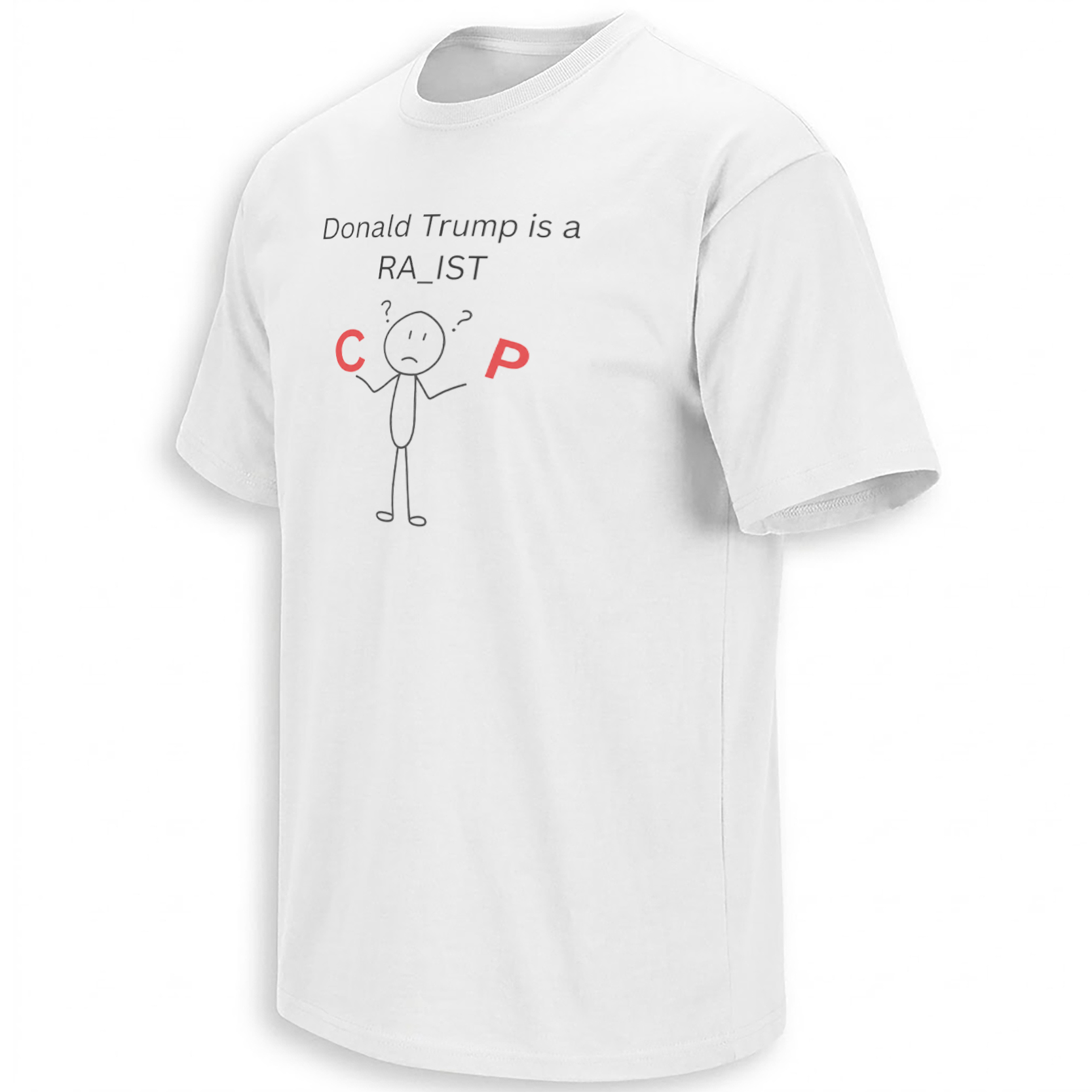
Donald Trump Is a Ra_ist
The missing letter is not decorative. It asks the viewer to choose between two of the most serious labels in American political debate.
Insert a C and “Ra_ist” becomes “racist.” Insert a P and it becomes “rapist.” The design compresses two long-running arguments about Donald Trump into a single blank space—but that compression makes factual precision more important, not less.
The shirt does not print either completed word. It makes the viewer supply both. That participation is the source of its force: the blank behaves like a tiny ballot, a prompt and an accusation at the same time.
The C reading: a political judgment, not a court verdict
“Racist” is a characterization rather than a legal status established by a single ruling. Trump has repeatedly denied being racist. Critics point to a public record extending well before his presidential campaigns, including the federal housing-discrimination case involving Trump Management, his promotion of the false birther theory about Barack Obama and his statements about the five men exonerated in the Central Park case.
Associated Press and Reuters fact checks have documented that accusations of racism against Trump did not begin only after he entered presidential politics. The label remains politically contested, but the history behind the dispute is real and substantially older than the shirt.
The P reading: the legal distinction matters
In 2023, a federal civil jury found Trump liable for sexually abusing and defaming writer E. Jean Carroll and awarded her $5 million. The jury did not find him liable for “rape” under the narrow New York legal definition presented at that trial. Trump denied Carroll’s allegation and challenged the verdict.
Judge Lewis Kaplan later explained that the conduct the jury found would fit the ordinary modern meaning of rape, even though it did not satisfy that then-applicable statutory definition. That distinction is why a sentence such as “a jury found Trump liable for rape” is inaccurate, while discussion of the judge’s common-language analysis requires the full context.
What the jury found
Civil liability for sexual abuse and defamation in the $5 million Carroll case.
What it did not find
A rape verdict under the specific, narrow New York definition supplied to that jury.
The legal story was still active in July 2026. The U.S. Supreme Court declined to hear Trump’s challenge to the $5 million verdict in June; Carroll subsequently received the judgment with interest. On July 28, Trump separately asked the Supreme Court to overturn the $83.3 million defamation award arising from his 2019 statements.
The blank makes the shirt visually simple. The history needed to explain it honestly is anything but simple.Ellie Shirt political culture desk
Why the blank is more powerful than printing both words
A conventional slogan tells the viewer what to read. “Ra_ist” creates an unresolved word and forces recognition. The eye pauses because the spelling is broken; the mind repairs it twice.
That structure also mirrors political argument. Supporters and opponents often begin from the same public event and arrive at incompatible labels. Here, however, the design is not neutral between interpretations. Both available completions are condemnations, so the only choice it offers is which indictment the viewer considers more immediate.
Donald Trump Is a Ra_ist
One missing letter turns typography into confrontation, asking the viewer to complete two anti-Trump accusations while carrying the burden of their different factual histories.
A protest design shaped by legal language
Political apparel often succeeds through certainty. This design succeeds through omission. Its blank creates room for two words, but it also exposes why labels cannot replace reporting.
The cultural artifact is therefore sharper than a simple insult. It records how arguments over Trump are fought simultaneously through court terminology, historical interpretation, personal judgment and viral typography. The shirt completes the words; the public record determines how carefully they must be used.
Reporting and legal context
- Associated Press: Trump faced accusations of racism before his presidential campaign
- Reuters Fact Check: the pre-presidential history of racism accusations
- U.S. Court of Appeals record: Carroll v. Trump
- Reuters: Carroll receives the $5.63 million judgment in July 2026
- Reuters: Trump seeks Supreme Court review of the separate $83.3 million award
Frequently asked questions
What letters complete “Ra_ist” on the shirt?
The letter C produces “racist,” while the letter P produces “rapist.” The design intentionally invites both anti-Trump readings.
Did a jury find Donald Trump liable for rape?
No. The 2023 civil jury found him liable for sexual abuse and defamation, not rape under the narrow New York definition used at trial. Judge Lewis Kaplan later said the conduct found by the jury fit the ordinary meaning of rape.
What was the status of the Carroll cases in July 2026?
The Supreme Court had declined Trump’s challenge to the $5 million verdict, and Carroll received about $5.63 million with interest. Trump separately asked the Court to overturn an $83.3 million defamation award concerning his 2019 statements.
Is “racist” a legal finding against Trump?
No. It is a political and moral characterization. Reporting can document the long history of statements, actions and controversies underlying the accusation, while Trump has denied that he is racist.