“Bible, Not the Straightble”: How Queer Christian Humor Reclaims Faith
A deliberately ridiculous rhyme has become a compact answer to a serious cultural question: who gets to belong inside Christianity, interpret Scripture and speak the language of faith?
“It’s called the Bible, not the Straightble” sounds like the kind of line invented in a comment section and repeated because it is too clean to forget. The joke compresses a long and frequently painful debate about Christianity, sexuality and biblical authority into a single unserious rhyme.
Its humor depends on reversal. For generations, LGBTQ people have heard Scripture invoked as evidence that heterosexuality occupies the unquestioned center of Christian life. “Straightble” turns that assumption into the joke. The Bible remains in the sentence; what disappears is the idea that only straight readers can claim it.
That distinction matters in the present religious landscape. A 2025 Pew Research Center analysis found that 48% of LGBT adults in the United States identified with a religion. LGBTQ identity and religious identity are therefore not opposite categories, even when public debate often treats them that way.
The joke does not remove queer people from the Bible. It removes heterosexuality’s claim to be the Bible’s only imaginable audience.
Why This Particular Joke Keeps Traveling
Internet phrases endure when they are easy to repeat but difficult to exhaust. “Bible, not the Straightble” meets both conditions. It is short enough for a caption, a protest sign or a shirt, yet it points toward arguments about translation, historical context, church authority and the experiences of queer Christians.
The phrase also borrows the cadence of a familiar conservative correction: “It’s Adam and Eve, not Adam and Steve.” Instead of answering that slogan with a paragraph of theology, it answers with another rhyme. The power shifts because the person who was expected to defend their existence becomes the person delivering the punchline.
That does not make the phrase a complete biblical argument. It was never designed to be one. Its cultural function is to interrupt a supposedly settled conversation and remind the audience that the relationship between Christianity and LGBTQ life remains actively interpreted, disputed and lived.
The Design Does Something the Slogan Cannot Do Alone
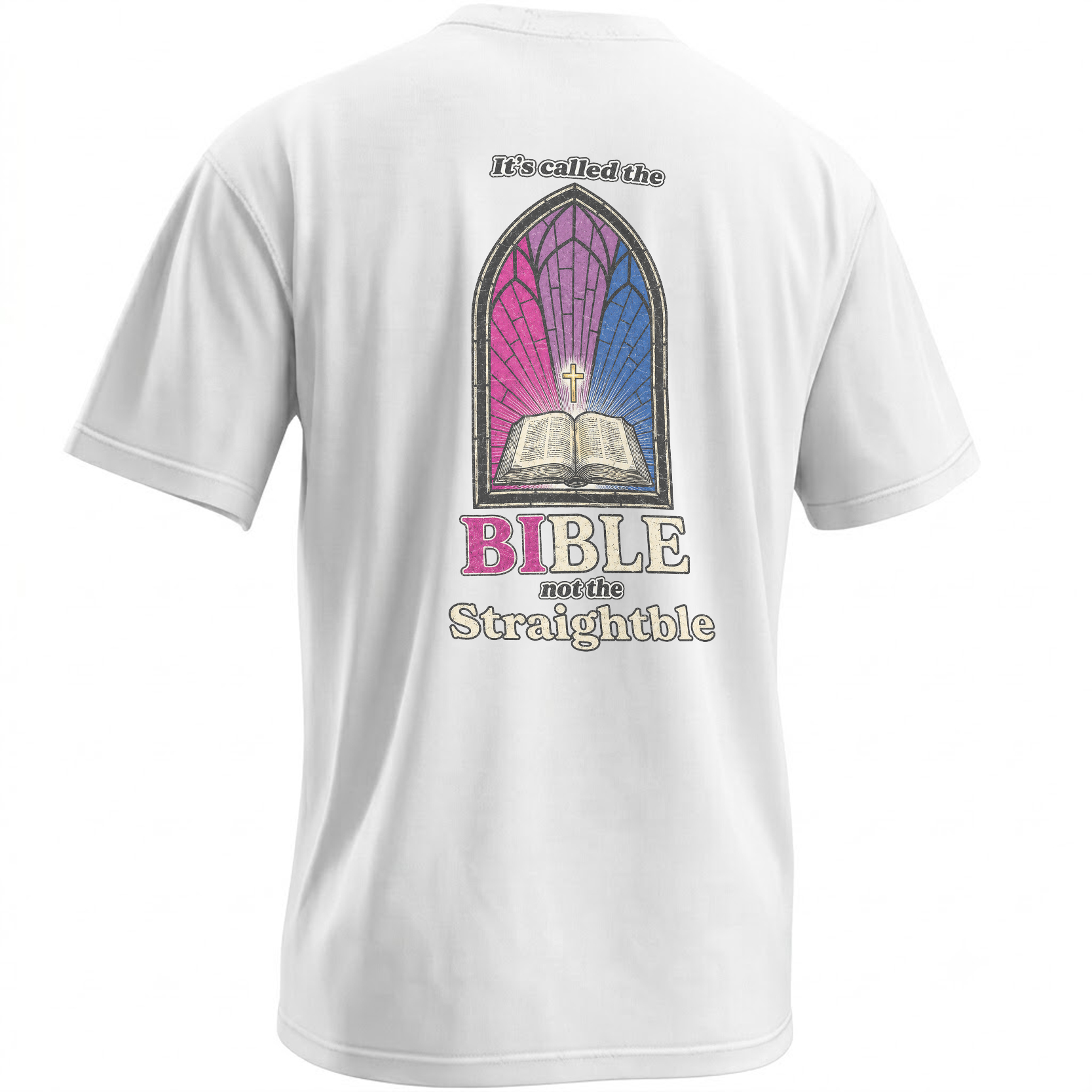
Printed only as text, the phrase could read as pure sarcasm. The artwork changes its emotional register. A tall pointed arch evokes stained glass, sanctuary architecture and the visual memory of entering a church. An open Bible rests at the bottom of the window, while a small illuminated cross occupies its center.
Those symbols prevent the design from becoming an outside attack on Christianity. The composition speaks from within Christian visual culture. The Bible is open rather than discarded. The cross is illuminated rather than crossed out. The church window is filled with color rather than broken.
Magenta, purple and blue radiate from the open pages, creating a palette closely associated with bisexual visibility while remaining legible as stained glass. The word “BIBLE” adds another layer: its opening “BI” is emphasized in the same colored language. The pun is therefore carried by both the sentence and the typography.
The distressed cream and charcoal lettering keeps the image from looking digitally polished or institutionally official. It has the worn texture of a community poster, an old church handbill or a graphic passed from one generation of believers to another. That visual aging gives a new internet phrase the feeling of an inherited declaration.
The arch establishes sacred space, the open book signals continuing interpretation, and the colored light places queer identity inside that space. The design’s central argument is visual before it is theological: faith and LGBTQ identity occupy the same frame.
Queer Christianity Is Not a Contradiction
Public discussion often presents LGBTQ people as standing outside religion and evaluating it from a distance. The data tells a more complicated story. Many queer people remain Christian, belong to other faith traditions or continue to hold spiritual beliefs even after difficult experiences with religious institutions.
Pew found that 64% of lesbian, gay or bisexual adults believed in God or a universal spirit, while 80% believed people possess a soul or spirit in addition to the physical body. Those figures do not erase conflict with churches. They demonstrate that conflict with a religious institution is not automatically the same as an absence of faith.
The institutional picture is changing as well, although not uniformly. In Pew’s 2023–24 Religious Landscape Study, 59% of religiously affiliated adults said homosexuality should be accepted by society. Most Catholics, mainline Protestants and members of historically Black Protestant churches favored acceptance, while most evangelical Protestants took the opposite position.
Those differences are important. There is no single contemporary “Christian view” that accurately describes every denomination, congregation or believer. Christian communities disagree about biblical passages, marriage, ordination, gender and the meaning of welcome. The disagreement is real; so is the growing visibility of Christians who openly affirm LGBTQ people.
Interpretation Has Always Been Part of Reading Scripture
The slogan’s comedy rests on a serious point: nobody approaches the Bible without interpretation. Readers make decisions about language, genre, historical setting, cultural assumptions and how ancient instructions relate to contemporary life. Even churches that describe their reading as literal still rely on interpretive traditions.
LGBTQ-affirming Christians argue that the small group of passages commonly used in debates about homosexuality does not address modern sexual orientation or covenantal same-sex relationships in the form understood today. Organizations such as The Reformation Project build that case through historical context, Greek terminology, biblical ethics and the distinction between consensual relationships and exploitation.
Traditional Christian interpreters dispute those conclusions and continue to understand the relevant passages as prohibiting same-sex sexual relationships. A responsible account of the debate must acknowledge both positions. The existence of disagreement, however, means that exclusion cannot simply be presented as the only Christian reading without further argument.
“Bible, not the Straightble” refuses to perform that entire debate every time it is spoken. Instead, it establishes the speaker’s presence inside it. The phrase says that queer believers are not merely subjects being discussed by other Christians; they are readers, interpreters and members of Christian communities themselves.
Humor as a Form of Religious Survival
Queer religious humor often sounds irreverent because it emerges from environments where reverence has been used to demand silence. A joke creates breathing room. It allows someone to name a contradiction, challenge authority and find other people who recognize the same experience without first delivering a formal testimony.
This is why the phrase moves naturally between memes, social captions, church-community spaces and apparel. Each format changes its meaning slightly. In a comment section, it is a comeback. On a protest sign, it becomes public dissent. Within an affirming congregation, it can function as affectionate insider humor. On a graphic, it becomes a portable record of all three.
Humor cannot resolve every theological disagreement, nor does every Christian reader experience the line as harmless. Its sharpness is intentional. The target is not the Bible itself but the presumption that “biblical” and “straight” are interchangeable words.
A Stained-Glass Window for People Once Kept Outside
Stained glass has historically taught biblical stories through light, color and public images. This design borrows that function but changes who appears to be addressed. Instead of depicting a saint or narrative scene, it frames the open book with colors associated with queer identity.
Symbolically, that placement matters. The color does not sit outside the arch asking to enter. It forms the window itself. Light reaches the Bible through it. The visual therefore imagines inclusion not as a reluctant exception but as part of how the sacred text becomes visible.
That perspective connects the design naturally to Ellie Shirt’s broader Christian collection, where faith graphics record the many ways people use humor, Scripture, testimony and visual symbolism to describe religious identity. The newest design archive places the phrase within the evolving language of contemporary internet culture.
Frequently Asked Questions
What does “It’s called the Bible, not the Straightble” mean?
It is a queer Christian wordplay that challenges the assumption that heterosexuality is the Bible’s only valid perspective or audience. The phrase uses humor to claim space for LGBTQ readers and believers within Christian conversation.
Is “Bible, not the Straightble” an actual Bible quotation?
No. It is an internet-era slogan and rhyme, not a biblical verse. Its purpose is cultural commentary on how Scripture is interpreted and used in debates about LGBTQ identity.
Can someone be both LGBTQ and Christian?
Yes. LGBTQ Christians belong to many denominations and theological traditions. Pew Research Center found that 48% of LGBT adults in the United States identified with a religion in a 2024 survey.
Why does the design use magenta, purple and blue stained glass?
The colors connect a traditional church-window form with queer and bisexual visual language. They also emphasize the “BI” inside “BIBLE,” extending the written joke into the typography.
Do all Christians agree about LGBTQ inclusion?
No. Christian denominations and individual believers hold sharply different views about same-sex relationships, marriage, gender and biblical interpretation. Affirming and traditional readings both remain active within contemporary Christianity.
The It’s Called the Bible Not the Straightble design preserves a distinctly contemporary form of queer Christian expression: a difficult argument transformed into a memorable rhyme, then placed inside the sacred visual language of an open Bible and stained glass.
It’s Called the Bible Not the Straightble Shirt pairs queer Christian wordplay with an open Bible, cross and magenta-purple-blue stained glass—framing LGBTQ identity and faith inside the same sacred space.