Dodgers October Mode Yamamoto, Kiké and Freddie Took Over Game 3
One ace, two fourth-inning home runs and three familiar October performers turned a tied NLDS into a 2–1 Dodgers series lead in Atlanta.
October Mode is not one statistical category. For the Dodgers on October 6, it looked like three completely different versions of postseason influence happening inside the same 3–1 victory.
Yoshinobu Yamamoto controlled the game from the mound. Kiké Hernández changed it with one swing. Freddie Freeman followed two batters later with another. By the time Edwin Díaz recorded the final out at Truist Park, Los Angeles had moved from a 1–1 series tie to a 2–1 NLDS advantage over Atlanta.
The names matter because all three already carry October reputations. Yamamoto entered the night as the 2025 World Series MVP. Hernández has spent years turning ordinary regular-season production into disproportionate playoff moments. Freeman remains one of the era’s most accomplished postseason hitters. Game 3 put those identities into one clean frame.
October Mode was not one superstar carrying Los Angeles. It was Yamamoto suppressing the game while Kiké and Freddie supplied exactly three runs.
What happened in Dodgers–Braves NLDS Game 3?
The first three innings felt like the duel everyone expected. Yamamoto and Chris Sale each reached six strikeouts through three scoreless frames, recreating the texture of an old postseason pitching battle at a moment when the series was completely even.
Los Angeles finally found the break in the fourth. Andy Pages singled. Kiké Hernández, making his first start of the postseason and batting ninth, caught a Sale changeup and drove it 406 feet to left for a two-run homer.
Two batters later, Freeman turned on an inside sinker and sent it over the right-field wall. The swing carried a little extra theater because Mauricio Dubón had robbed Freeman of a potential homer one inning earlier.

Yamamoto made three runs feel enormous
A 3–0 lead is comfortable only when the pitcher turns it into one. Yamamoto allowed four hits, walked one and struck out 10 over seven innings, setting a new personal postseason strikeout high.
His only difficult stretch came in the fifth. Atlanta loaded the bases with one out and pushed home a run on a ground ball, cutting the lead to 3–1. Yamamoto then retired Ronald Acuña Jr. to end the inning and did not allow another baserunner.
MLB noted that he became the first Dodgers pitcher since Blake Snell in the 2025 Wild Card Series to deliver at least seven postseason innings with double-digit strikeouts and no more than one run allowed. It was also his first playoff appearance since his extraordinary relief work to close Game 7 of the previous World Series.
Kiké and Freeman created the runs fans replay. Yamamoto created the conditions that made those three runs enough. Game 3’s identity disappears if any one of the three is removed.
Why “October Kiké” keeps returning
Hernández’s home run was the 17th postseason homer of his career. More unusually, his playoff home-run frequency remains dramatically higher than his regular-season rate — exactly why his October reputation has survived multiple roster roles and lineup changes.
He had barely started during the weeks leading into Game 3. Dave Roberts put him at third base and ninth in the batting order specifically against Sale. Hernández responded in his first start of the 2026 postseason with the biggest offensive swing of the game.
MLB’s own recap leaned into the familiar phrase “October Kiké,” while Freeman joked that he wished there were a recipe teammates could copy. That is why a three-player “October Mode” composition does not feel like arbitrary star stacking. Hernández represents the strange switch postseason fans have watched flip for years.
Freddie Freeman supplied the second punch
Freeman’s homer was his 18th in postseason play and his second in as many games. It also came in Atlanta, the city where he spent the first 12 seasons of his career and won a World Series with the Braves.
The sequence gave Game 3 an unusually compact offensive story. Hernández changed the score from 0–0 to 2–0. Freeman changed it to 3–0. Los Angeles never scored again, and it never needed to.
That efficiency is part of what the design captures. Instead of trying to summarize every Dodger in the game, it isolates the three players responsible for the night’s most memorable forms of control: pitching, clutch power and veteran postseason power.
Why the three-player October Mode layout works
Yamamoto belongs at the center because he controlled the largest portion of the game. Hernández supplies the volatility — the utility player who suddenly becomes an October slugger. Freeman gives the composition veteran gravity and the second home-run beat.
Dodgers blue unifies three very different player identities, while the October framing makes the shirt event-specific rather than merely a roster collage. “NLDS Game 3” is the differentiating search angle: Atlanta, October 6, 2026, one pivotal series game.
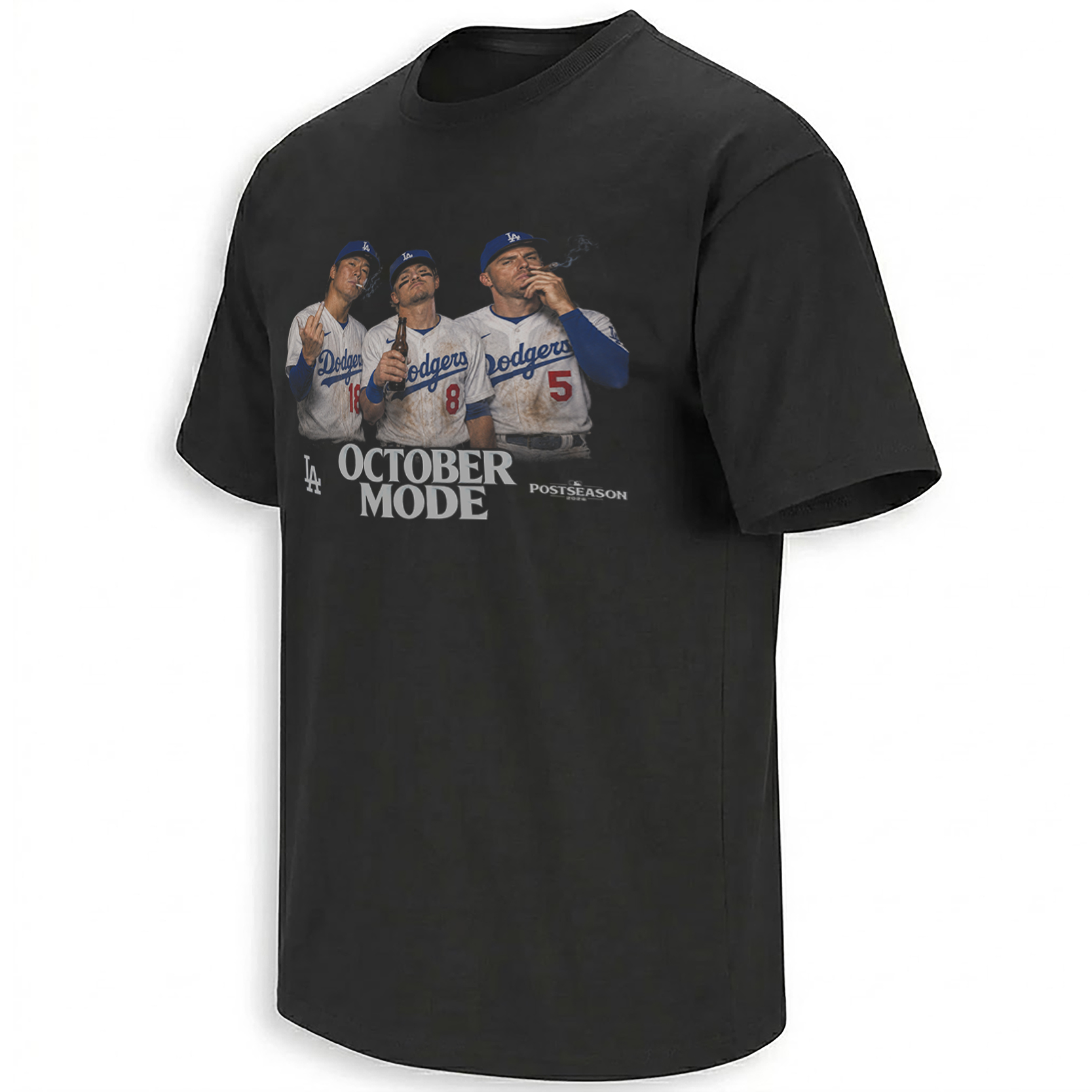
Yamamoto, Kiké and Freeman are treated as three parts of one postseason game: ace pitching, the decisive two-run blast and the insurance homer that held up as the final margin.
View the October piece →The Dodgers moved one win from another NLCS
Game 3 mattered because the series arrived in Atlanta tied 1–1. The winner would take control of the best-of-five and force the other club to play elimination baseball immediately.
Los Angeles did exactly that. The Dodgers left the night leading 2–1 and needing one more win to reach a third consecutive NLCS as their pursuit of a World Series three-peat continued.
That context is what turns the artwork from three popular Dodgers into a timestamp. It records the night Los Angeles’ October machinery looked familiar again.
Player-specific EllieShirt searches: Yoshinobu Yamamoto, Kiké Hernández, and Freddie Freeman.
Where October Mode belongs inside EllieShirt
The verified Los Angeles Dodgers collection is the natural archive for postseason player moments, championship graphics and current Dodgers culture.
The broader MLB collection places Game 3 inside the full 2026 postseason conversation.
Frequently Asked Questions
What happened in Dodgers vs. Braves NLDS Game 3?
Los Angeles won 3–1 on October 6, 2026, taking a 2–1 lead in the National League Division Series.
How did Yoshinobu Yamamoto pitch in Game 3?
Yamamoto allowed one run on four hits over seven innings and struck out a postseason career-high 10 batters.
What did Kiké Hernández do in NLDS Game 3?
Hernández hit a two-run home run off Chris Sale in the fourth inning to break a scoreless tie.
What did Freddie Freeman do in Game 3?
Freeman hit a solo home run two batters after Hernández, extending the Dodgers’ lead to 3–0.
Why does the shirt feature Yamamoto, Kiké and Freeman together?
The three players defined different parts of the same pivotal win: Yamamoto dominated on the mound, Hernández drove in the first two runs and Freeman supplied the final run with his homer.
The Dodgers October Mode graphic preserves Game 3 as one three-player postseason frame, while the Dodgers archive follows the larger 2026 playoff run.
Dodgers October Mode Shirt captures Yoshinobu Yamamoto’s 10-strikeout gem, Kiké Hernández’s two-run homer and Freddie Freeman’s solo shot from Los Angeles’ pivotal 3–1 victory in 2026 NLDS Game 3.