Flag on the Play. Party on the Field.
The Detroit Lions turned one Packers penalty into a full-team dance party, a viral Charlie Brown comparison and one of the most memorable scenes of their 20–17 victory.
It began with a yellow flag. It ended with Detroit’s offense looking like it had collectively unlocked every celebration in a video game. On October 25, 2026, with the Lions and Green Bay Packers tied late in the fourth quarter at Ford Field, Packers defensive lineman Karl Brooks jumped into the neutral zone — and the Lions responded with a perfectly chaotic dance party.
The penalty came at a crucial point in a 17–17 game. Detroit faced third-and-five near the two-minute warning, needing another first down to keep its final drive alive. Brooks’ infraction delivered the first down, helped Detroit control the remaining clock and produced a scene that instantly felt built for the internet.
Amon-Ra St. Brown, Jahmyr Gibbs, Jameson Williams, Isaac TeSlaa, Penei Sewell and other Lions players broke into their own animated celebrations. Some pointed toward Green Bay. Others danced, pumped their arms or enthusiastically signaled the first down. It was spontaneous, theatrical and unmistakably Detroit.
The Penalty That Turned Into a Dance Floor
The immediate football significance of the call was straightforward. With the game tied and the clock becoming Detroit’s ally, an automatic first down gave Jared Goff’s offense a better opportunity to position kicker Jake Bates for a winning field goal.
But the camera caught something else. Instead of simply resetting for the next snap, multiple Lions players transformed the penalty into a series of overlapping celebrations.
The NFL’s official social media account posted footage of the moment with the caption “Did we miss somebody?” The sequence rapidly drew attention because nearly everyone seemed to have a different reaction.
Why Fans Called It the Charlie Brown Dance
The visual comparison that gave the play an additional life online came from the exaggerated, individual movements. Viewers connected Detroit’s celebration to the memorable dancing sequence from A Charlie Brown Christmas, where characters move in different directions while sharing the same musical setting.
The connection was not an official choreographed tribute announced by the Lions. It emerged as a recognizable way to describe the strange collective rhythm of the moment.
In the Detroit Lions Reddit discussion, supporters shared the clip, GIFs and reactions to individual players’ dances. Some focused on Gibbs, while others singled out the movements of St. Brown and TeSlaa.
One penalty gave Detroit the first down. The celebration gave the internet a whole new highlight.
Flag on the Play, Party on the Field: The Graphic
The phrase works because it captures two contrasting emotions in one sentence: the formal language of NFL officiating and the completely informal energy of the players’ response.
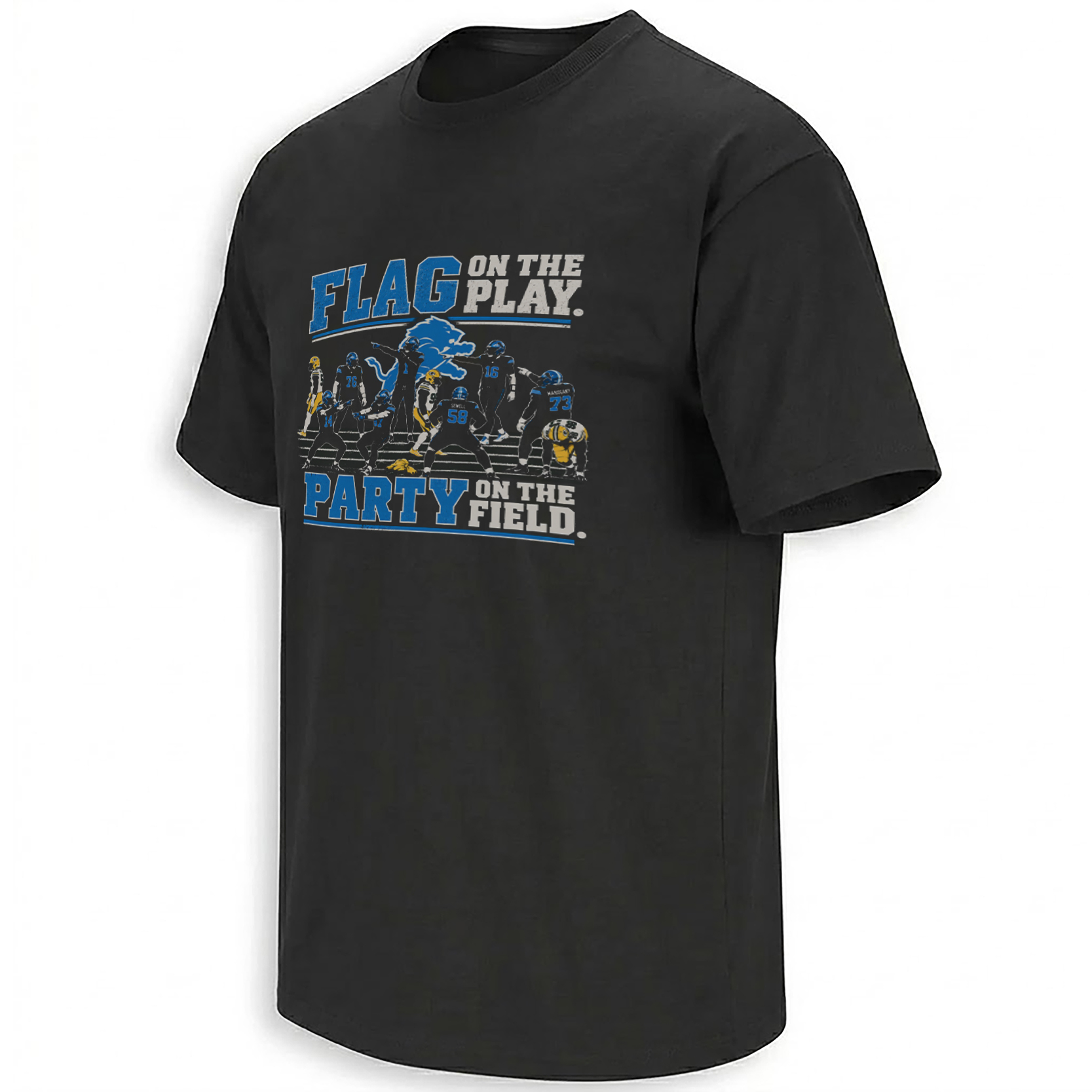
A Detroit Lions fan-culture graphic referencing the remarkable on-field celebration that followed Green Bay’s late-game penalty.
View the celebration design →The Flag on the Play Party on the Field Shirt turns the scene into a piece of visual football humor. The slogan balances the official seriousness of a penalty with the spontaneous enjoyment of an offense realizing it has been handed a crucial advantage.
The design is tied to a particularly specific moment rather than a generic rivalry sentiment. It refers to the Lions’ October 25 victory and the celebration that followed the infraction.
The Other Side of the Meme: Was It Taunting?
Not every reaction was purely celebratory. The viral footage also reopened a familiar argument about the NFL’s enforcement of taunting rules.
Green Bay receiver Matthew Golden had been penalized for a much smaller celebration against Dallas the previous week, while the Lions were not penalized for their group reaction after Brooks’ infraction. Packers supporters and other viewers questioned the consistency.
The argument was complicated by the broader officiating story from the game. Green Bay had concerns about roughing-the-passer calls, including a late penalty on Brooks that helped Detroit move downfield. That made the final drive unusually combustible for both fan bases.
The Packers’ official postgame notes documented the officiating disputes, while Associated Press coverage described the late penalty and dancing aftermath.
The internet debate therefore carried two competing interpretations. Detroit supporters saw a joyful, ridiculous celebration in a rivalry game. Critics questioned why such an elaborate reaction was allowed when other players had previously been flagged for less.
Jake Bates Delivered the Ending
The celebration would have been remembered differently without the eventual result. Detroit still needed to finish the drive.
After the first down, the Lions managed the remaining clock and moved into field-goal range. Jake Bates connected from 22 yards as time expired, securing a 20–17 victory.
The win moved Detroit to 4–2 and ended Green Bay’s three-game winning streak. It also ensured that the penalty dance belonged to a victorious home team, adding one more emotional layer to a moment that was already spreading across social media.
The Lions’ official Week 7 observations provide further context on the team’s performance.
How Detroit’s Football Personality Became Internet Language
Under Dan Campbell, the Lions have developed a public identity associated with emotion, physicality and an unusually expressive team personality. Those characteristics are not a substitute for football execution, but they help explain why the celebration felt recognizable to supporters.
The players’ individual styles were visible simultaneously. That is what separated the clip from a standard first-down signal or rehearsed touchdown routine.
For fans following that culture, the Detroit Lions collection serves as a visual archive of team identity, rivalry moments and memorable celebrations. The NFL collection provides the wider league context, while the Green Bay Packers collection reflects the other side of this historic NFC North rivalry.
Moments involving particular players also become part of their individual fan cultures, from Amon-Ra St. Brown to Jahmyr Gibbs and Jameson Williams.
Frequently Asked Questions
Why did the Detroit Lions dance against the Packers?
Detroit players celebrated after Packers defensive lineman Karl Brooks committed a neutral-zone infraction late in the fourth quarter of their October 25, 2026 game, giving the Lions an important first down.
What is the Detroit Lions Charlie Brown dance?
It is a fan comparison between Detroit’s animated group celebration and the distinctive dancing from A Charlie Brown Christmas. The Lions celebration was not officially announced as a Peanuts tribute.
Who won the Lions vs. Packers game on October 25, 2026?
The Detroit Lions defeated the Green Bay Packers 20–17 on a 22-yard field goal by Jake Bates as time expired.
Which Lions players joined the viral celebration?
The sequence included Amon-Ra St. Brown, Jahmyr Gibbs, Jameson Williams, Isaac TeSlaa, Penei Sewell and several other Detroit offensive players.
Were the Lions penalized for the dance?
No additional taunting penalty was called for the group celebration, although the clip prompted debate about the consistency of NFL officiating.
What does Flag on the Play, Party on the Field refer to?
The slogan refers to the Packers penalty and Detroit’s energetic celebration during the final minutes of the Lions’ 20–17 Week 7 victory.
The Flag on the Play Party on the Field graphic preserves the moment when Detroit turned a crucial first down into an instant NFL meme. Explore the wider Lions visual archive for more snapshots of Detroit football culture.
Flag on the Play Party on the Field Shirt captures the Detroit Lions’ viral penalty celebration against the Green Bay Packers on October 25, 2026. The graphic remembers the team’s animated Charlie Brown-style dance before Jake Bates secured a 20–17 victory.
Editorial reporting: Packers official recap · Detroit Lions · ClutchPoints · Reddit fan discussion.