
Dave Roberts Reached 1,000 Wins. No MLB Manager Got There Faster.
The Los Angeles Dodgers’ 9–3 victory over the Athletics on June 30, 2026, carried an achievement that extended far beyond one night in West Sacramento: Dave Roberts had reached 1,000 regular-season managerial wins in fewer games than anyone before him.
The final out looked routine. The meaning attached to it was anything but routine. When the Dodgers completed their 9–3 victory over the Athletics at Sutter Health Park on June 30, Dave Roberts officially became a 1,000-win manager—and the fastest manager in Major League Baseball history to reach the number.
Roberts required 1,606 regular-season games to record those 1,000 victories. That pace moved him ahead of the previous benchmark associated with Cap Anson, who reached the mark after 1,641 decisions. Thirty-five games separated the two paths, but the larger meaning came from the sustained level of winning required to reach four digits so quickly.
The milestone immediately gave Dodgers fans a different way to evaluate an era they have often experienced through October pressure, championship expectations and constant roster scrutiny. One thousand wins reduced that complicated decade into a clean number, while “fastest” transformed the number into baseball history.
One thousand wins is a career landmark. Reaching it faster than every manager before you turns the landmark into an argument about an entire era.
The Night a Dodgers Win Became a Managerial Record
The milestone arrived during a game in which the Dodgers gave Roberts little reason for late-inning anxiety. Justin Wrobleski worked seven innings and recorded a career-high 11 strikeouts, while Tommy Edman produced four hits, drove in four runs and homered. Miguel Rojas also went deep as Los Angeles built the kind of controlled victory that has become familiar during Roberts’ tenure.
Once the final out was secured, however, the focus moved away from the box score and toward the manager. Roberts described the achievement as “mind-blowing,” reflecting on the consistency—and job survival—required to remain in one of baseball’s most demanding positions long enough to approach the milestone.
That reaction mattered because Roberts has rarely been allowed to exist in public conversation as a simple winner. Every pitching change, October lineup and postseason loss has been examined under the weight of the Dodgers’ payroll and expectations. Win No. 1,000 did not end those debates. It changed the scale on which they now have to occur.
Why 1,606 Games Changes the Meaning of 1,000 Wins
Many managers have accumulated 1,000 victories. The distinction attached to Roberts is speed. Reaching the landmark in 1,606 games means winning at a rate that leaves little room for extended rebuilding cycles, prolonged losing seasons or organizational drift.
Roberts’ path began with a one-game interim assignment for San Diego in 2015 before he took control of the Dodgers the following season. His first win as Los Angeles manager came on Opening Day in 2016, a 15–0 victory over the Padres. From there, the total grew through division races, deep postseason runs, roster turnover and the pressure of managing a club expected to contend every year.
Roberts managed one interim game for San Diego, beginning the official record later associated with his career total.
He opened his Dodgers tenure with a 15–0 victory and began a sustained run of regular-season success in Los Angeles.
The Dodgers’ June 30 victory over the Athletics delivered win No. 1,000 in his 1,606th managerial game.
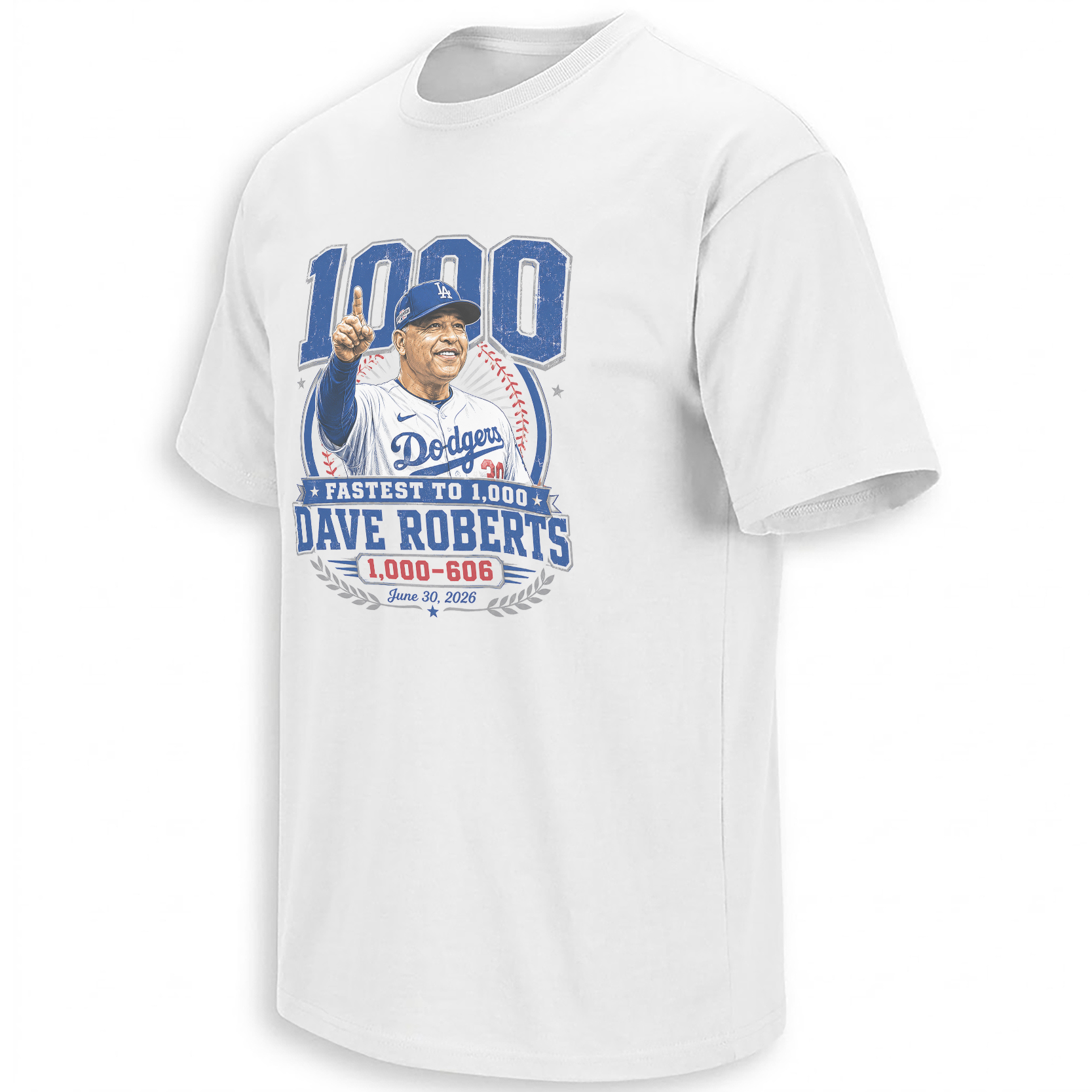
The 1,000–606 record printed on the graphic captures that pace in its simplest form. It does not explain every controversial decision or every championship run, but it establishes the foundation beneath all of those conversations: Roberts’ teams have won with exceptional regularity.
The Record Reframes a Decade of Dodgers Debate
Roberts has occupied one of the strangest positions in contemporary baseball culture. He has managed a dominant franchise through an era of repeated contention, yet many fan discussions have focused less on the victories than on the seasons that did not end with a championship parade.
That tension comes with the Dodgers’ modern identity. A 100-win season can feel like the beginning of the assignment rather than the accomplishment itself. Regular-season excellence establishes expectations; October determines how fans remember the year. Managers therefore receive limited credit for building the machine and disproportionate blame when the machine stops.
The fastest-to-1,000 record complicates that pattern. It does not ask fans to forget postseason frustration or stop debating individual decisions. It does force those arguments to coexist with an achievement no previous MLB manager reached at the same pace.
Roberts’ milestone is powerful because it does not erase debate. It places the debate beside a record. Fans can still question a pitching move, but they now do so while discussing the fastest manager ever to accumulate 1,000 regular-season victories.
How the Artwork Turns a Statistic Into a Baseball Artifact
Managerial records are difficult to visualize. A home-run milestone has a swing. A strikeout record has a pitch. A championship has a trophy lift. One thousand managerial wins are distributed across years of lineup cards, bullpen decisions and ordinary nights that rarely survive as individual images.
The Fastest To 1,000 design solves that problem by arranging the achievement like a career plaque. The distressed blue “1000” dominates the upper composition, immediately establishing the central number. A baseball with red stitching creates a circular frame behind Roberts, while his raised index finger turns the portrait into a direct visual reference to the landmark.
The lower half carries the evidence. “Fastest To 1,000” appears across a dark blue ribbon, followed by the manager’s name, the 1,000–606 record and the handwritten date June 30, 2026. Silver stars and laurel branches give the layout the formality of an award emblem without removing it from Dodgers visual culture.
Blue provides institutional identity. Red creates scorecard emphasis. White space allows the layered elements to remain readable, while the weathered treatment prevents the graphic from feeling like a sterile data panel. The result resembles a design that could sit between an old stadium program, a milestone newspaper front and a modern fan-made tribute poster.
Why the Fan Reaction Became Bigger Than One Game
Across baseball and Dodgers fan spaces, the record quickly reopened the long-running argument over how Roberts should be evaluated. Supporters pointed to the scale of the achievement, his winning percentage and the difficulty of sustaining success under constant championship expectations. Critics returned to familiar postseason decisions and the advantages of managing a star-heavy roster.
That split reaction is part of why the milestone travelled so effectively. Numbers create certainty, but managerial reputations remain emotional. “1,000 wins” is factual. “Fastest ever” is factual. What those numbers should mean for Roberts’ legacy remains open to interpretation, which gives fans a reason to keep talking.
The moment also arrived with unusual symmetry. Roberts’ first managerial game in 2015 came against the Athletics as an interim manager for San Diego. Eleven years later, an Athletics game became the setting for the victory that placed him in the MLB record book.
A Visual Record of the Modern Dodgers Era
The milestone belongs inside a broader chapter of Los Angeles baseball that has been defined by annual expectations, star power, October scrutiny and an unusually high baseline for success. Roberts is not a side character in that story. He is the manager whose tenure connects the changing versions of the roster.
That continuing story can be followed through Ellie Shirt’s Los Angeles Dodgers collection, where player moments, championship memories, clubhouse phrases and record-setting performances function as a changing visual archive of the franchise.
The wider MLB collection places Roberts’ achievement beside the broader culture of baseball milestones, breakout performances, rivalries and season-defining images. Fans tracking the newest moments across sports can also explore Ellie Shirt’s latest releases, where current events begin turning into graphics while the conversation is still active.
Frequently Asked Questions
When did Dave Roberts earn his 1,000th managerial win?
Dave Roberts recorded win No. 1,000 on June 30, 2026, when the Los Angeles Dodgers defeated the Athletics 9–3 at Sutter Health Park in West Sacramento.
Why is Dave Roberts called the fastest manager to 1,000 wins?
Roberts reached 1,000 regular-season managerial victories in 1,606 games, fewer games than any previous MLB manager needed to reach the milestone.
What does the 1,000–606 record on the design mean?
It represents Roberts’ career regular-season managerial record at the moment he reached his 1,000th victory: 1,000 wins and 606 losses.
Who held the previous fastest pace to 1,000 managerial wins?
The previous benchmark was associated with Cap Anson, who reached 1,000 victories after 1,641 decisions. Roberts reached the number 35 games sooner.
Why did the Dave Roberts milestone create debate among Dodgers fans?
The record highlighted Roberts’ sustained regular-season success while also reviving familiar discussions about postseason decisions, roster strength and the extraordinary expectations attached to managing the Dodgers.
What does the Fastest To 1,000 design represent?
The graphic preserves Roberts’ historic total, record-setting pace, Dodgers identity and the June 30, 2026 milestone date as a visual artifact from the modern Los Angeles baseball era.
The Fastest To 1,000 Shirt records the exact night Roberts reached baseball history, while the wider Dodgers visual archive follows the players, championships, debates and milestones that continue to define this Los Angeles era.
Fastest To 1,000 Shirt captures Dave Roberts becoming the quickest MLB manager to reach 1,000 regular-season wins through his Dodgers No. 30 portrait, 1,000–606 record and June 30, 2026 milestone date.