Cowboys Barbell: Dallas Football Built From the Line Out
Dallas opened the 2026 preseason with a 17–7 win over Seattle, but the Barbell story started almost two weeks earlier in Oxnard. The first pads went on August 3, the offensive line began receiving real resistance, and Tyler Smith described those sessions as the point where players finally begin returning to true football shape.
There may be no football team more associated with visual spectacle than Dallas. The star, the stadium, Thanksgiving, national television and the sheer scale of Cowboys conversation can make everything surrounding the franchise feel larger than ordinary football.
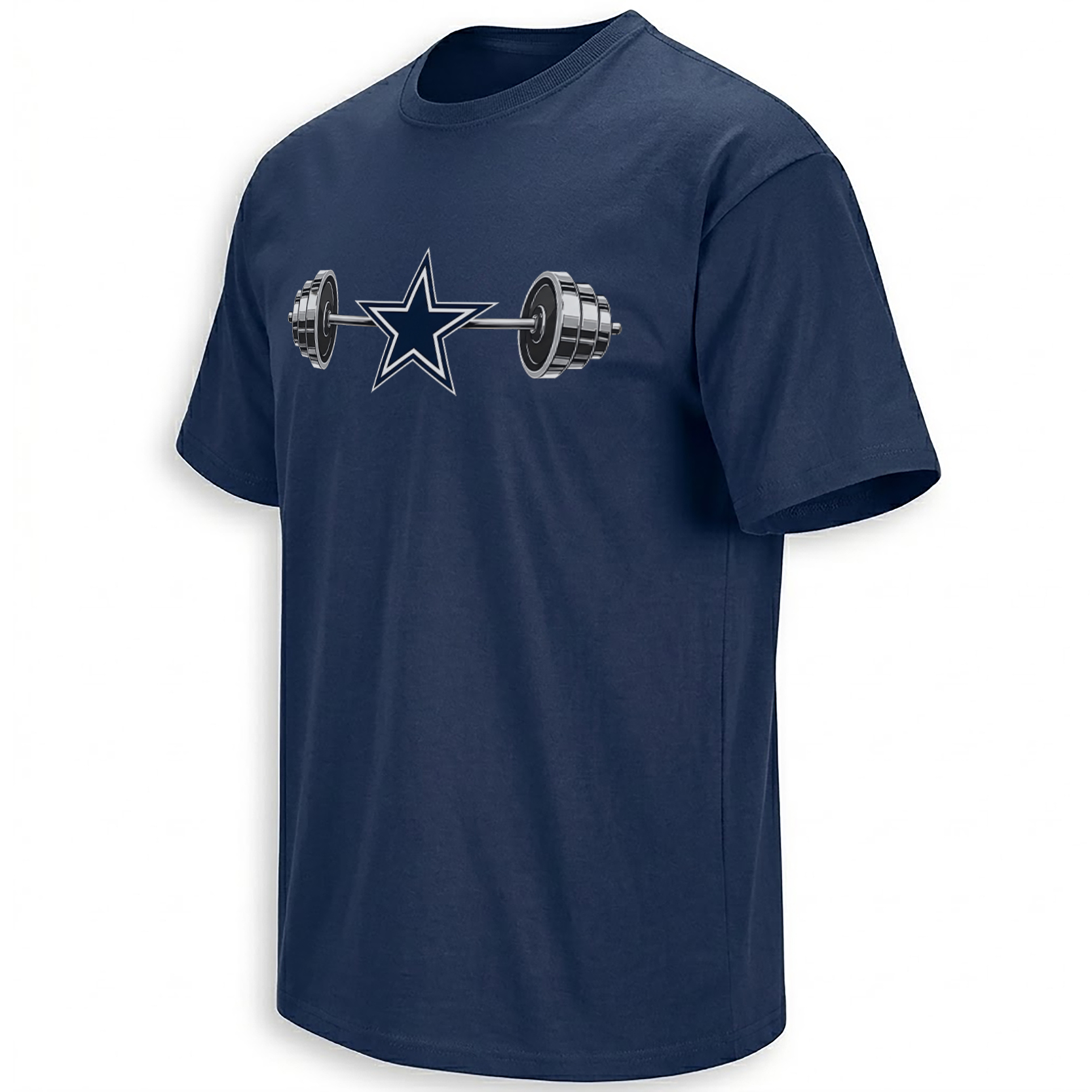
A barbell takes the image in the opposite direction. It removes the spectacle and reduces the game to resistance. Put weight on both ends. Control the load. Repeat. Increase it. Return tomorrow.
That simplicity makes Cowboys Barbell especially interesting during the current training-camp window. Dallas’ stars largely sat out the preseason opener, leaving August to become less about celebrity and more about depth, conditioning and whether the physical work from Oxnard can survive another NFL front.
The Cowboys star can represent fame. The barbell represents everything football requires before anyone earns the spotlight.
The pads changed Dallas training camp
The first padded practice arrived on August 3. That date matters because offensive-line evaluation changes immediately once defenders are allowed to deliver and absorb meaningful contact.
Two days into padded work, Tyler Smith described the transition as a return to the physicality required by football. For linemen, “football shape” means something more specific than cardiovascular conditioning. It means keeping technique intact while another large, explosive athlete is trying to bend the pocket, cross the face or remove leverage.
That is the real-world version of the Barbell idea. Strength exists first as capacity. Pads reveal whether that capacity can remain controlled when the resistance begins moving unpredictably.
Tyler Smith explains why strength cannot stand alone
Smith is a useful reference point because guard play makes the difference between weight-room strength and usable football strength easy to see. A guard can be enormously powerful and still lose if his feet stop, his hands arrive outside or his pad level rises.
Dallas’ current interior line has spent camp learning that balance through repetition. Smith and Tyler Booker continue to draw attention, while Cooper Beebe has quietly produced some of the more physical moments of practice at center.
One Cowboys camp report highlighted Beebe driving rookie lineman LT Overton to the ground during a would-be Jaydon Blue touchdown run. That is not important because one practice rep predicts September. It matters because it shows exactly how strength becomes football imagery: leverage first, movement second, result third.

The Seattle win supplied a useful checkpoint
Dallas’ defense allowed only 76 yards over Seattle’s final seven drives and repeatedly produced stops when the Seahawks were given favorable field position. Brian Schottenheimer liked the response but also emphasized penalties and other details that needed cleaning up.
The offensive line had a less clean opening. Schottenheimer acknowledged that Dallas struggled at times to move Seattle’s front early in the game before improving later.
That mixed evaluation actually strengthens the Barbell narrative. The design is not a trophy graphic. It represents unfinished work. The point of resistance training is precisely that some loads expose weakness. Preseason does the same thing to a roster.
Deep navy creates the Dallas identity, silver behaves like metal and the loaded-bar geometry gives the artwork the structure of an old football strength-program mark. The visual star language stays subtle so the concept remains focused on work rather than spectacle.
Why offensive-line culture matters so much in Dallas
Cowboys history gives offensive-line play unusual cultural weight. Different eras have been associated with different versions of dominant fronts, and Dallas fans have learned that a star-filled offense becomes significantly less impressive when the five bodies in front cannot control the game.
That history gives the Barbell concept a deeper meaning than simply “Cowboys plus gym.” The visual is really about the foundation beneath an offense. Quarterback timing, running lanes and downfield routes all depend on a pocket or a crease existing long enough to matter.
That is why Tyler Smith belongs in the conversation even though the artwork itself does not require his name. Readers interested in player-specific pieces can continue through the Tyler Smith product search, while Cowboys Barbell remains a team-level strength graphic.
Dallas should feel cleaner than the other Barbell teams
A shared series works only if each team keeps its own emotional language. Raiders Barbell naturally belongs in a black, industrial weight room. Detroit can lean into factory steel. Baltimore works with dark pressure and purple intensity.
Dallas should be cleaner. Navy and silver create a polished athletic-program feel, while the symmetry of the bar echoes the geometry of the team’s star identity. It should feel organized and powerful rather than gritty for the sake of grit.
That approach also fits a franchise whose public image has always mixed football toughness with presentation. Cowboys Barbell keeps the visual precision while moving the subject away from glamour and toward preparation.
The design is bigger than the 17–7 score
Dallas winning a preseason opener for the first time since 2017 is an interesting current detail, but it should not become the whole meaning of the shirt. Most headline starters did not play, and the coaching staff is using August to evaluate depth rather than chase preseason mythology.
That makes the Barbell design more durable. It belongs to camp, lifting, conditioning, trench work and the process of becoming ready. Those ideas remain relevant when the next score replaces Seattle’s 17–7 result.
Inside the wider Dallas Cowboys collection, the graphic sits naturally beside player references and current football moments. The broader NFL collection shows how that same barbell framework develops a completely different personality when another team’s colors and culture take over.
Frequently Asked Questions
Why does a barbell fit Dallas Cowboys football culture?
The barbell represents preparation, strength under resistance and the physical foundation beneath Dallas’ offense and defense, particularly its offensive-line culture.
Why is Cowboys Barbell timely during August 2026?
Dallas began padded training-camp work on August 3 and then opened the preseason with a 17–7 victory over Seattle on August 15.
Is Cowboys Barbell a Tyler Smith design?
No. Tyler Smith helps illustrate how weight-room strength becomes football technique, but Cowboys Barbell represents the broader Dallas team-strength identity.
Why does offensive-line play matter to the Barbell concept?
Offensive-line play shows how raw power must combine with balance, footwork, hand placement and leverage before strength becomes useful on the field.
Does the 17–7 preseason win define the Cowboys Barbell design?
No. The result provides current context, but the graphic is designed around preparation and football strength rather than one preseason score.
The Cowboys Barbell graphic turns Dallas strength culture into one compact training-program visual, while the Dallas Cowboys archive tracks the wider players, slogans and football moments surrounding 2026.
Cowboys Barbell Shirt turns Dallas football strength into a navy-and-silver weightlifting graphic, connecting Cowboys culture with padded 2026 training camp, Tyler Smith and the physical work of the offensive line.