Buccaneers Barbell: Tampa Bay Football Forged in the Heat
Tampa Bay entered the 2026 preseason with a 24–16 road win over the Jets, but the Barbell connection had already been built at the AdventHealth Training Center. Once full pads arrived, Buccaneers camp became a daily laboratory for linemen, edge defenders and a run game trying to turn strength into movement.
A Tampa football training camp carries a kind of resistance that cannot be loaded onto a bar. Heat and humidity change how every rep feels. Pads trap warmth. Recovery becomes harder. Technique gets tested when the body would prefer to slow down.
That gives the Buccaneers version of the Barbell concept a different emotional character from the other teams in the series. This does not need to be a cold steel room or a northern blue-collar metaphor. Tampa’s version can feel heated, worn and heavy — pewter metal sitting beneath a red warning stripe.
The timing works especially well in 2026. The Buccaneers transitioned into full pads at the start of August, immediately creating the kind of offensive-line and defensive-line one-on-one work where gym strength finally has to become football strength.
In Tampa, the barbell is only the first form of resistance. Pads, humidity, leverage and another NFL body make the real test harder.
The first full-pad sessions made the concept real
Before pads, football practices can reveal timing, speed and understanding. Once full equipment arrives, the line of scrimmage changes. Offensive linemen can finally strike with realistic force. Defensive linemen can test counters. Coaches can see whether strength survives contact instead of simply looking impressive in movement drills.
Tampa Bay’s early-August practices provided exactly that environment. Official team galleries from the first week show Luke Goedeke working against Rueben Bain Jr., Ben Bredeson matched with Calijah Kancey and Cody Mauch engaged with Rakeem Nunez-Roches.
Those images are unusually useful for the Barbell article because the subject is not generic football practice. It is resistance against resistance — precisely what the loaded bar is meant to symbolize.
The preseason opener showed another kind of power
Tampa Bay beat the Jets 24–16 at MetLife Stadium on August 14, moving to 1–0 in the preseason. As always in August, the score needs context: roster evaluation matters more than pretending a preseason win predicts the regular season.
Still, several plays fit the physical theme. First-year running back Josh Williams scored on a 12-yard run, while quarterback Jalon Daniels later powered in from one yard. On defense, pressure helped create turnovers and rookie Ayden Garnes produced a pick-six.
The interesting connection is that strength appeared in different forms. The offensive line needed to create space. A quarterback had to finish through goal-line traffic. Defensive pressure helped change the shape of passing plays. Barbell culture is therefore not isolated to one position group.

Graham Barton represents the center of the idea
Center is an especially useful position for explaining why Barbell imagery can belong in a football article without turning the piece into gym content. The center begins every offensive snap while also being responsible for identifying fronts, communicating protection and immediately dealing with interior force.
Graham Barton has become central to Tampa Bay’s offensive-line identity, and his spring comments about the new-look run game under Zac Robinson emphasized the combination of commitment and technique required from the front.
That is a better description of football strength than simply saying a player is powerful. The strength has to fit the scheme. Linemen need to reach the right landmark, strike at the correct moment and maintain enough body control to keep the runner’s path alive.
Readers looking for Barton-specific pieces can naturally continue through the Graham Barton product search, while Buccaneers Barbell stays team-first.
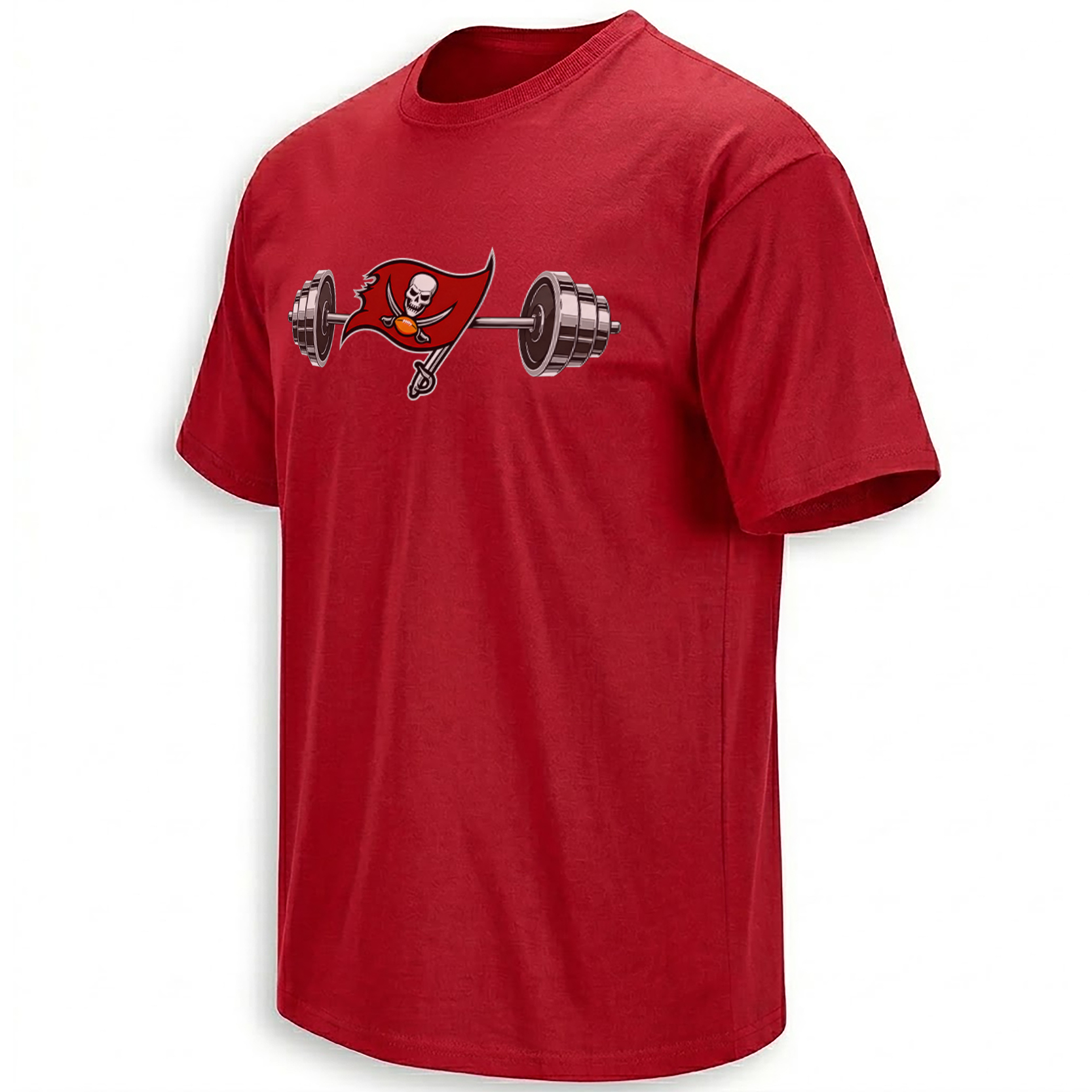
Dark pewter creates the metal foundation, Buccaneers red provides the violent accent and small touches of orange add heat without turning the page into a pirate-cartoon theme. The goal is a football strength room shaped by Tampa, not generic gym merchandise.
The red-and-pewter version should feel hot, not polished
The Barbell series works because the same central object can carry different environmental meanings. Dallas reads cleaner in navy and silver. Kansas City can feel like a red-and-gold athletic program. Las Vegas belongs in black steel.
Tampa Bay should feel like heated metal. Pewter is already an unusually useful football color because it resembles worn equipment. Pair it with deep red and the graphic begins to feel like a plate that has been dragged through years of strength rooms, practice fields and Florida summers.
That approach also avoids a common trap with Buccaneers visuals: relying too heavily on pirate imagery. The franchise identity remains visible through the colors without forcing skulls, ships and cannons into every section.
Defense gives Barbell culture another direction
Tampa’s 24–16 preseason victory also produced several defensive examples of strength transferring to football. Elijah Roberts created disruption from the defensive line, while pressure helped create mistakes that the secondary could exploit.
The defense’s current camp imagery reinforces the same principle. Kancey, Bain, Nunez-Roches and other front players are repeatedly photographed in direct one-on-one exchanges with offensive linemen.
In those reps, both sides are trying to solve the same physical problem differently. The blocker is attempting to preserve space. The defender is attempting to erase it. Both rely on strength, but strength alone will not decide the rep.
The heat makes conditioning part of the identity
A Tampa Bay training camp has one natural variable that northern franchises cannot reproduce in exactly the same way: the Florida environment. Conditioning is therefore not just an offseason checkbox. It is part of a player’s ability to repeat technically sound movement while heat and humidity accumulate.
That gives the loaded bar another layer of meaning. Resistance training builds capacity, but football asks whether that capacity can be repeated during a long practice when the body has already absorbed hundreds of small stresses.
The Barbell design can therefore be read as a symbol of durability rather than maximum weight. The useful athlete is not the one who can produce force once. It is the player who can reproduce it when the next snap arrives.
The 24–16 win is context, not the entire story
Tampa’s preseason opener was encouraging, particularly for younger players trying to build roster cases. Garnes, Williams and Daniels all found the end zone in different ways.
But tying Buccaneers Barbell entirely to that game would make the design smaller than its central idea. Training culture exists before the Jets game and will continue after it. Full pads, trench work, run-game technique and defensive pressure are the longer story.
That makes the graphic a natural fit inside the wider Tampa Bay Buccaneers collection, where current player and team moments can sit beside a more foundational strength identity.
The broader NFL collection turns the Barbell project into something larger: one simple symbol showing how Buffalo, Detroit, Dallas, Tampa and other football cities interpret strength differently.
Frequently Asked Questions
Why does a barbell fit Tampa Bay Buccaneers football culture?
The barbell represents preparation, conditioning and strength under resistance, while Tampa’s pewter-and-red identity gives the concept a distinct heated-metal visual language.
Why is Buccaneers Barbell timely in August 2026?
Tampa Bay has moved through full-pad training-camp work and opened the preseason with a 24–16 victory over the New York Jets on August 14.
Is Buccaneers Barbell a Graham Barton design?
No. Barton helps illustrate how strength, technique and run-game structure connect, but Buccaneers Barbell represents the broader Tampa Bay football strength identity.
Why is offensive-line versus defensive-line work important to the design?
Those one-on-one trench reps show strength meeting active resistance, making them one of the clearest football translations of the loaded-bar concept.
Does Tampa Bay’s 24–16 preseason win define the Barbell graphic?
No. The victory provides current context, while the design itself is centered on preparation, conditioning, trench strength and the larger football process.
The Buccaneers Barbell graphic turns Tampa’s hidden strength work into a football-culture artifact, while the Buccaneers archive tracks the wider players, slogans and moments shaping the 2026 season.
Buccaneers Barbell Shirt turns Tampa Bay football strength into a red-and-pewter weightlifting graphic, connecting Bucs culture with full-pad 2026 training camp, trench work and the team’s 24–16 preseason-opening win.