
Cody Bellinger’s Two-Run Swing Became A New Yankees All-Star Marker
Seven years after his previous All-Star appearance, Cody Bellinger returned to the Midsummer Classic, drove in the decisive runs of a 4–0 American League victory and left Philadelphia with the Ted Williams All-Star Game MVP Award.
Cody Bellinger needed one swing to give the 2026 MLB All-Star Game its direction. With the bases loaded in the first inning at Citizens Bank Park on July 14, he sent a two-run single into right field, scoring Steven Kwan and Junior Caminero before Philadelphia’s crowd had settled into the night.
Ben Rice followed with another run-scoring single, the American League pitching staff allowed only three hits, and the early lead held through a 4–0 shutout. Bellinger finished 1-for-3, but his two RBIs supplied the decisive separation and earned him the Ted Williams All-Star Game MVP Award.
The scene carried weight beyond one exhibition result. This was Bellinger’s first All-Star Game since 2019, the season in which he won National League MVP. Seven years, multiple teams and several reinventions later, he returned wearing Yankees colors and joined one of the franchise’s shortest, most recognizable honor rolls.
The game lasted nine innings, but its defining offensive image arrived before the first one was finished.
Why the First-Inning Single Carried the Entire Night
All-Star Games are built from fragments. Players enter and leave quickly, pitchers face only a handful of hitters, and the spotlight moves from one superstar to another before any individual can control the full narrative. That structure gives early moments unusual permanence.
Bellinger’s single did not possess the instant theatrical shape of a towering home run, but it changed the game more decisively. Facing Phillies left-hander Cristopher Sánchez in the host ballpark, Bellinger stayed through the pitch and delivered two runs into right field. The swing gave the American League a lead its pitchers never surrendered.
By the eighth inning, Miguel Vargas had added a solo homer, and the AL staff had built a collective pitching performance featuring 15 strikeouts. Yet the MVP decision still returned to that opening at-bat. In a game defined by abbreviated appearances, Bellinger had created the central result.
“MVBelli” Compresses a Career Arc Into One Word
“MVBelli” works because fans already understand both halves. “Belli” has followed Bellinger across Los Angeles, Chicago and New York, while the inserted “MV” connects the familiar nickname to an award vocabulary that has defined several stages of his career.
He was the 2017 National League Rookie of the Year, the 2018 NL Championship Series MVP and the 2019 NL MVP. The 2026 All-Star honor does not recreate those earlier seasons. It adds another point to a career distinguished by sharp changes in form, location and expectation.
The nickname therefore carries a subtle comeback narrative. It recalls the player Bellinger once appeared certain to become, acknowledges the difficult seasons that complicated that path and records the fact that he returned to a national stage as the most consequential hitter of the night.
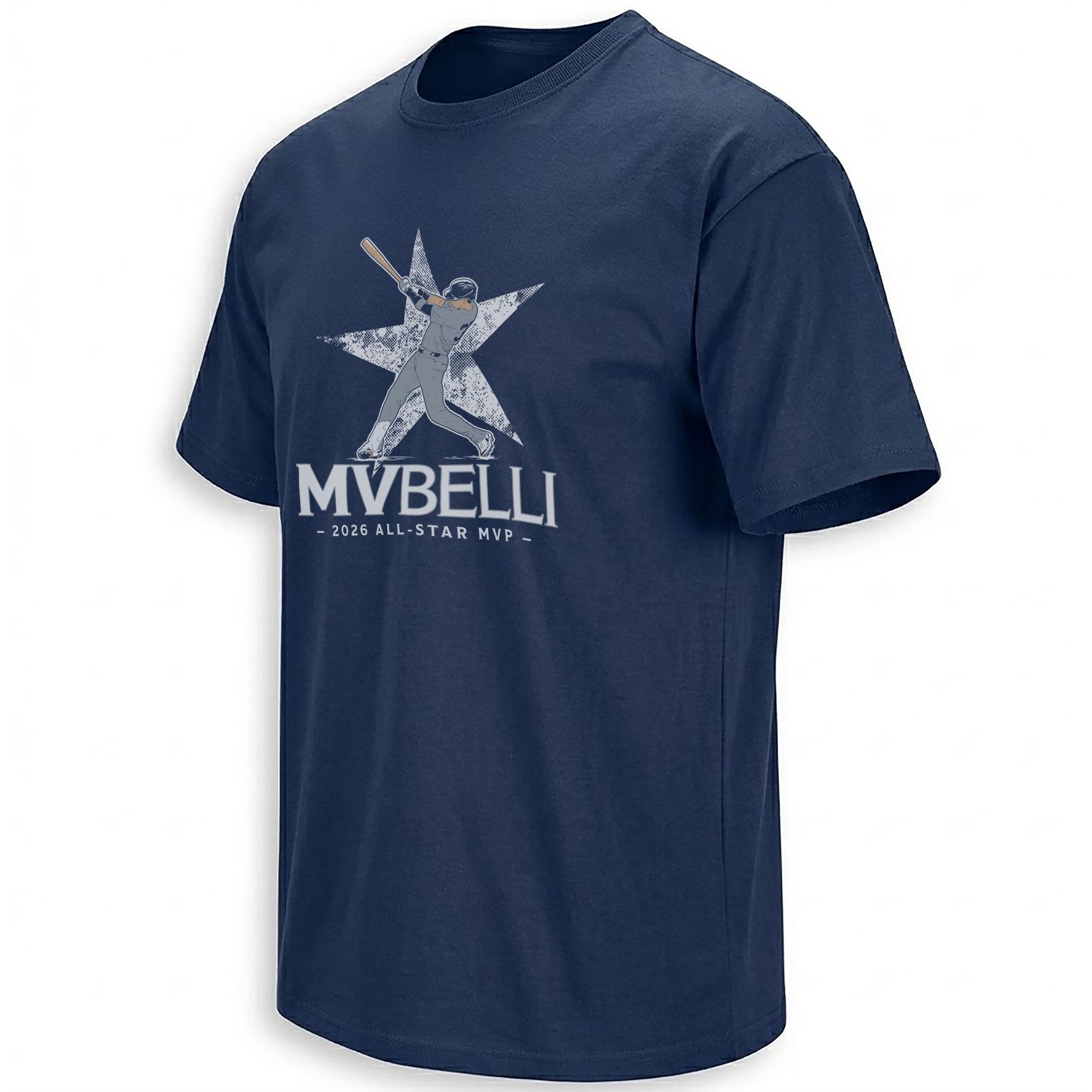
The Artwork Chooses Ceremony Over Noise
The design uses a narrow palette of navy, silver, white and muted bat wood. That restraint fits the subject. Rather than recreating a crowded scoreboard or filling the composition with statistics, it isolates the three elements needed to preserve the moment: the star, the swing and the new nickname.
The batter is shown at the end of his follow-through, allowing the body position to communicate completion. The ball has already left the bat; the event has already happened. Behind him, the distressed five-point star functions both as a direct All-Star symbol and as a faded archival field.
“MVBelli” appears in a broad serif face associated with newspaper headlines, championship programs and institutional sports lettering. The smaller “2026 All-Star MVP” line settles the interpretation without competing with the central wordmark.
Bellinger’s game-used bat was sent to the National Baseball Hall of Fame after the game. That decision gives the design an unusually literal archival connection: the swing already has an official physical object preserved in Cooperstown.
Four Yankees Across Twenty-Six Years
Bellinger became the fourth Yankees player to win All-Star Game MVP since the award was introduced in 1962. Derek Jeter won it in 2000, Mariano Rivera followed in 2013 and Giancarlo Stanton earned the honor in 2022.
The names reveal how rare the achievement is even inside a franchise saturated with baseball history. Jeter represented the dynasty-era position-player ideal. Rivera received the award during his farewell season. Stanton produced his own memorable All-Star power display. Bellinger entered the group through a two-run single during his third All-Star selection and first as a Yankee.
His postgame reaction showed an awareness of that uniform’s historical pressure. Bellinger described feeling proud to wear it and acknowledged what comes with representing New York. That language matters because Yankees culture constantly places present performances beside earlier ones. One award can immediately become a conversation across decades.
A Family Scene Changed the Tone of the Award
After the formal presentation, the celebration became less institutional. Bellinger’s wife, Chase, and their two daughters joined him, turning the MVP ceremony into a family image. During the postgame media appearance, his children sat beside him as he tried to explain a night they might only partially remember.
That contrast gave the moment emotional range. The award connected Bellinger to Yankees history, while the family scene returned it to personal time: a father completing a seven-year journey back to the All-Star Game with his children present for the ending.
It also strengthened the sense that this was not simply an extension of 2019. Bellinger returned older, carrying a different career story and representing a different league. The familiar swing remained, but nearly everything surrounding it had changed.
How One Night Enters the Yankees Visual Archive
Yankees fandom is built around constant historical comparison, yet the most useful graphics do not attempt to reproduce the entire franchise timeline. They isolate a current image clearly enough that it can hold its own place within that larger archive.
The MVBelli design does this through economy. It records the player, the award and the year while letting the star and follow-through carry the emotion. It feels tied specifically to Philadelphia on July 14, 2026, but its visual language resembles an object that could have been printed for an older All-Star exhibition.
Bellinger’s award now joins the player moments documented inside the New York Yankees collection, where individual performances become a running visual record of the club’s present era. The broader MLB collection places that moment inside baseball’s wider culture of All-Star identities, milestone graphics and game-used memory.
Why This Moment Will Remain Searchable After July
All-Star MVP searches often begin with a simple question—who won?—but the answer becomes memorable through context. In Bellinger’s case, the relevant details connect cleanly: a two-run first-inning single, an American League shutout, a seven-year absence from the event and a place beside three earlier Yankees winners.
“MVBelli” packages those details into fan language. It does not replace the box score. It gives the box score a name, a shape and a visual cue that can travel through Yankees spaces long after the regular season resumes.
Frequently Asked Questions
Who won the 2026 MLB All-Star Game MVP Award?
Cody Bellinger of the New York Yankees won the Ted Williams All-Star Game MVP Award after driving in two runs during the American League’s 4–0 victory.
What did Cody Bellinger do in the 2026 All-Star Game?
Bellinger went 1-for-3 and delivered a two-run single in the first inning, producing the decisive runs in the American League’s shutout win.
How many Yankees have won All-Star Game MVP?
Bellinger became the fourth Yankees winner, joining Derek Jeter in 2000, Mariano Rivera in 2013 and Giancarlo Stanton in 2022.
What does “MVBelli” mean?
“MVBelli” combines Bellinger’s familiar “Belli” nickname with MVP, creating fan shorthand for his 2026 All-Star Game award and decisive performance.
Why was Bellinger’s bat sent to the Baseball Hall of Fame?
The bat was used during his 2026 All-Star MVP performance, including the two-run single that helped decide the game, making it a physical artifact from the event.
The MVBelli graphic preserves that Philadelphia moment through the star, the follow-through and the new MVP nickname, while the Yankees visual archive follows the wider performances shaping New York’s 2026 season.
MVBelli Shirt captures Cody Bellinger’s two-run swing, 2026 All-Star MVP award and entry into rare Yankees history through a distressed star and commemorative navy-and-silver design.