Svech, Hallsy, Jarvy and the Champs: How Carolina’s Nicknames Became a Championship Roster
Carolina’s 2026 Stanley Cup will be remembered through official names, statistics and the Cup lift. Inside fan culture, however, the team also lives through a more intimate roll call: Svech, Hallsy, Jarvy, Ghost, Fly, Fishy, Stank and Staal.
When the Carolina Hurricanes completed their 16–3 postseason with a 3–0 Game 6 victory in Las Vegas, the official record identified the players through surnames, goals and assists. Fans carried a different vocabulary into the celebration—shortened names, locker-room-style references and familiar labels that made the championship team feel personal.
Svech. Hallsy. Jarvy. Ghost. Fly. Fishy. Stank. Staal. Read in sequence, the names sound less like a formal roster and more like a group being called across a dressing room, bench or crowded Raleigh bar.
That informality is the point. Championships eventually become official history, but supporters do not experience them as official documents. They experience them through repeated names, private jokes, player personalities, broadcast shorthand and the words used in everyday conversations throughout the run.
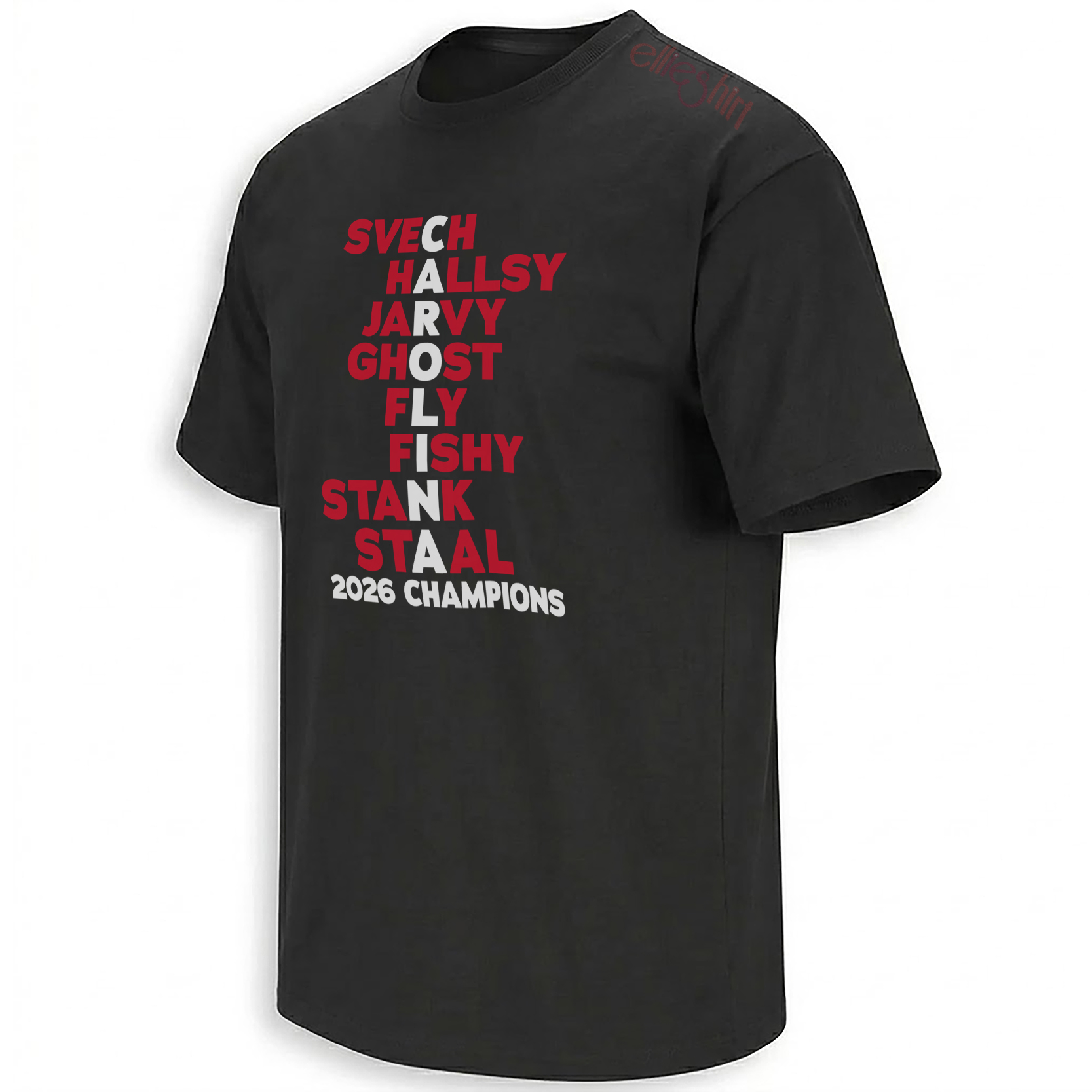
The two nickname designs preserve that layer of the championship. One hides “CAROLINA” inside the names through contrasting white letters. The other connects the players with ampersands, turning separate nicknames into one continuous team sentence.
Official rosters document who played. Nicknames preserve how a championship team sounded inside its own fan culture.
The Stanley Cup Turned Familiar Names Into Permanent Language
Every long playoff run creates a vocabulary. By the time a team reaches the Final, supporters have repeated certain names hundreds of times—in celebration, frustration, prediction and relief.
Andrei Svechnikov becomes Svech because the shorter form carries speed and familiarity. Taylor Hall becomes Hallsy in the traditional language of a hockey room. Seth Jarvis becomes Jarvy, a name matching the youthful personality fans already associate with him.
Shayne Gostisbehere naturally becomes Ghost. Nikolaj Ehlers appears as Fly, a shorthand that also fits the speed central to his game. Sebastian Aho has long been associated with Fishy, while Logan Stankoven becomes Stank. Jordan Staal needs no alteration; his surname already lands with the blunt force of a captain’s name.
These labels should be understood as fan-facing shorthand rather than a formal statement that every player uses one fixed official nickname. Their cultural value comes from recognition. A Hurricanes supporter can read the list quickly and reconstruct the players behind it.
The First Design Hides Carolina Inside the Players
The black-shirt composition initially reads like a stacked nickname roster. Each line is compact, uppercase and heavy, with the red lettering creating a direct connection to the Hurricanes’ visual identity.
The deeper idea appears through the contrasting white letters. Read vertically, those selected characters spell “CAROLINA.” The state and team identity are not placed outside the roster as a separate headline. They are constructed from within the players’ names.
That visual device gives the design a meaning larger than simple wordplay. Carolina exists because of the group. Remove the names, and the hidden state disappears. Remove the collective, and the championship identity cannot be completed.
The composition therefore mirrors how the Hurricanes won. The title did not come from a single isolated star. It came through interconnected contributions: top-line skill, veteran scoring, defensive structure, depth pressure and a goaltending change that became one of the Final’s defining stories.
The hidden “CAROLINA” turns the roster into an identity puzzle. The team name is not merely printed beneath the players; it is assembled from them, reinforcing the idea that the championship belonged to the complete group.
The Second Design Turns the Roster Into One Sentence
The red-shirt version changes the rhythm. Instead of using block capitals and hidden letters, it presents the names as a flowing sequence joined by ampersands: Svech & Hallsy & Stank & Jarvy & Staal & Fly & Fishy.
The ampersand is doing more than separating names. It refuses to allow the list to end until every featured player has been connected. No comma creates distance. No ranking places one nickname above the rest. The repeated symbol keeps adding another person to the same championship sentence.
“2026 Champs” then arrives as the conclusion beneath the list. The title is not presented first and justified afterward. The players come first; the championship is the outcome of their connection.
This version feels less like a formal team poster and more like a typographic locker-room roll call. Its narrow black lettering against the red garment gives the piece the simplicity of a tour shirt, concert lineup or culture graphic built around names fans already recognize.
Selected letters spell the state name vertically, making the championship identity emerge directly from the players.
See the hidden-word graphic →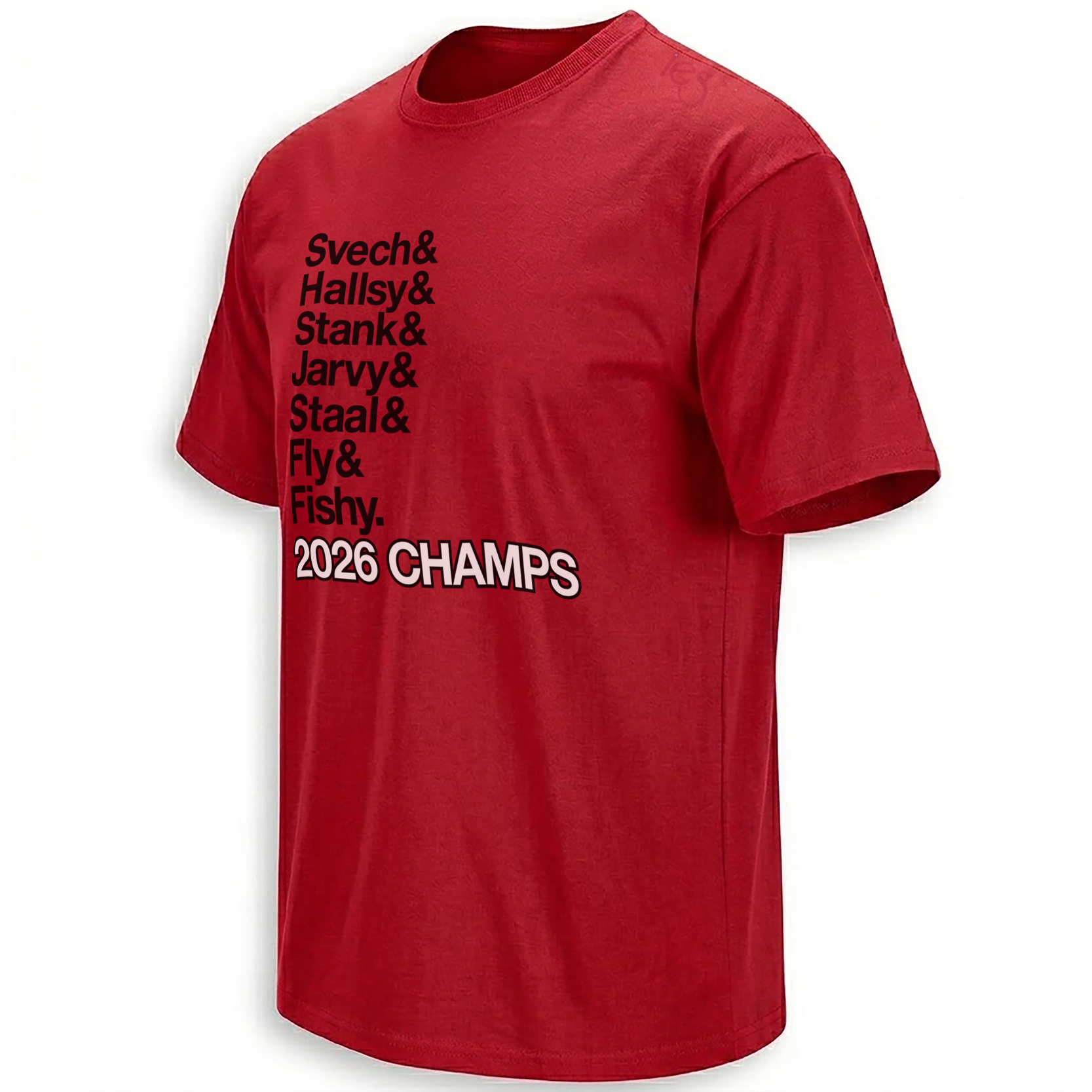
Repeated ampersands connect Svech, Hallsy, Stank, Jarvy, Staal, Fly and Fishy as one continuous championship unit.
Explore the nickname sequence →Svech Represents the Force at the Front of the Group
Svechnikov’s nickname opens both designs with the kind of recognition normally reserved for a player deeply established in the culture of a team.
“Svech” is immediate. It carries the physical directness of his game and the expectation that he can change a shift through power, speed or an individual scoring play.
His place near the top of the roster also reflects the way fans read Carolina’s offensive identity. Svechnikov is one of the players opponents must account for before the game begins, but the championship run showed that planning for one threat was never enough.
The nickname does not attempt to summarize his statistics. It retrieves the player through personality and familiarity—the way supporters refer to him when no formal introduction is required.
Hallsy Turned a Long Career Into a First Cup
Taylor Hall’s championship carried one of the clearest career narratives on the roster. After playing for multiple teams and spending years as one of the league’s most recognizable forwards, he reached the Cup for the first time with Carolina.
His goal in Game 6 opened the scoring and gave the Hurricanes the first structural advantage in the championship-clinching night. It also gave “Hallsy” a permanent place inside Carolina’s Cup memory.
That is one of the strengths of nickname rosters. They flatten differences in résumé and age into one shared moment. A former first-overall pick and a younger player establishing himself can appear in the same visual sequence because the championship has joined their stories.
Hall’s career arrived in Carolina through many turns. The nickname makes the ending feel personal rather than administrative.
Jarvy Carries the Energy of the New Generation
Seth Jarvis occupies a different emotional position. While Staal and Hall bring veteran history, Jarvis represents the current and future face of Carolina’s core.
“Jarvy” matches the personality fans see around him—energetic, accessible and naturally suited to the less formal language of a nickname piece.
His presence inside the design also shows how the championship connected generations. The Hurricanes did not win only through players who had carried years of disappointment. They won through younger pieces capable of extending the identity of the team beyond the immediate Cup run.
A championship roster therefore becomes both an ending and a beginning. It closes the twenty-year wait while establishing the names younger supporters may associate with Carolina hockey for years afterward.
Ghost, Fly and Fishy Give the List Its Fan-Culture Texture
Ghost, Fly and Fishy are the names that make the design feel especially internet-native. They move beyond shortened surnames into labels that operate through association.
“Ghost” is instantly recognizable for Gostisbehere and carries the visual quality of a name that already feels designed for apparel. “Fly” reads as a speed reference around Ehlers, even when treated primarily as fan shorthand. “Fishy” has long provided a playful way for supporters to refer to Aho.
Together, the three names prevent the roster from feeling too official. They introduce the humor and affection through which fans transform professional athletes into familiar characters within a shared season.
This is not the language of a media guide. It is the language that appears in captions, group chats and arena conversations when everyone already knows who is being discussed.
A compact, forceful shorthand for one of Carolina’s defining offensive and physical presences.
Traditional hockey-room language attached to a veteran whose Game 6 goal opened the clinching victory.
A youthful nickname that reflects the personality and future-facing energy of Carolina’s core.
Fan-facing identities that bring humor, recognition and internet-era familiarity into the championship roster.
A clipped form of Stankoven that fits the blunt rhythm of hockey nickname culture and the design’s compact typography.
The captain needs no transformed identity; his surname already carries the authority of the Conn Smythe run.
Stank Adds the Breakout Energy Every Cup Team Needs
Logan Stankoven’s shortened name works naturally inside the graphic because it sounds built for a hockey room: quick, blunt and immediately repeatable.
His role in the lineup gave Carolina another layer of pace and pressure. Championship teams often need a player whose energy changes the speed of a shift before the score sheet fully explains the effect.
“Stank” carries that breakout feeling. The nickname roster does not separate him into a secondary tier beneath the established stars. It places him inside the same sequence because the Cup removed the distinction between headline contribution and supporting contribution.
Every featured name now belongs to the same answer when fans ask who defined the 2026 team.
Staal Ends the List With the Weight of a Captain
Jordan Staal’s name is the only one in the first design that does not need a playful transformation. That difference gives the final line additional authority.
Staal scored in each of the first five games of the Stanley Cup Final, finished the series with six goals and received the Conn Smythe Trophy. At 37, his performance turned a veteran leadership story into the central competitive narrative of the championship.
Ending the list with Staal creates the feeling of a captain completing the roll call. The younger personalities, veteran additions and fan-favorite shorthand all lead toward the player who lifted the Cup first.
The typography does not need to place a captain’s “C” beside his name. The postseason context supplies it.
The Nicknames Show Why This Was Never a One-Star Championship
Carolina’s 16–3 record came from a team capable of producing different answers throughout the postseason. One game could be defined by the top line. Another could turn through Staal’s net-front work, Hall’s scoring, Ehlers’ speed, Gostisbehere’s puck movement or Stankoven’s pressure.
Brandon Bussi became the Final’s most unexpected figure, winning his three starts and completing the title with a 22-save shutout. Jackson Blake added a goal and an assist in Game 6. The defense protected dangerous areas while the forwards maintained Carolina’s forechecking identity.
A nickname design cannot include every tactical role or every member of the full roster. It should therefore be read as a fan-facing character map rather than an official complete team list.
Its purpose is cultural. It gathers several of the most recognizable personalities into one visual rhythm and uses them to represent the larger collective.
Why “CAROLINA” Emerging From the Names Matters
The hidden-letter concept is especially effective because Carolina is both a team identity and a regional identity. The Hurricanes represent Raleigh, but the championship celebration extends across the Triangle and the wider Carolinas.
Building the word from player names suggests that the region’s current hockey identity was created through the roster. Each featured player contributes one necessary letter. No single nickname contains the full meaning.
It also reverses the normal relationship between team and player. Usually, the franchise name appears first and athletes are listed beneath it. Here, the players reveal the franchise from inside the design.
That makes the word puzzle more than a decorative trick. It is the central editorial idea of the piece: Carolina became champion because separate personalities aligned into one readable whole.
The Ampersand Version Feels Like a Championship Credits Sequence
The second graphic has a different cultural reference. Its repeated ampersands resemble the way names appear in music lineups, fashion graphics or the closing credits of a collaborative project.
Each name is followed by another. The design resists the idea of a final solo star until the championship line appears at the bottom.
That structure fits a team sport particularly well. A player can score the goal, but the sequence began earlier—with a zone exit, defensive read, forecheck, screen or save.
The ampersand becomes a symbol of dependency. Svech and Hallsy and Stank and Jarvy and Staal and Fly and Fishy. The title belongs after the chain because the chain is what produced it.
Raleigh Now Has a New Set of Names to Pass Down
For twenty years, Carolina championship memory centered on the 2006 team. Those players became surnames repeated through anniversary features, old highlights and stories shared with younger supporters.
The 2026 championship created a second generation of language. Younger fans now have their own captain, their own unexpected goaltending hero and their own collection of familiar names attached to the Cup.
Nicknames make that inheritance feel even more personal. They sound like the language of people who watched the season closely rather than the formal terminology of a historical archive.
The wider Carolina Hurricanes collection follows that new championship vocabulary through player moments, roster graphics, Raleigh rituals and the slogans that emerged during the Cup run.
The broader NHL Shirts collection places the nickname pieces inside hockey’s larger tradition of turning locker-room shorthand, playoff heroes and team chemistry into fan-facing visual culture.
Why Nickname Graphics Often Age Better Than Formal Rosters
A formal roster preserves accuracy. A nickname roster preserves intimacy.
As years pass, statistics remain available in databases and official records. What becomes harder to recover is the everyday feeling surrounding a team—the names supporters used casually, the personality attached to each player and the language that made the roster feel close.
These designs record that atmosphere. The hidden Carolina version preserves the collective identity. The ampersand version preserves the sense of connection.
Trades and retirements will eventually separate the players. Their nicknames will continue to occupy the same visual sequence, fixed at the moment they became 2026 champions together.
Frequently Asked Questions
What names appear in the Carolina Hurricanes nickname roster designs?
The graphics feature fan-facing shorthand including Svech, Hallsy, Jarvy, Ghost, Fly, Fishy, Stank and Staal, with the exact selection and order varying between the two designs.
What word is hidden inside the first nickname roster?
Selected white letters inside the stacked player names spell “CAROLINA,” making the team and regional identity emerge directly from the roster.
What do the ampersands mean in the second design?
The repeated ampersands connect the nicknames into one continuous championship sentence, emphasizing that the title came through linked contributions rather than one isolated player.
Are these intended as official player nicknames?
The designs use recognizable fan-facing and hockey-style shorthand. They function as cultural references rather than a claim that every player has one formally designated official nickname.
When did Carolina win the 2026 Stanley Cup?
The Hurricanes clinched the championship on June 14, 2026, with a 3–0 Game 6 victory over the Vegas Golden Knights, completing a 4–2 series win.
What was Carolina’s postseason record?
Carolina completed the 2026 Stanley Cup Playoffs with a 16–3 record, losing only three games across all four rounds.
Why is Jordan Staal’s name important in the design?
Staal was Carolina’s captain and Conn Smythe Trophy winner, scoring six goals in the Final and giving the championship roster its emotional center.
The hidden Carolina nickname roster and ampersand 2026 Champs design turn Carolina’s championship personalities into two different visual archives, while the wider Hurricanes collection follows the players, rituals and fan language behind Raleigh’s second Stanley Cup.
Carolina Hurricanes nickname roster designs bring Svech, Hallsy, Jarvy, Ghost, Fly, Fishy, Stank and Staal together through hidden CAROLINA lettering and an ampersand-style 2026 championship roll call.