Canada Looks Toward Europe: Why Carney, Trump and the EU Suddenly Fit the Distracted Boyfriend Meme
Mark Carney’s European trip, Ursula von der Leyen’s unprecedented “associate member” idea and Donald Trump’s angry response created an unusually meme-ready diplomatic triangle — but the real story is more complicated than Canada simply breaking up with America.
Political memes work fastest when months of policy can be compressed into one glance. By September 17, Canada’s increasingly tense relationship with Washington and its accelerating courtship of Europe had produced exactly that kind of image: Mark Carney turning toward the European Union while Donald Trump looks on from the relationship Canada already has.
The trigger came in Strasbourg. During her September 16 State of the European Union address, European Commission President Ursula von der Leyen floated the possibility of Canada becoming the EU’s first “associate member” — a category that does not currently exist in formal EU law.
Carney welcomed the ambition the next day while addressing the European Parliament. He proposed deeper Canada–EU cooperation in defence, critical minerals, energy, artificial intelligence, digital trade, payments, research and youth mobility. Trump responded from the United States by warning that, depending on the intent, he could view the move as hostile and answer with heavy tariffs on Europe.
The joke says Canada dumped America for Europe. The real story is Canada discovering that having more than one major partner can itself be a form of leverage.
The Meme Became Possible Because the Politics Already Looked Like a Triangle
The classic Distracted Boyfriend format is built for situations where one relationship suddenly has competition. One figure represents the decision-maker, another represents the established commitment, and a third represents the newly attractive alternative.
In this version, Canada is the decision-maker through Carney. Europe becomes the new option. Trump personifies a U.S. relationship that remains enormously important but has become more confrontational through tariffs, procurement disputes and repeated arguments over trade.
Carney and Europe Really Are Moving Closer
The visual joke would fall flat without a genuine shift underneath it. Canada and the EU already have CETA, a major trade agreement, and in 2025 they added a Strategic Partnership of the Future and a Security and Defence Partnership.
In February 2026, Canada became the first non-European country to join the EU’s Security Action for Europe, or SAFE, defence initiative. Carney has also pushed cooperation on critical minerals, energy, artificial intelligence and research while arguing that Canada needs greater strategic autonomy.
His September speech made the logic explicit: diversification gives countries leverage. Canada does not need complete economic separation from the United States to reduce the risks of excessive dependence on it.
.jpg)
Trump’s Reaction Supplied the Meme With Its Third Character
Trump’s response transformed a technical conversation about alliances into something much easier for internet culture to process. He called the possibility of Canada joining the EU in some associate form “laughable,” said Canada had been a poor trade partner and warned Europe that a move he viewed as hostile could trigger serious tariffs.
Carney responded by emphasizing Canadian sovereignty. He argued that other countries cannot dictate whom Canada is allowed to make international agreements with. European officials similarly said the proposed relationship was intended to strengthen Canada and Europe rather than target the United States.
That disagreement supplies the emotional grammar of the design: Carney looks elsewhere, Europe becomes visually inviting, and Trump becomes the visibly annoyed third party.
But “Canada Chooses Europe” Is Deliberate Meme Exaggeration
This is where the graphic works best as satire rather than literal reporting. Canada is not becoming a full EU member. It is not leaving North America. The United States remains Canada’s largest trading partner by an enormous margin, and geography alone makes the bilateral relationship impossible to replace.
Even the proposed “associate member” concept is unfinished. EU diplomats have questioned what the phrase actually means, some governments want different terminology, and any substantial institutional arrangement would still require negotiations and political approval.
The meme says “Canada chooses Europe.” The policy says “Canada wants more options.” That gap is exactly where the humor lives.
Why the Distracted Boyfriend Format Is So Effective Here
Distracted Boyfriend became one of the internet’s defining object-labeling memes because viewers understand the narrative before reading every label. Its entire visual grammar is about shifting attention, temptation and neglected relationships.
Political satire benefits from that efficiency. The Canada–U.S.–Europe relationship involves tariffs, supply chains, defence procurement, CETA, critical minerals and diplomatic sovereignty. The meme turns all of that into three faces and one sideways glance.
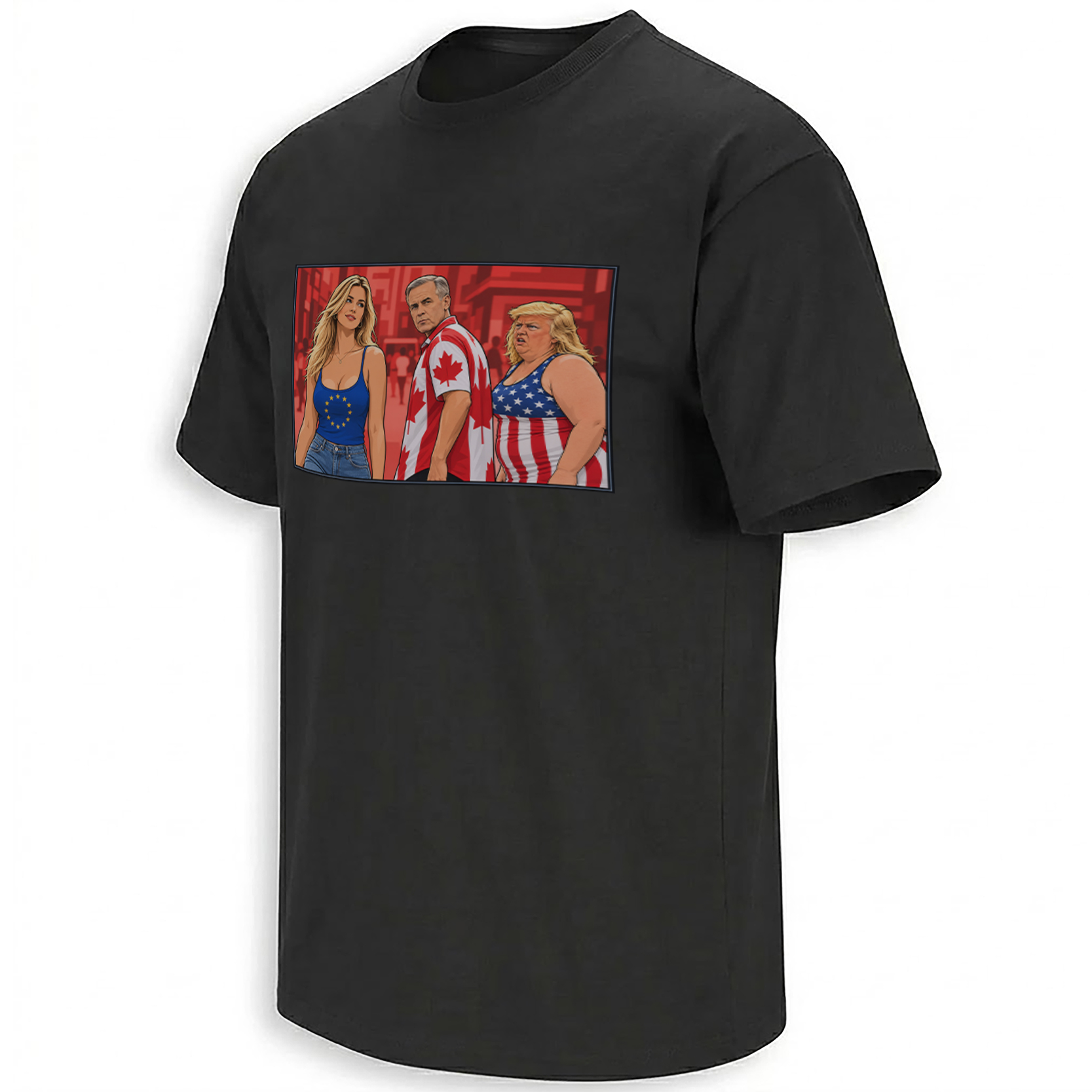
The design turns September 2026 diplomacy into relationship comedy: Carney represents a Canada looking toward Europe while Trump’s reaction supplies the jealous-partner energy that makes the meme instantly readable.
View the satire piece →The Joke Arrived at an Almost Perfect Political Moment
Timing is what separates a reusable meme template from a cultural artifact. In another year, replacing the Distracted Boyfriend characters with Carney, Europe and Trump might feel arbitrary. In September 2026, every role has current context.
Canada is openly diversifying. Europe is openly inviting deeper integration. Trump is openly objecting. None of those facts require the meme to invent the conflict — it only exaggerates the emotional relationships between them.
Because the design centers specific political figures, related Ellie Shirt pieces can also be explored through the Mark Carney search and Donald Trump search. The wider Anti-Trump collection gathers additional political satire responding to Trump-era headlines and internet discourse.
Frequently Asked Questions
Is Canada actually joining the European Union?
No full EU membership has been proposed. European Commission President Ursula von der Leyen floated a new form of “associate membership,” but that category is not currently defined in EU treaties and the details remain under negotiation.
Why is Mark Carney pushing closer ties with Europe?
Carney argues that Canada should diversify its major partnerships and deepen cooperation with Europe in trade, defence, critical minerals, energy, artificial intelligence, research and strategic infrastructure.
How did Donald Trump react?
Trump criticized the proposed Canada–EU arrangement, called the idea of Canada joining the EU laughable and warned that he could impose heavy tariffs on Europe if he viewed the move as hostile.
Why does the Distracted Boyfriend meme fit this story?
The format depicts one party turning toward an attractive alternative while an existing partner reacts negatively, making it an efficient satire of Canada exploring deeper European ties during tensions with Washington.
Does “Canada Chooses Europe” literally describe Canadian policy?
No. It is satirical shorthand. Canada is seeking greater diversification and strategic autonomy, not ending its relationship with the United States or replacing it completely with Europe.
The Canada Chooses Europe graphic preserves the exact September 2026 moment when a complicated transatlantic realignment became simple enough to understand through one of the internet’s most recognizable meme formats.
Canada Chooses Europe Shirt turns Mark Carney’s push for deeper EU ties and Donald Trump’s angry response into Distracted Boyfriend political satire, capturing the September 2026 debate over Canada’s strategic turn toward Europe.