
Talk Sh*t. Get Hit. Brock Lesnar’s Entire WWE Aura in Four Words
As Brock Lesnar and Oba Femi move toward a Hell in a Cell collision, the stripped-down black tank seen on Raw operates like a warning label rather than conventional wrestling merchandise.
Brock Lesnar returned to Monday Night Raw in Dallas on July 13 without needing an elaborate new slogan. The confrontation with Oba Femi already had fake police officers, restraining orders, Paul Heyman manipulation and the promise of a Hell in a Cell match. His clothing reduced all of that theatrical conflict to four blunt words.
“Talk Sh*t Get Hit” functions because Lesnar has spent most of his WWE career making language feel secondary. Paul Heyman explains the threat. Opponents describe the stakes. Lesnar’s character enters the frame as the physical consequence waiting after those words end.
That dynamic became especially visible in the current story with Femi. WWE is presenting the younger powerhouse as someone unwilling to accept intimidation, while Lesnar remains the established measuring stick for destructive legitimacy. The shirt sits between those identities like a warning neither man intends to obey.
Paul Heyman supplies the paragraphs. Brock Lesnar’s shirt supplies the ending.
Why the Raw Segment Needed Fake Authority
The Dallas segment used an intentionally strange form of protection. Heyman surrounded Lesnar with men presented as police officers and claimed restraining orders were required to keep Oba Femi away from his client.
The twist later revealed the authority display as another Heyman construction. The officers and paperwork were part of a psychological strategy rather than legitimate protection, allowing the story to frame Lesnar’s side as both dangerous and manipulative.
That detail matters because Lesnar rarely needs protection in the ordinary sense. The visual of barriers, uniforms and legal language made Femi’s pursuit feel larger while raising a provocative question: was Heyman protecting Brock from Oba, or protecting his investment from an unpredictable fight?
Four Words That Fit Lesnar Better Than a Catchphrase
Traditional wrestling catchphrases are designed for repetition. Crowds complete them, commentators quote them and performers use them to control the rhythm of a promo. Lesnar has rarely depended on that relationship.
His presence is built around interruption. An entrance changes the atmosphere. A suplex breaks the normal pacing of a match. An F-5 ends whatever argument was taking place before he arrived.
“Talk Sh*t Get Hit” matches that structure. The first half acknowledges wrestling’s verbal culture. The second half dismisses it. It reads like a complete Brock Lesnar segment reduced to one sentence.
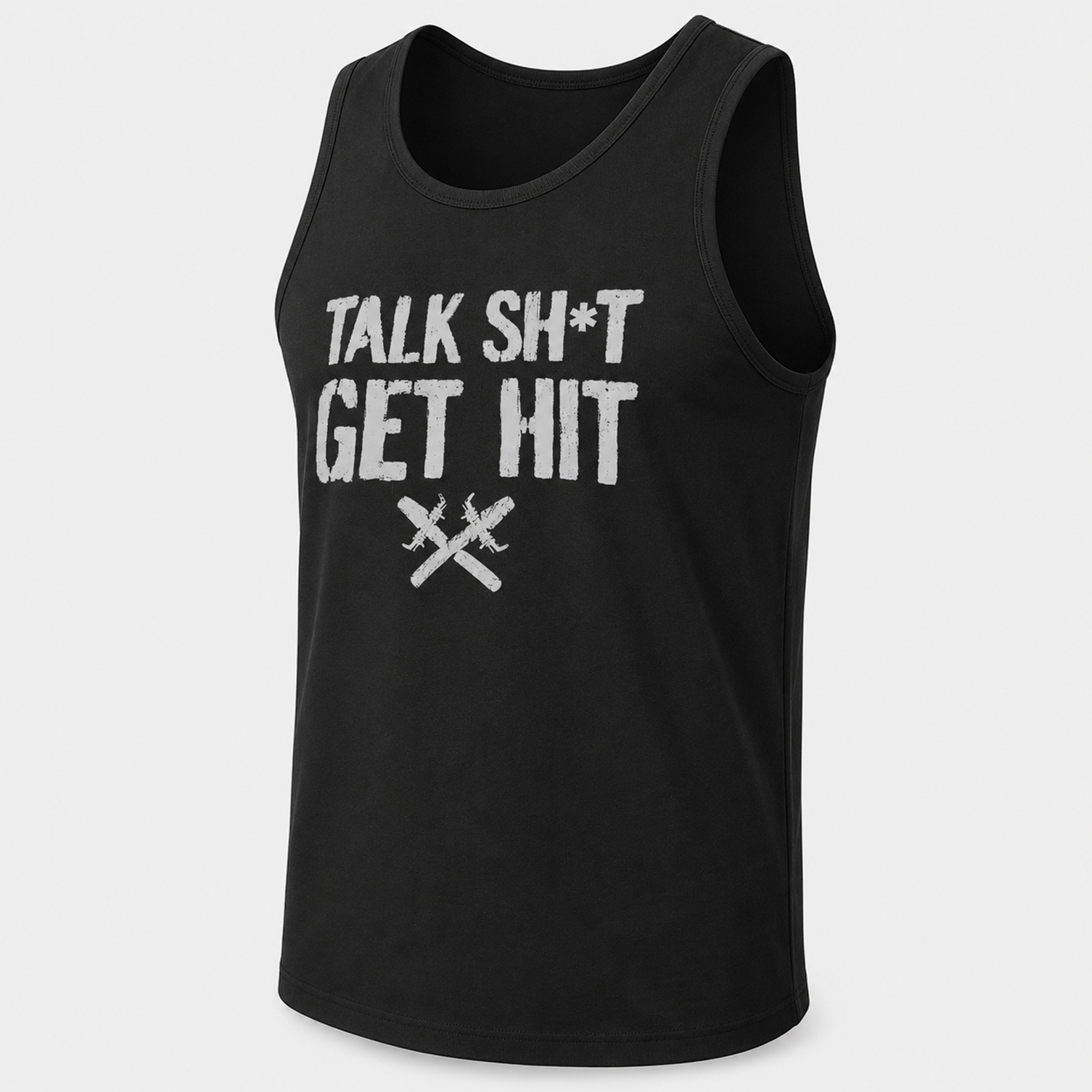
The typography is distressed rather than clean, the white ink behaves like stencil paint, and the crossed emblem beneath it creates a hard military or fight-camp finish. Nothing in the composition asks to be read as playful.
Why the Tank Version Carries More Meaning
The sleeveless black top is closely connected to Lesnar’s visual history. It exposes the scale of his shoulders and arms while keeping the clothing itself utilitarian. The garment does not compete with the body wearing it.
That makes the tank especially effective for this design. The phrase reads like equipment labeling rather than fashion. It belongs to the training-room, combat-sports side of Lesnar’s image and recalls the stripped-down tops he has worn during some of his most physical WWE appearances.
The standard tee version changes the silhouette without changing the message. It carries the same distressed front graphic in a more familiar form while preserving the black-and-white severity of the original look.
The closest visual connection to Lesnar’s stripped-down Raw presence and combat-sports silhouette.
View the tank layout →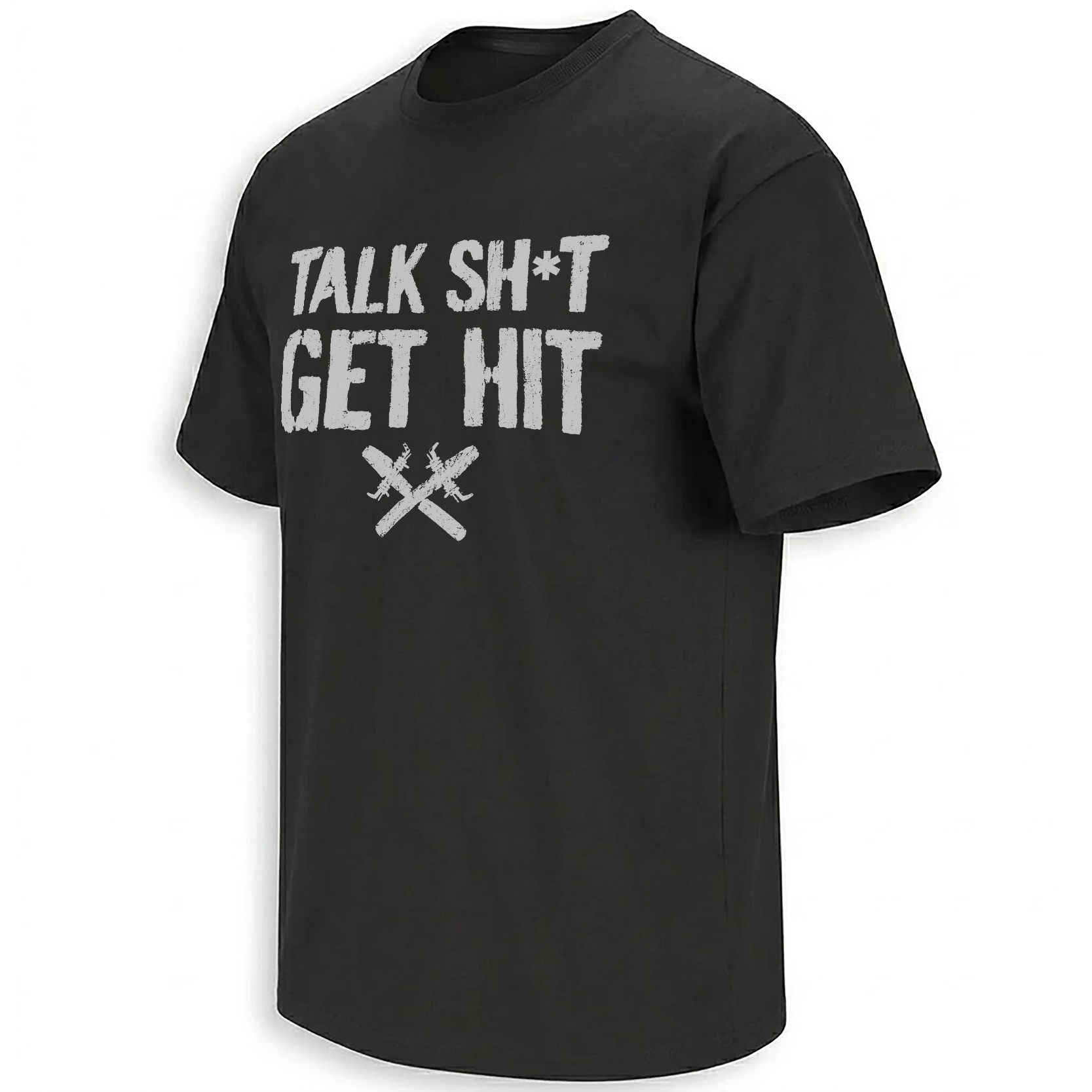
The same confrontational graphic translated into a classic black wrestling tee format.
View the shirt layout →Oba Femi Changes the Meaning of the Message
The phrase would work as general Lesnar language in almost any era, but the current rivalry gives it a more specific tension. Oba Femi is not being positioned as someone who failed to understand the warning. He is being positioned as someone who understands it and walks forward anyway.
That distinction gives the story its scale. WWE has repeatedly used Lesnar as the point where confidence becomes physical evidence. An opponent can speak like a future champion, but standing across from Lesnar turns that confidence into a test.
Femi’s refusal to retreat converts the shirt from a simple threat into the argument driving the rivalry: what happens when the person being warned believes he can deliver the same consequence?
Hell in a Cell Removes the Escape Route
The cell is an especially appropriate destination for this story because the Raw segment was built around distance, barriers and supposed legal protection. A restraining order attempts to keep two people apart. Hell in a Cell is designed to lock them together.
That reversal gives the match stipulation narrative clarity. Heyman’s elaborate attempt to control access becomes temporary. Once the door closes, neither paperwork nor staged authority can manage the physical conflict.
In that environment, “Talk Sh*t Get Hit” stops reading like general attitude and begins to feel like the stipulation’s unofficial operating rule.
How Wrestling Shirts Become Character Evidence
Wrestling clothing often works as a compressed promo. A logo, phrase or symbol can establish alignment, mood and threat level before a microphone is raised.
This design is unusually direct because it avoids imagery of Lesnar himself. There is no portrait, championship belt or detailed event composition. The wearer occupies the missing space, allowing the sentence to behave as character evidence rather than illustration.
The Talk Sh*t Get Hit design preserves that Raw visual in both tank and tee form. The broader WWE collection places it beside other phrases, rivalries and superstar graphics that document how wrestling stories move from televised moments into fan language.
Frequently Asked Questions
Why is “Talk Sh*t Get Hit” associated with Brock Lesnar?
The phrase matches Lesnar’s WWE character, which is built around minimal talking, physical intimidation and the idea that confrontation quickly becomes consequence.
What happened between Brock Lesnar and Oba Femi on Raw?
Their rivalry escalated during the July 13, 2026 episode in Dallas through a segment involving Paul Heyman, staged police protection and fake restraining orders designed to keep Femi away from Lesnar.
Why does the design use distressed white lettering?
The distressed treatment gives the wording a fight-camp, stencil-painted quality that fits Lesnar’s rough and utilitarian visual identity.
What does the crossed emblem beneath the words represent?
The crossed combat-style shapes reinforce the confrontational tone and give the otherwise minimal text design a compact finishing symbol.
Why does the phrase fit the Hell in a Cell rivalry?
The storyline has centered on threats, distance and attempts to keep Lesnar and Femi apart. Hell in a Cell removes those barriers and turns the shirt’s warning into the basic logic of the match.
The Talk Sh*t Get Hit tank and tee preserve the stripped-down Raw look, while the wider WWE visual archive follows the catchphrases, conflicts and televised details that become part of wrestling memory.
Talk Sh*t Get Hit Shirt captures Brock Lesnar’s 2026 WWE Raw fight aesthetic through distressed white lettering, a crossed combat emblem and the blunt warning surrounding his escalating rivalry with Oba Femi.