
Brice Turang’s No. 2 Is Becoming Milwaukee’s Everyday Engine
Speed once defined the first version of Brice Turang’s Major League identity. In 2026, harder contact, growing power and his constant movement through Milwaukee’s infield have turned him into something broader: the player who keeps the Brewers’ game in motion.
Brice Turang entered July doing what he has increasingly done for Milwaukee: appearing inside the inning before the crowd has finished deciding what kind of game it is watching. On June 29, he drove his 12th home run of the season to center field to tie Cincinnati in the seventh. Three days later, his double down the left-field line brought Jackson Chourio home and gave the Brewers another late source of pressure.
Those swings belong to a different version of Turang than the one initially introduced to the league. His speed and second-base defense remain central, but they are no longer the complete explanation. His average exit velocity and hard-hit rate in 2026 reflect a player whose contact is beginning to carry more physical authority.
Milwaukee fans have watched that evolution happen without losing the qualities that first made Turang recognizable. He still runs, turns the pivot, covers space and changes the tempo of an inning. The difference is that the same player now has enough power to change the score before the defense can begin moving.
Turang’s value is not contained in one swing. It is the constant feeling that the next baseball action has already started moving through him.
A Player Built Around Motion
Some players become visually recognizable through stillness: a batting stance, a home-run pose or a slow walk toward the mound. Turang’s identity works differently. He is almost always in transition.
He is leaving the batter’s box, accelerating toward second, rotating across the middle infield or completing a throw before the runner reaches the final step. Even his power moments feel connected to movement rather than spectacle. The June 6 home run in Colorado traveled a projected 444 feet, but the larger story was that this kind of contact had begun entering the same game previously defined by speed and defense.
That athletic versatility helped earn Turang a place with Team USA for the 2026 World Baseball Classic. The selection positioned him inside a larger national roster, but it also confirmed how far his reputation had moved beyond the boundaries of one specific role.
Why the Throwing Pose Tells the Right Story
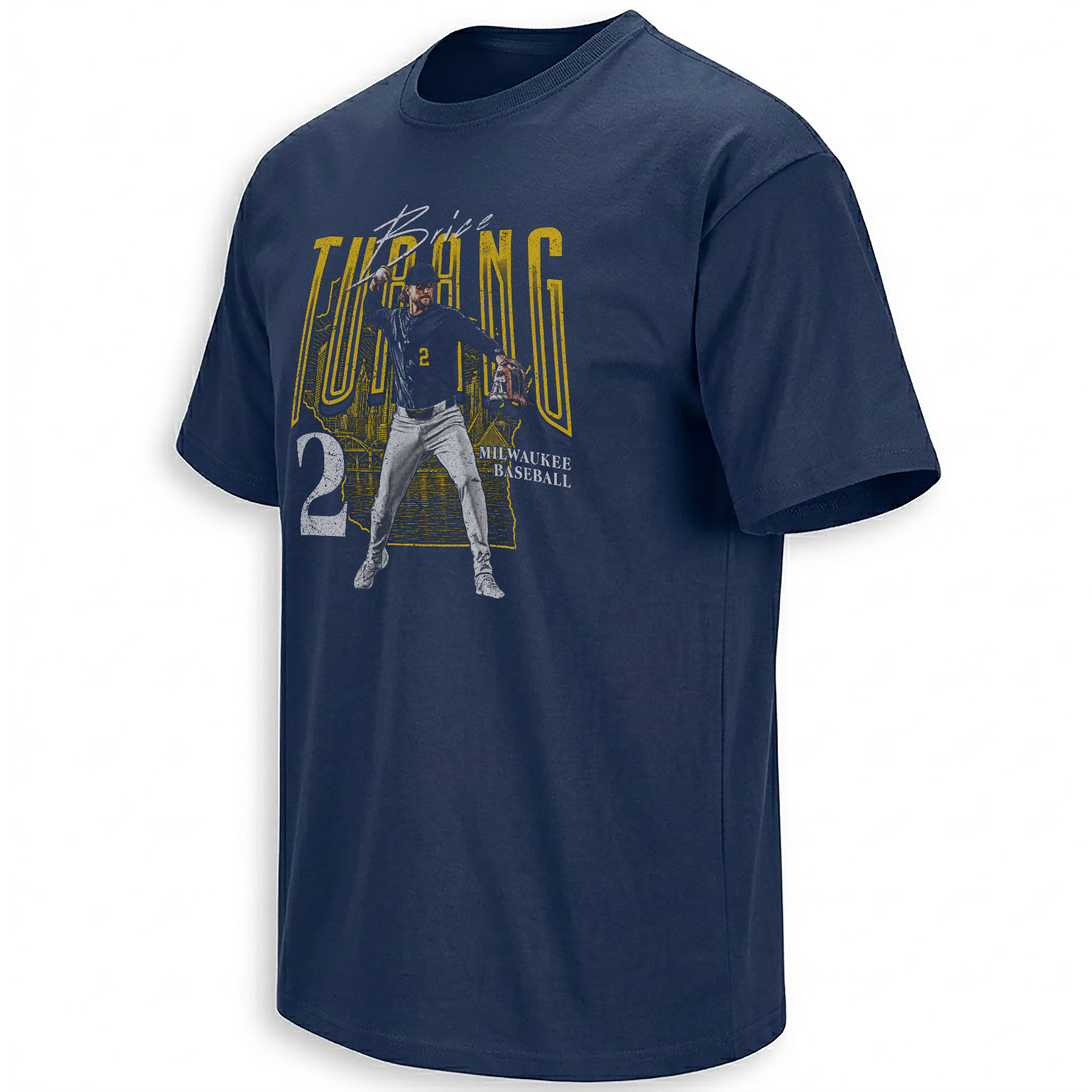
The Brice Turang graphic does not freeze him after a home run. It catches him in the defensive act, body turned, throwing arm extended and No. 2 visible as the point around which the full composition moves.
That choice matters because Turang’s cultural identity in Milwaukee was formed through the middle infield. Even as his offensive profile expands, the throwing motion remains the image that connects his earlier game to his current one.
Oversized name typography sits behind the figure like a player-introduction wall. Navy, blue, cream and gold create an atmosphere that feels part baseball card, part ballpark program and part modern city poster. The artwork avoids excessive action effects because Turang’s actual body position already supplies the speed.
Power Without Losing the Original Identity
Player development often gets described as replacement: a contact hitter becomes a power hitter, a speed player slows down, or a defensive specialist begins chasing offense. Turang’s progression has felt more additive.
His harder contact has not erased the pressure he creates on the bases. The home runs have not removed the throwing accuracy or range. Instead, each layer makes the previous one more difficult for opponents to manage.
Range, speed, contact and quick defensive movement established Turang as one of Milwaukee’s most active players.
Increased impact contact and a growing home-run total have added genuine damage without changing the athletic foundation of his game.
Why No. 2 Fits Milwaukee’s Current Mood
Milwaukee baseball culture has often embraced players whose value comes through accumulation rather than celebrity distance. The player who advances a runner, steals a base, finishes a double play and then changes the next game with a long home run fits naturally into that tradition.
Turang’s No. 2 has therefore become less like a conventional jersey identifier and more like a mark of continuity. It appears in the lineup, in the infield and in the spaces between the obvious highlights.
The broader Milwaukee Brewers collection records that evolving team language through current players, local references and season-specific graphics. The wider MLB Shirts collection places Turang’s piece inside baseball’s larger visual archive of motion, numbers and player identity.
Frequently Asked Questions
What number does Brice Turang wear for Milwaukee?
Brice Turang wears No. 2 for the Milwaukee Brewers, and the number appears prominently in the throwing graphic.
Why is Brice Turang’s 2026 season drawing attention?
His established speed and defense have been joined by stronger contact and growing home-run power, creating a more complete offensive profile.
Did Brice Turang join Team USA for the 2026 World Baseball Classic?
Yes. Turang was selected for Team USA, reflecting his growing reputation as a versatile second baseman with value across several parts of the game.
Why does the design show Turang throwing instead of batting?
The throwing pose preserves the middle-infield movement and defensive identity that first made Turang recognizable in Milwaukee.
What does the No. 2 graphic represent?
It represents Turang’s role as a constant source of motion in Milwaukee’s lineup and infield, while marking the expansion of his game during the 2026 season.
The Brice Turang No. 2 graphic captures the throwing motion at the foundation of his identity, while the Brewers visual archive follows the larger team culture developing around Milwaukee’s current core.
Brice Turang Shirt captures Milwaukee’s No. 2 in a dynamic defensive throwing pose, combining modern Brewers colors, oversized player typography and the movement behind his expanding 2026 game.