Believeland: Why Progressive Field’s Iconic Lights Still Define Cleveland Baseball
The story behind Cleveland’s most enduring sports slogan begins with baseball, long before the Cavaliers’ famous title, and continues beneath the unmistakable light towers of Progressive Field.
When José Ramírez sent a two-run home run over the right-field wall at Progressive Field on October 10, 2026, Cleveland had a familiar reason to believe again.
The Guardians had lost the first two games of their American League Division Series against the Chicago White Sox. Three consecutive victories later, they were heading to the ALCS. Under the stadium lights, another unlikely Cleveland comeback had become reality.
That evening gave renewed meaning to a word older than the current team name and older than the city’s most celebrated modern championship: Believeland.
For Cleveland fans, the word is about much more than predicting a victory. It expresses the stubborn optimism that has followed generations through unforgettable seasons, disappointing endings and moments when everything suddenly felt possible.
Where did the word Believeland come from?
It is easy to associate Believeland exclusively with LeBron James, the Cleveland Cavaliers and the 2016 NBA championship. Those events certainly helped bring the term into national conversation.
But its documented origins lead back to Cleveland baseball.
According to Case Western Reserve University’s Encyclopedia of Cleveland History, the word appeared in The Plain Dealer in 1995, describing a sign held by a fan at a Cleveland Indians game.
That origin is meaningful. During the mid-1990s, Cleveland baseball was experiencing a resurgence, with Jacobs Field becoming one of the city’s defining sports destinations.
Believeland combined two ideas into a single word: the city’s name and the determination of supporters who continued expecting something extraordinary from their teams.
Its later appearances helped broaden the meaning. The Cleveland Browns used the term on apparel in 2007, while ESPN’s 2016 documentary Believeland examined the city’s long relationship with sporting heartbreak.
When the Cavaliers ended Cleveland’s major professional championship drought that June, the slogan gained an entirely new emotional dimension.
Still, the 1995 baseball connection remains a crucial part of its story.
Believeland is not the name of one championship. It is the language Cleveland fans use when the outcome is still uncertain.
Why are Progressive Field’s lights so recognizable?
Long before Cleveland’s current postseason storyline, the city already had an unusual baseball landmark rising above its downtown skyline.
When Jacobs Field opened in 1994, its vertical lighting system looked unlike the floodlight structures traditionally seen at Major League ballparks.
The stadium features 19 tall light towers arranged around the playing field, including three positioned behind the scoreboard.
Their long vertical supports and stacked rectangular lighting panels reminded fans of oversized toothbrushes. The nickname toothbrush lights became part of Cleveland’s architectural vocabulary.
What seems like a playful visual oddity actually had a practical purpose. As explained by original stadium designer Jim Chibnall in Cleveland Magazine’s 2009 architectural feature, the vertical arrangement helped outfielders track balls in flight.
Horizontal lighting banks could create visual difficulties. The unusual vertical solution balanced stadium illumination with baseball visibility.
The design was distinctive enough to become part of the original Jacobs Field logo and later baseball imagery associated with the stadium.

Those structures make the Cleveland ballpark instantly recognizable. Even without a scoreboard, team logo or identifiable player, their silhouette gives the stadium its own architectural identity.
What changed when Jacobs Field became Progressive Field?
The ballpark opened in April 1994 as Jacobs Field, replacing Cleveland Stadium as the city’s major league baseball home.
In 2008, it received the name Progressive Field through a naming-rights agreement. The official name changed, but the ballpark’s most recognizable structural features remained.
The vertical lights therefore connect more than three decades of Cleveland baseball history.
They have watched the rise of different rosters, playoff celebrations, changes in team identity and renovations intended to keep the downtown stadium relevant for new generations.
This continuity is important to Cleveland fans who remember different eras of the same ballpark.
Whether they first visited Jacobs Field in the 1990s or Progressive Field during the Guardians era, the lights provide a shared visual reference.
How did the 2026 Guardians make Believeland relevant again?
The Cleveland Guardians entered their 2026 Division Series against Chicago with expectations of a competitive October.
Yet after losing Games 1 and 2 at home, they faced elimination. Their postseason would end unless they won three straight games.
Cleveland responded with two road victories to force a deciding Game 5 back at Progressive Field.
On October 10, José Ramírez delivered the game’s only runs with a two-run homer in the fourth inning. Gavin Williams struck out 12 hitters, while Cleveland’s pitching staff completed a 2-0 shutout.
The Guardians’ pitchers combined for 21 strikeouts, a nine-inning postseason record, as Cleveland finished its comeback and advanced to face Tampa Bay.
The stadium’s emotional reaction was an important part of the evening. MLB described the roaring crowd, flickering lights, fireworks and the curtain call for Ramírez after his decisive swing.
As of October 14, the ALCS against the Rays is tied 1-1, with the series moving to Cleveland for Game 3.
The larger outcome remains undecided. That uncertainty fits the Believeland tradition: the city is still watching, hoping and waiting for its next unforgettable chapter.
How the Believeland graphic preserves Cleveland’s ballpark identity
A piece of baseball artwork doesn’t always need a player portrait or a championship year to communicate where it belongs.
The Believeland design relies on the place itself.
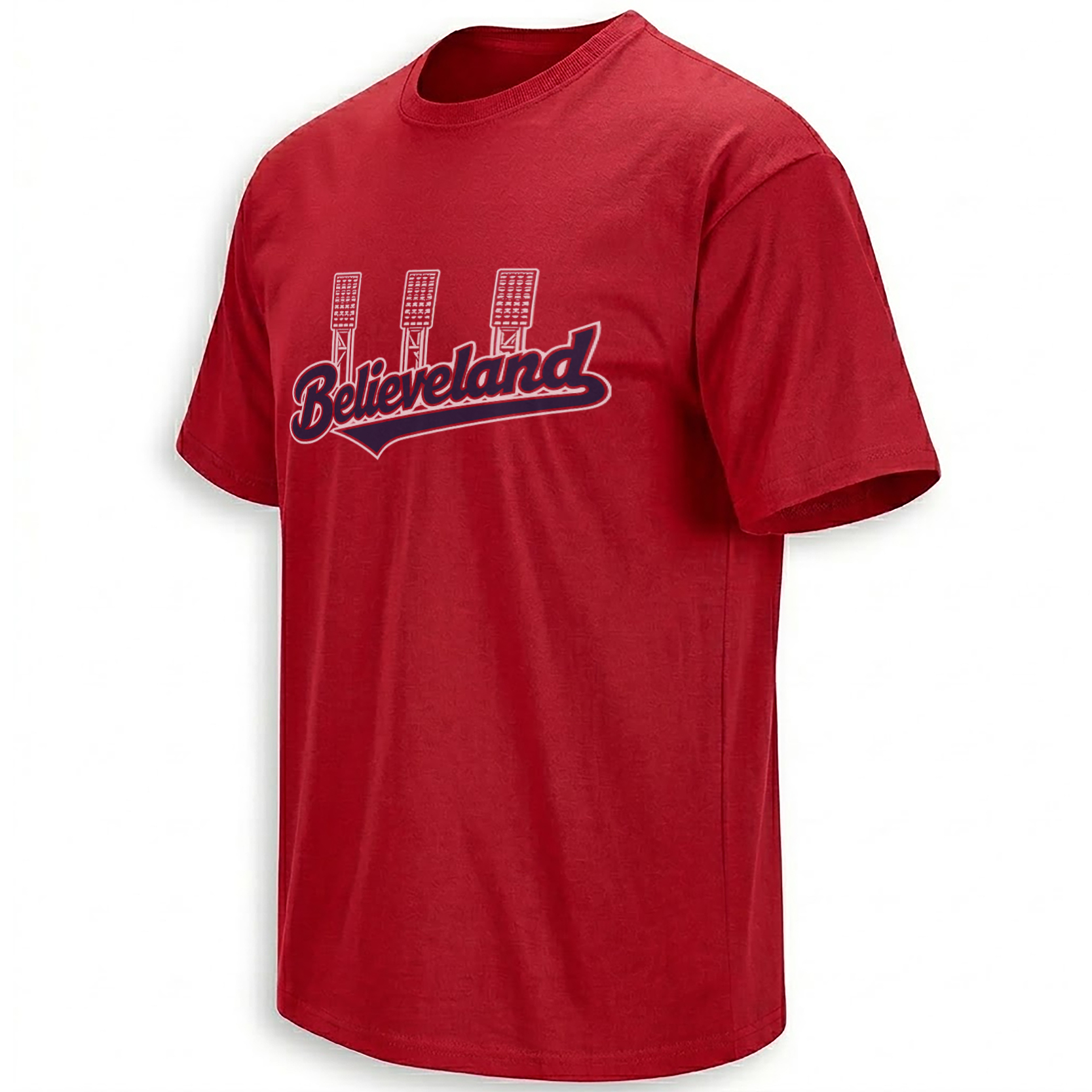
Three recognizable stadium light towers, flowing baseball lettering and Cleveland’s red-and-navy palette bring the city’s baseball heritage into one compact graphic.
View the design →Three illustrated light towers rise behind a large script wordmark. The navy Believeland lettering has white and red outlines, creating the feeling of an old baseball uniform emblem.
A long sweeping underline extends beneath the letters, reinforcing the classic sports-script composition.
The red background and restrained use of white and navy make the design unmistakably associated with Cleveland baseball.
These details distinguish the artwork from general city-pride merchandise. The word communicates a shared emotion; the lights identify the actual location where generations experienced it.
And unlike designs that announce a particular championship, there is no final score or title claim. The graphic works across different Cleveland baseball seasons.
Why Believeland remains bigger than a playoff result
For local fans, the identity behind the slogan includes memories of attending games, seeing the skyline beyond the outfield, hearing the crowd and experiencing the city’s changing fortunes.
The iconic lights become powerful precisely because they are ordinary parts of that experience. Fans see them every time they return to the ballpark, regardless of whether their team wins.
This connection places the design naturally within EllieShirt’s Cleveland Guardians collection, where player moments and hometown references form different parts of the same baseball culture.
The broader MLB collection connects similar stadium and fan traditions across the league. Readers interested in the slogan itself can browse Believeland-related graphics.
One image of the ballpark captures a specific time and place. But the feeling attached to that place can survive entire generations of baseball.
Frequently Asked Questions
What does Believeland mean?
Believeland combines Cleveland and believe. It expresses the optimism, resilience and loyalty associated with Cleveland sports fans.
Where did the Believeland slogan originate?
Its documented history includes a fan sign at a Cleveland baseball game reported by The Plain Dealer in 1995.
Why does the Believeland design show three light towers?
The towers reference the recognizable vertical stadium lights behind the Progressive Field scoreboard.
Why are Progressive Field’s lights called toothbrush lights?
Their long vertical supports and rectangular lighting panels resemble oversized toothbrushes, giving the structures their familiar nickname.
Was Progressive Field originally called Jacobs Field?
Yes. The stadium opened as Jacobs Field in 1994 and was renamed Progressive Field in 2008.
What made Believeland especially relevant in October 2026?
The Cleveland Guardians overcame a 2-0 ALDS deficit against the White Sox and advanced to the ALCS after winning three consecutive games.
The lights stay on, and Cleveland keeps believing
For many cities, sporting memories are represented by championships, legendary athletes or specific final scores.
In Cleveland, one of the most meaningful symbols is simpler: a familiar word beneath three recognizable ballpark lights.
The Guardians’ 2026 comeback offers another dramatic chapter, but Believeland’s real history began decades earlier. The phrase remains a reminder that hope is part of Cleveland baseball’s identity even before anyone knows how the season will end.
Believeland celebrates Cleveland baseball’s enduring optimism through vintage script lettering and the iconic Progressive Field toothbrush lights. Its 1995 baseball roots feel newly relevant following the Guardians’ dramatic 2026 ALDS comeback.