
RISE UP. DIRTY SOUTH.
Michael Penix Jr. and Bijan Robinson have given Falcons fans a new offensive conversation. OutKast’s Stankonia provides the cultural backdrop for an Atlanta football revival.
Atlanta has always understood how to turn local pride into a visual language. Music, football, neighborhoods, and city identity frequently share the same cultural space. In October 2026, the Falcons provided a particularly loud reminder of that connection: two commanding road victories, an explosive running game, and renewed excitement around quarterback Michael Penix Jr. and running back Bijan Robinson.
On October 5, the Falcons defeated the New Orleans Saints 45–24 at the Caesars Superdome. Robinson ran for 145 yards and two touchdowns, including a 59-yard burst on Atlanta’s third offensive play. Penix added 223 passing yards and a touchdown. The victory followed a 35–14 win against Green Bay, giving Atlanta 80 points across two games and lifting the team to 2–2.
Those results help explain why a Falcons graphic inspired by OutKast’s Stankonia feels timely. The album was released on October 31, 2000, but its unmistakable black-and-white flag cover remains a landmark image of Atlanta hip-hop. Replacing the musical duo with two Falcons players allows a modern football moment to speak through a familiar piece of the city’s visual history.
What Is Behind Atlanta’s 2026 Offensive Revival?
Atlanta’s opening two games produced only 16 combined points. Penix’s return after injury provided a new starting point, with head coach Kevin Stefanski’s offense finding a better balance between passing efficiency and an aggressive rushing attack.
Against the Saints, Robinson reached a recorded top speed of 21.78 mph on his long touchdown run. Brian Robinson Jr. added three rushing scores, while Penix connected with Jahan Dotson for a 31-yard touchdown. The quarterback and running backs complemented one another instead of relying on a single source of production.
That balance changed the feeling around the team. What had looked like an uncertain beginning started to resemble a functioning offensive system. Penix’s decision-making, Bijan’s ability to turn open space into explosive gains, and the productivity of supporting players gave Atlanta supporters fresh reasons to look forward.
Atlanta’s football revival has its own soundtrack—and the Dirty South is still part of the city’s vocabulary.
Why Does OutKast’s Stankonia Matter to Atlanta?
OutKast’s fourth studio album was released in 2000 through LaFace Records. André 3000 and Big Boi had already helped place Southern hip-hop on the national map, and Stankonia became another defining step in their creative development. Its music combined Southern rap with funk, gospel, rock, electronic experimentation, and other influences.
The record included “Ms. Jackson,” “So Fresh, So Clean,” and “B.O.B. (Bombs Over Baghdad).” Its cultural importance extends beyond individual songs. The album announced a particular kind of Atlanta confidence: unusual artistic decisions did not need approval from older centers of American music.
The cover made that attitude immediately visible. Photographed by Michael Lavine, it presents the two artists against a stark monochrome American flag. The absence of conventional red and blue coloring places attention on the musicians themselves and creates one of the most recognizable compositions in early-2000s hip-hop artwork.

How Does the Falcons Artwork Reinterpret Stankonia?
The visual relationship is unusually precise. The original album shows two Atlanta musicians standing in front of a black-and-white flag. The Rise Up Dirty South graphic keeps that basic composition while replacing them with Penix in a red No. 9 jersey and Robinson in a red No. 7 jersey.
Penix occupies the left side with a restrained, serious expression. Robinson stands at right, smiling and extending his red-gloved hands forward. Their colorful uniforms contrast with the distressed grayscale flag, making the players appear like the contemporary subjects of a well-known album portrait.
The graphic adds small “PENIX · BIJAN” lettering, followed by RISE UP and DIRTY SOUTH near the upper-right flag stripes. These elements distinguish the piece from a straightforward cover reproduction while keeping its city-specific cultural reference intact.
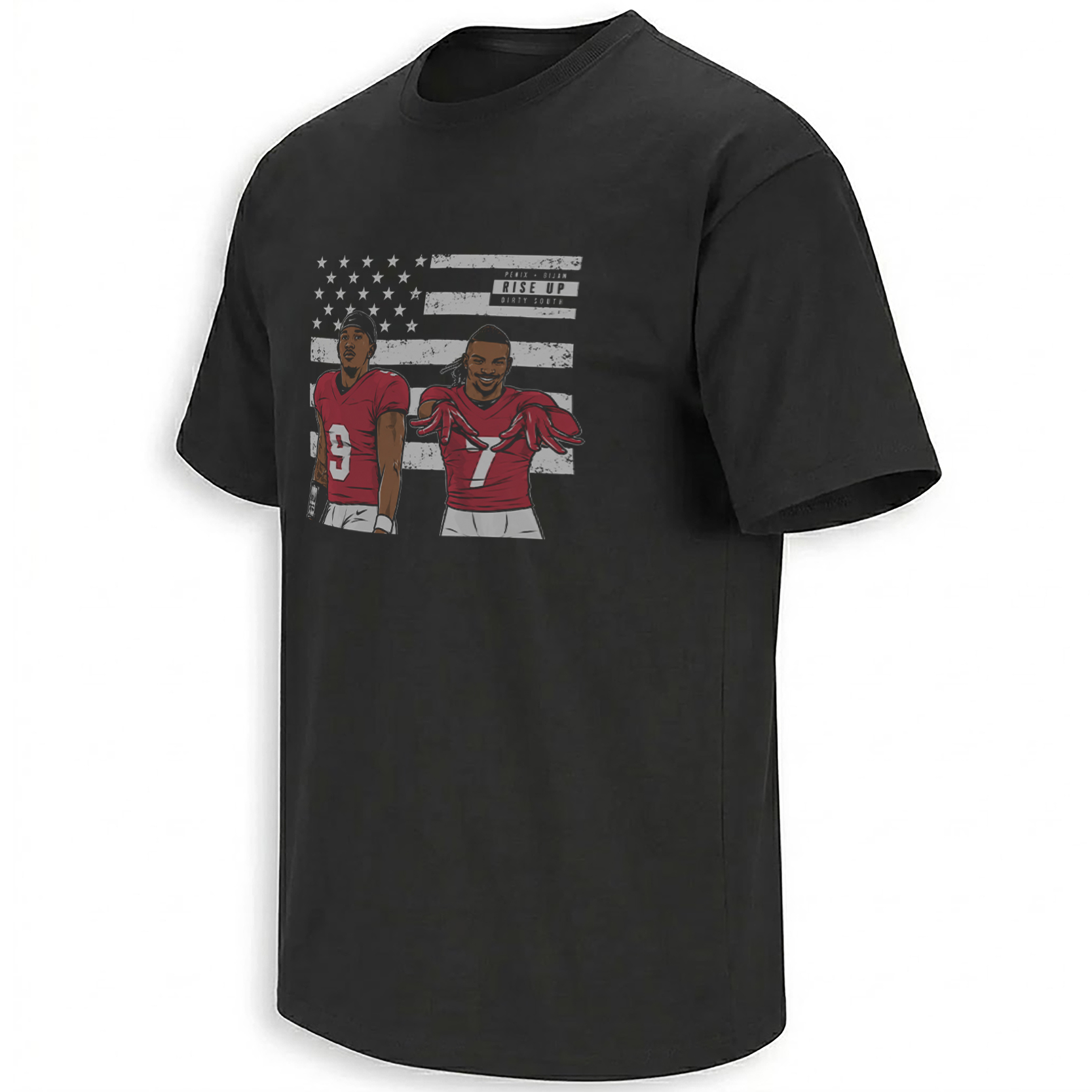
This is a visual parody inspired by OutKast’s 2000 album cover. It is not presented as an official collaboration with OutKast, its artists, or the Atlanta Falcons.
What Do Rise Up and Dirty South Mean?
“Rise Up” is a longstanding Atlanta Falcons rallying cry, associated with the team’s modern marketing identity and supporters. Its meaning is rooted in shared effort, resilience, and excitement around Atlanta football.
“Dirty South” belongs to the cultural language of Southern rap. It became closely associated with artists and communities whose music challenged the idea that national hip-hop culture revolved exclusively around New York and Los Angeles.
Together, the two phrases join different expressions of Atlanta pride. The words do not imply that Penix or Robinson are musicians. Instead, they suggest that Atlanta’s football team and its musical history can belong to the same broader cultural story.
How Did Falcons Fans React to the Saints Victory?
The Saints game was particularly satisfying for Atlanta supporters because of the rivalry and its setting. New Orleans was commemorating the twentieth anniversary of its emotional 2006 Superdome reopening, but the Falcons seized control early and maintained their advantage.
On social media, the Falcons’ official account celebrated Robinson’s touchdown. In the team’s fan community, discussions centered on the running game, Penix’s return, and the impressive margin of victory. These responses illustrate the renewed confidence following back-to-back wins without establishing how the remainder of the season will unfold.
What Makes This an Atlanta Cultural Crossover?
Sports and music imagery often borrow from the same visual traditions, but the Stankonia reference is unusually rooted in one city. OutKast and the Falcons represent different periods and types of Atlanta public life, while the design’s two-player composition connects them without requiring a fictional meeting or collaboration.
The wider Atlanta Falcons collection includes other player moments and city-centered graphics. The NFL collection provides the broader football context, while the Music collection offers a separate reference point for music-inspired visual culture.
For player-specific artwork, see the internal archives for Michael Penix Jr. and Bijan Robinson.
Frequently Asked Questions
Which OutKast album inspired Rise Up Dirty South?
OutKast’s 2000 album Stankonia, featuring André 3000 and Big Boi against a black-and-white American flag, inspired the composition.
Who are the two Falcons players on the graphic?
Michael Penix Jr. appears in a red No. 9 jersey on the left, while Bijan Robinson wears No. 7 on the right.
How did Atlanta perform against New Orleans in October 2026?
The Falcons won 45–24 on October 5. Robinson ran for 145 yards and two touchdowns, while Penix passed for 223 yards and one touchdown.
What does Dirty South mean in this context?
It refers to the influential tradition of Southern hip-hop, especially the music and identity associated with Atlanta.
Is the design an official OutKast collaboration?
No official collaboration is established. The artwork is a Falcons-themed reinterpretation of Stankonia’s recognizable cover composition.
The Rise Up Dirty South visual captures a particular cultural connection: the confidence returning to Atlanta football, framed by one of the city’s most memorable album covers.
Rise Up Dirty South connects Michael Penix Jr. and Bijan Robinson with the visual legacy of OutKast’s Stankonia. Red Falcons jerseys, monochrome flag imagery, and Atlanta hip-hop references reflect the team’s renewed offensive energy in October 2026.