
Bauers & Mitchell Go Back-to-Back: The NLCS Game 3 Turnaround
Milwaukee trailed the Dodgers 2–1. An eleven-pitch battle and the next swing made Dodger Stadium sound very different.
For six innings at Dodger Stadium on October 14, 2026, the Los Angeles Dodgers had reason to believe their National League Championship Series was about to change direction. Will Smith had driven in two runs to give the home club a 2–1 lead. Blake Snell was missing bats, the stadium was energized, and Milwaukee was suddenly facing a familiar October test.
Then Jake Bauers stepped into the seventh inning and refused to make the moment easy for anyone. His plate appearance against Snell stretched across 11 pitches. He fought off offerings, stayed alive, and finally launched a two-run home run that turned the score to 3–2. The swing would have been memorable on its own. Garrett Mitchell made sure it became a sequence.
The very next Brewers batter hit a solo home run, pushing Milwaukee ahead 4–2. The visitors eventually won 6–2 and took a 3–0 lead in the best-of-seven series. A game that seemed to be turning toward Los Angeles had instead become a vivid example of Milwaukee’s persistence.
How Did Jake Bauers Beat Blake Snell in an 11-Pitch At-Bat?
One of the pleasures of baseball is that a plate appearance has a story before its final result. Bauers did not simply capitalize on the first mistake he saw. Snell had struck out nine batters over the opening six innings, and the Dodgers had just seized the lead. An Andrew Vaughn walk began the top of the seventh; Bauers then extended the confrontation by fouling off pitches.
The eleventh pitch finally decided it. Bauers got a fastball he could drive, sending the ball deep to right field for a two-run homer. The emotional impact came from the endurance as much as the contact. Each additional pitch stretched the tension, with everyone in the stadium knowing how much was riding on the at-bat.
What Happened When Garrett Mitchell Batted Next?
Baseball frequently follows a difficult at-bat with an anticlimax. Not this time. Mitchell stepped in after the lead-changing swing and connected for a solo homer off Snell, putting the Brewers two runs ahead and turning one breakthrough into consecutive blows. Statcast’s combined projected home-run distances were reported as approximately 840 feet.
The contrast created the drama: Bauers had to survive a long duel, while Mitchell accelerated the outcome almost immediately. From the broadcast booth to fan discussions, the two swings became a single highlight. The phrase back-to-back bombs describes the event without embellishment. Both hitters produced home runs in consecutive plate appearances during the same seventh-inning rally.

Eleven pitches to turn a season-defining game. One more swing to make the turning point unforgettable.
Why Was the Seventh Inning Such a Big Postseason Moment?
Milwaukee had not appeared in the World Series since 1982. With a third NLCS win in hand, it stood one victory from ending that wait. That was the real reason every replay felt larger than a typical two-home-run inning.
What Did Baseball Fans Say About Bauers and Mitchell?
The fan response on Reddit was unusually focused on the plate appearances themselves. Viewers emphasized the length of Bauers’ battle, debated when the Dodgers should have removed Snell, and celebrated Mitchell for immediately following the go-ahead swing. Those were reactions to an actual baseball sequence, not manufactured praise for a merchandise slogan.
How Does the Bauers Mitchell ’26 Artwork Capture the Inning?
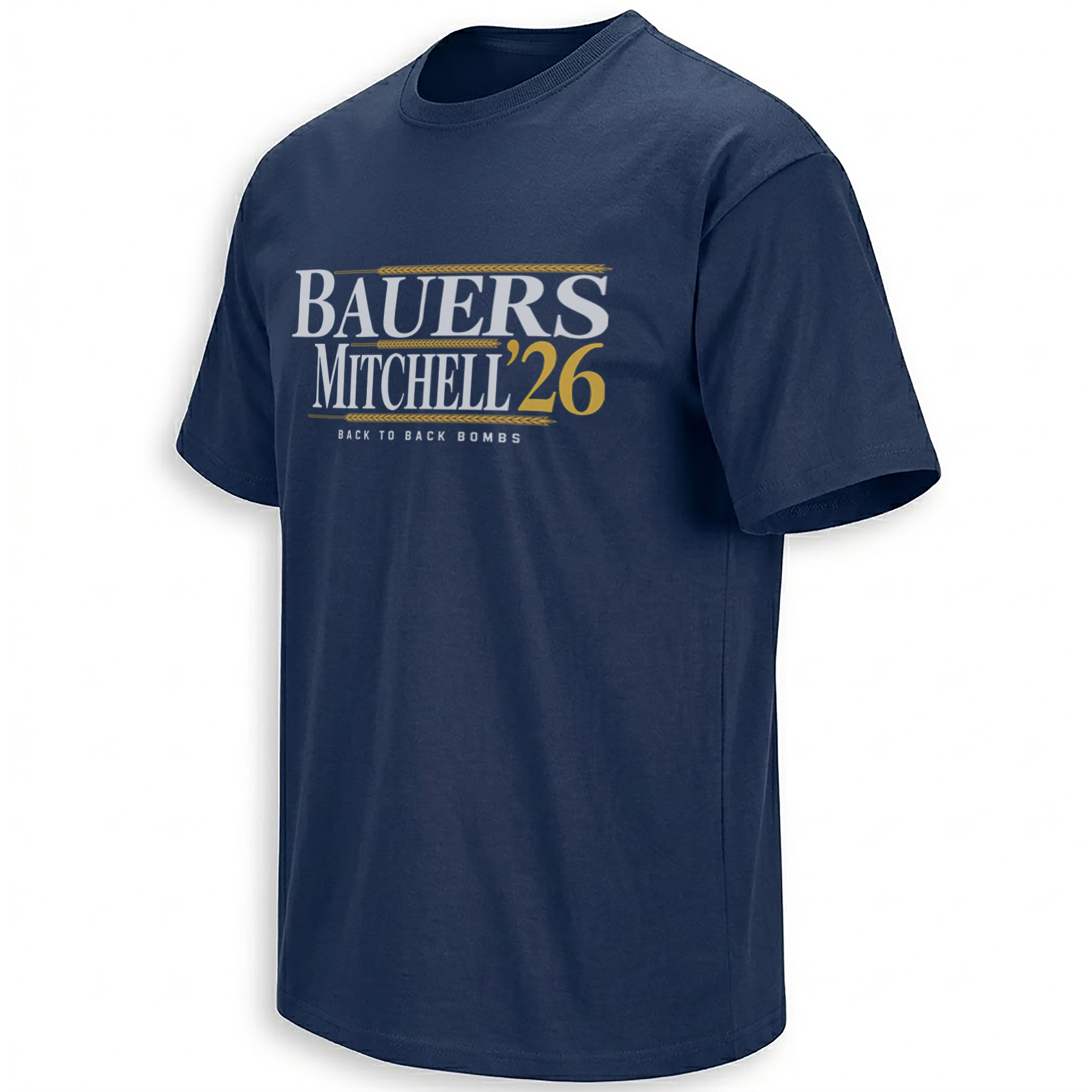
The design chooses a typographic treatment rather than pretending to be a live photograph. Bauers and Mitchell share the headline in large cream-and-gold lettering, while the year ’26 anchors the postseason reference. Wheat-inspired accents connect the composition to Milwaukee’s Brewers identity. Its navy base creates the recognizable sports-poster look without requiring either player to be reduced to a caricature.
How Does This Fit Into Milwaukee Brewers Postseason Culture?
Fans exploring Milwaukee Brewers designs will recognize a larger visual record of this playoff run: clutch hitting, defensive moments and the feelings attached to individual games. The MLB graphic archive provides the broader baseball context. For player-specific pieces, there are also internal searches for Jake Bauers and Garrett Mitchell.
Questions About the Back-to-Back Home Runs
When did Jake Bauers and Garrett Mitchell hit back-to-back home runs?
They hit consecutive home runs in the seventh inning of Brewers–Dodgers NLCS Game 3 on October 14, 2026.
How many pitches did Jake Bauers see before his home run?
Bauers hit the go-ahead two-run homer on the eleventh pitch of his at-bat against Blake Snell.
What was the final score of Brewers vs. Dodgers Game 3?
Milwaukee won 6–2, giving the Brewers a 3–0 lead in the 2026 National League Championship Series.
What does Back to Back Bombs mean on the shirt?
It refers to the consecutive seventh-inning home runs by Bauers and Mitchell during NLCS Game 3.
The replay tells the entire story: persistence first, impact second. One batter dragged the duel to pitch eleven; the next made the comeback impossible to ignore. That is why this inning has its own place in Milwaukee’s October memory.
Bauers Mitchell ’26 remembers Milwaukee’s pivotal seventh inning against Los Angeles in 2026 NLCS Game 3. Jake Bauers won an 11-pitch battle with a two-run homer, and Garrett Mitchell followed with another blast as the Brewers seized a 3–0 series lead.