You’ll Get the Point Eventually.
Why a deadpan modern joke fits Vlad the Impaler, the historical ruler whose frightening reputation inspired centuries of dark storytelling and became entangled with the Dracula legend.
Imagine a solemn medieval portrait looking back at you with an oddly reassuring message: “You’ll get the point eventually.” Without its historical subject, the sentence sounds like a patient teacher explaining something complicated. With Vlad the Impaler staring above it, the meaning turns considerably darker.
The joke works because the English phrase “get the point” has two meanings. It can describe understanding an explanation, but “point” can also refer to the end of a sharpened object. Vlad III of Wallachia earned his enduring nickname through a historical reputation for impalement, making the normally harmless expression into an unsettling punchline.
In October, when Gothic imagery and dark historical humor naturally find a seasonal audience, the combination feels particularly fitting. The graphic also belongs to a longer cultural tradition: the transformation of an actual fifteenth-century ruler into a recognizable figure of horror, medieval legend, and internet jokes.
Who Was Vlad the Impaler?
Vlad III was a ruler of Wallachia, a principality in the region of modern Romania. He held power during several separate periods in the fifteenth century, most notably between 1456 and 1462 and briefly again in 1476. His reign unfolded amid political conflict, rival nobles, shifting regional alliances, and military pressure from the Ottoman Empire.
He is remembered under several names, including Vlad Dracula and Vlad Țepeș. The latter means Vlad the Impaler, referring to the punishment most strongly associated with his reputation.
Impalement was not a punishment he invented. It had existed long before his lifetime. But historical accounts associate Vlad with using it as a method of execution and intimidation. Stories of large numbers of victims spread across Europe, contributing to a frightening image that followed his name long after his death.
That history should not be flattened into a supernatural legend or treated entirely as an exaggerated joke. Vlad was a political and military ruler operating in a violent historical environment. His reputation involves real brutality, although historians also examine how hostile pamphlets and political propaganda shaped particular accounts of his conduct.
Why Is He Called Vlad the Impaler?
The nickname refers to Vlad’s association with impalement, a method of execution in which a person’s body was pierced by a stake or pole. Contemporary and later accounts portray it as an instrument of punishment, political terror, and public warning.
Some stories describe extraordinary numbers of victims and deliberately horrifying displays directed at enemies. The precise details and casualty estimates in many narratives remain difficult to establish, particularly because hostile political groups circulated sensational accounts in printed pamphlets.
Art historian Alice Isabella Sullivan’s discussion of Vlad’s portrait for Smarthistory explains how late-fifteenth-century printed stories helped create a recognizable image of a brutal ruler. The stories circulated in political and cultural contexts that complicate how they should be interpreted today.
For the modern pun, the detailed historical disputes are not required. The nickname itself establishes the reference. That economy is what makes the punchline understandable to anyone familiar with Vlad’s reputation, even if they know little about Wallachian politics.
You’ll get the point eventually.
A Modern Historical Pun — Not a Vlad III QuotationWhat Is the Double Meaning of “You’ll Get the Point Eventually”?
In everyday English, saying that someone will get the point eventually is a mild expression of confidence that an explanation will eventually make sense. It often suggests that the speaker is being patient with a person who has not yet understood.
With Vlad the Impaler, that ordinary meaning remains intact, but the viewer is invited to recognize a second possibility. The ruler’s nickname turns “point” into the literal end of a stake, while “eventually” adds uncomfortable comic timing.
The sentence becomes amusing through contrast. Its language is calm, reassuring, and understated. Its historical reference is severe. The joke does not need an illustration of violence, because the audience supplies the missing association.
There is also an important distinction: no reliable historical source identifies these words as something Vlad actually said. It is a contemporary joke constructed around a familiar historical nickname.
What Did Vlad III Really Look Like?
Many modern depictions of Vlad are shaped by the famous Ambras Portrait, a sixteenth-century painting now associated with the collection at Schloss Ambras in Innsbruck, Austria. It is not a modern photograph or a verified portrait painted directly from life; it is a later representation of the Wallachian ruler.
The painting gives Vlad a distinctive identity: dark curling hair, a prominent mustache, a rich red garment, and an elaborate jeweled headdress. His expression is serious and controlled, while the decorative elements emphasize noble status rather than supernatural horror.
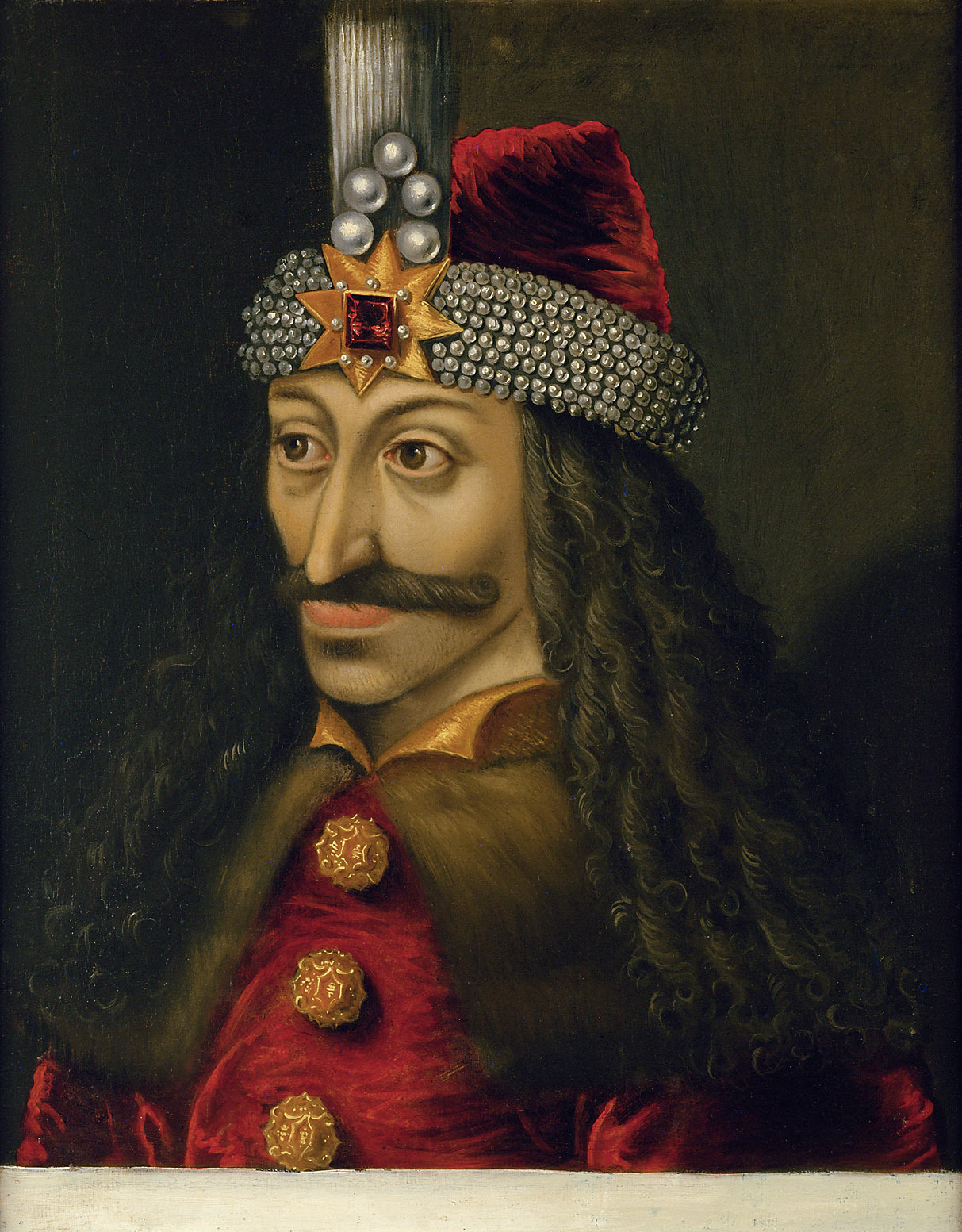
The portrait matters because it separates the historical subject from the later image of Dracula as a vampire. Vlad is shown as an aristocratic ruler, not a creature with fangs or a black cape. The elaborate headwear, long hair, and sharply defined face would become essential visual clues in modern reinterpretations.
Its later repetition in engravings, books, and digital artwork explains why audiences often recognize the figure despite knowing little about the original painting’s date or artistic context.
How Did Vlad Become Connected to Dracula?
Vlad III’s association with Dracula comes partly through his name. His father, Vlad II, was connected to the Order of the Dragon and was known as Dracul. Vlad III inherited the Dracula name, conventionally explained as “son of Dracul.”
Centuries later, Bram Stoker published Dracula in 1897. The novel introduced the fictional vampire Count Dracula to an international literary audience, eventually inspiring a vast tradition of horror films, theater, illustrations, and seasonal imagery.
The extent to which Stoker drew on the historical Vlad’s actual life remains debated. The name and certain associations with Eastern European history were important, but the supernatural vampire should not be treated as a straightforward biography of Vlad III.
That is part of what makes the impalement joke distinctive. Unlike a generic Dracula reference built around blood, bats, and fangs, it points back toward the historical ruler and his established nickname.
Why Does Vlad Appear So Often in History Memes?
Internet history humor frequently compresses large, complicated historical subjects into a familiar image and a single sharp line. Vlad the Impaler is especially recognizable because his nickname sounds almost self-explanatory and his historical reputation is unusually extreme.
Online discussions also reveal disagreement over how to interpret him. Some people emphasize his resistance to Ottoman expansion and his status in Romanian historical memory. Others challenge attempts to minimize the brutality attributed to his rule. Both perspectives appear in conversations about how historical figures become legends.
The “You’ll Get the Point Eventually” joke belongs to the lighter, wordplay-focused side of this tradition. It relies on recognition rather than an invented historical anecdote, making the punchline accessible without pretending that it describes a specific documented event.
Why Does the Gothic Portrait Make the Joke Stronger?
The You’ll Get the Point Eventually artwork takes its inspiration from formal historical portraiture. Vlad appears in a decorative pointed arch, his face framed by flowing hair and an ornate cap. Fine antique-gold lines create a weathered, engraved appearance against a black background.
The lettering appears in three stacked sections: “YOU’LL GET,” “THE POINT,” and “EVENTUALLY.” Its serif typography feels old-fashioned and serious, contrasting with the casual tone of the actual words.
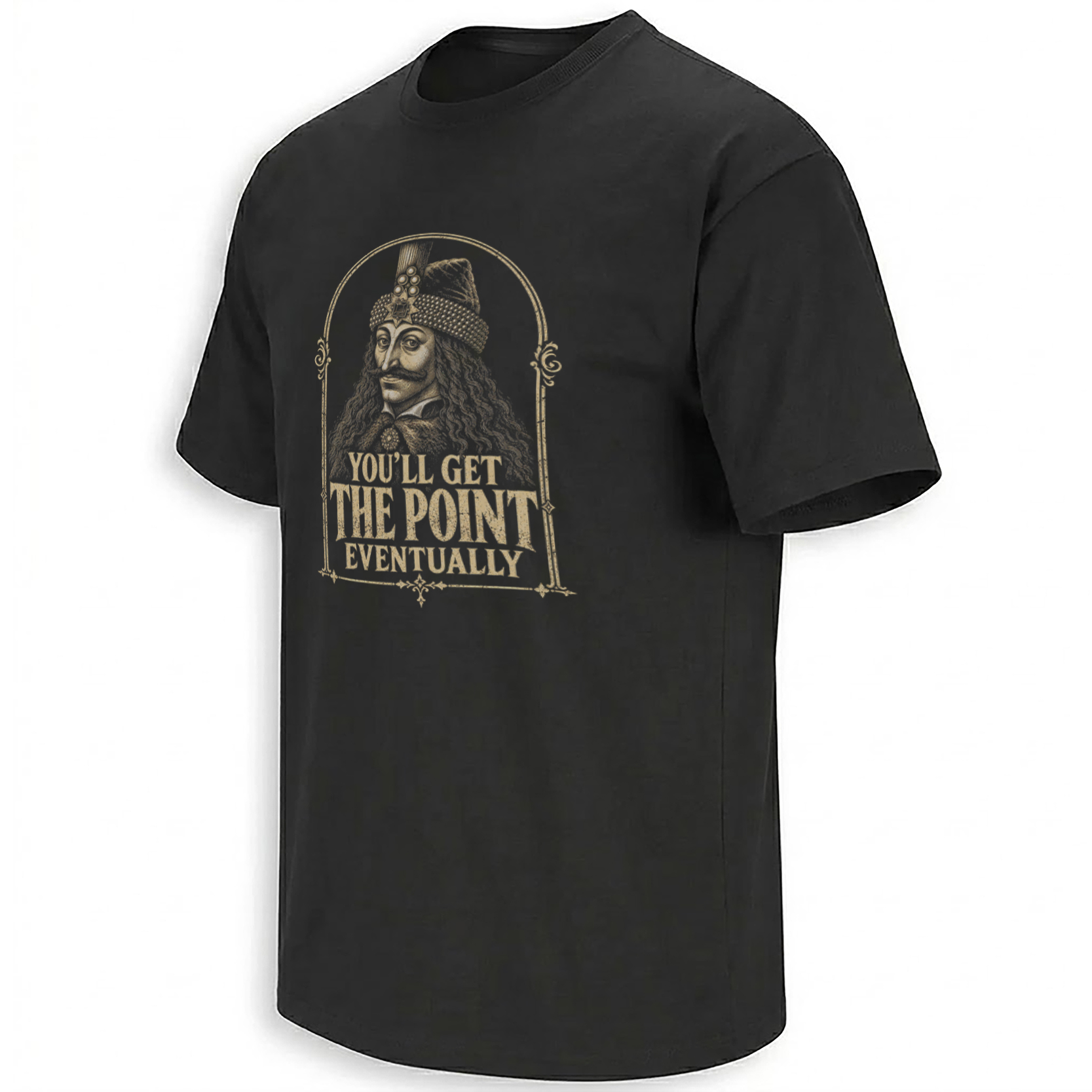
The artwork wisely avoids obvious props. There are no wooden stakes, fangs, bats, or fictional castle scenes. Instead, the visual identity comes from historical portrait details and decorative framing. The words complete the association after the viewer recognizes the face.
The aged-gold palette, Gothic arch, serious historical portrait, and carefully stacked typography give the graphic the atmosphere of an old illustrated bookplate. The humor comes from the text rather than a graphic depiction of violence.
Why Does This Kind of Historical Humor Work Around Halloween?
October naturally brings renewed attention to supernatural stories, medieval-looking imagery, and Gothic literature. Vlad sits at the intersection of those interests because audiences associate his name both with actual history and the later fictional Dracula tradition.
The graphic retains a historical focus while borrowing the visual atmosphere of Gothic artwork. It fits the broader language of dark seasonal humor without requiring a Halloween date or pretending that Vlad himself was a supernatural character.
Other approaches to this theme appear in EllieShirt’s Funny Halloween Shirt collection and the broader Halloween collection. For work centered on this particular historical figure, readers can explore Vlad the Impaler graphics.
Frequently Asked Questions
What does “You’ll Get the Point Eventually” mean?
It is a dark pun connecting the everyday expression “get the point” with Vlad the Impaler’s historical association with impalement.
Did Vlad the Impaler really say this phrase?
No verified historical source establishes this as a quotation from Vlad III. It is a modern joke based on his nickname.
Who was Vlad the Impaler?
Vlad III was a fifteenth-century ruler of Wallachia, in present-day Romania, known for his conflicts with regional opponents and his brutal reputation.
Is Vlad the Impaler the same as Count Dracula?
No. Vlad III was a historical ruler; Count Dracula is the fictional vampire from Bram Stoker’s 1897 novel. Their names and cultural histories became connected.
What historical portrait inspired the design?
The design recalls the Ambras Portrait of Vlad III, with his jeweled headdress, long dark hair, prominent mustache, and aristocratic appearance.
Vlad III’s historical reputation, the Ambras Portrait, and a carefully constructed English pun come together in the You’ll Get the Point Eventually graphic. It is a small example of how recognizable historical imagery can acquire an entirely new life in popular culture.
You’ll Get the Point Eventually transforms Vlad the Impaler’s historical reputation into a deadpan medieval-history pun. Its antique-gold Gothic portrait, decorative arch, and vintage lettering connect Wallachian history, the Dracula legend, and modern dark humor.