
The Bears Are 3–1 — and Old-School Chicago Suddenly Feels Very Current
Chicago’s 23–12 Week 4 win over the Jets gave Bears fans another reason to think beyond one player or one Sunday. A retro running-bear graphic fits that mood because Chicago football identity has always been bigger than the current depth chart.
Soldier Field did not need Caleb Williams on Sunday to look like a team building momentum. With Tyson Bagent starting at quarterback, Kyle Monangai pounding through the Jets defense and Chicago controlling almost every major statistical category, the Bears walked away from October 4 with a 23–12 victory and a 3–1 record.
The numbers looked even more emphatic than the score. Chicago produced 492 yards to New York’s 157, recorded 34 first downs, held possession for 42 minutes and 45 seconds and did not punt. Monangai carried 30 times for 146 yards and two touchdowns, while Bagent threw for 239 yards in his first start since 2023.
That kind of afternoon naturally generates player graphics. But it also creates something broader: the sense that the team itself is becoming the story again. That is where a smiling, football-carrying cartoon bear makes surprising cultural sense.
Quarterbacks change. Sunday heroes change. A bear running with a football can survive every roster cycle.
Why a Retro Mascot Works Better Than Another Player Portrait
The Chicago Bears Mascot Shirt does not attempt to freeze one touchdown or identify one star. Its subject is Chicago football itself.
The bear is cheerful rather than intimidating, sprinting with the football beneath orange “Chicago Bears” lettering. Navy, burnt orange, cream and brown keep the palette inside familiar team territory, while the illustration looks closer to an old program cover, pennant or neighborhood athletic shirt than contemporary licensed graphics.
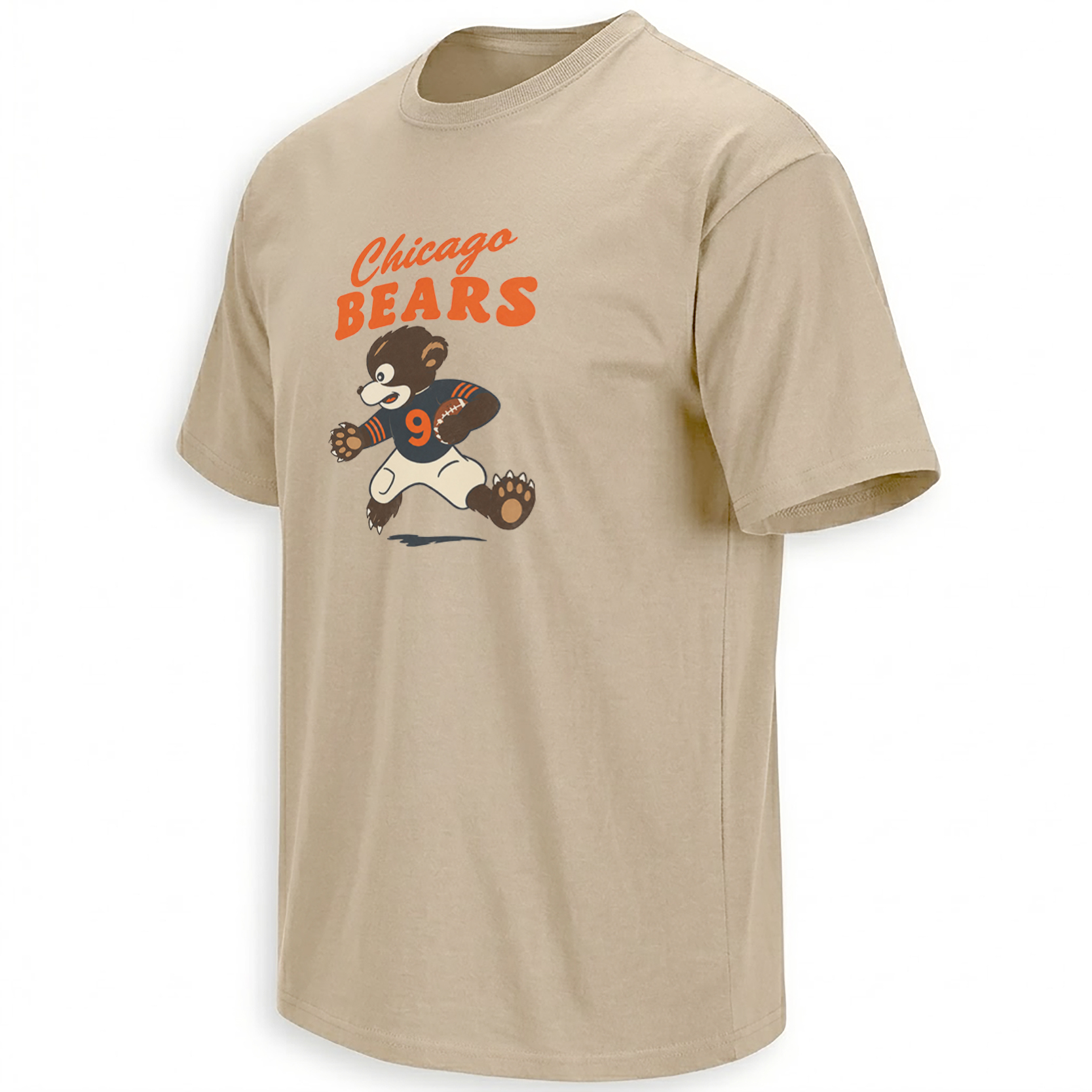
A team-identity graphic using the language of vintage athletic mascots rather than one player, one score or one season.
View the piece →The Bears Have More Than a Century of Visual Memory
Chicago can support this kind of artwork in a way younger franchises cannot. The organization traces its history to 1920, when the club began as the Decatur Staleys. Over the decades, Bears branding moved through illustrated bears, football imagery, uniform changes and eventually the familiar wishbone “C.”
That history matters because retro mascot art does not need to pretend it is an exact reproduction of one official mark. Instead, it can borrow the visual grammar of earlier sports culture: anthropomorphic animals, simple athletic poses, limited spot colors and lettering with the personality of hand-painted signage.

An official Bears store retro poster shows how deep the franchise’s history of illustrated bear imagery runs, giving modern mascot graphics a genuine historical visual context.
Source: Chicago Bears Pro Shop →The Bears’ branding has used bear imagery for generations, including older illustrated marks built around the animal and a football. The current retro-running concept should therefore be read as part of a broader Chicago football tradition rather than as a portrait of one modern player.
The Number on the Jersey Should Not Be Over-Explained
One detail invites an easy SEO mistake: the mascot’s jersey number. Because a current or historical Bears player may share that number, it would be tempting to force a player connection into the article.
There is no reason to do that. The artwork itself gives no evidence that the cartoon is meant to depict a specific player. Its anatomy is a bear, its face is a mascot face and its uniform is intentionally simplified. Treating the number as a vintage design detail keeps the interpretation accurate and prevents a timeless team graphic from being trapped inside one roster year.
Why the Design Feels Especially Timely After the Jets Win
Chicago’s current momentum makes the old-school aesthetic feel less nostalgic than celebratory. The Bears have now won with three different quarterbacks in the opening four weeks, while the Week 4 offense controlled the Jets with the kind of ground-heavy, possession-dominant football that fans instinctively associate with traditional Chicago toughness.
Monangai’s performance adds an amusing visual echo. The product mascot literally runs with a football tucked under its arm; one day after the design arrived, Chicago’s real offense leaned on a runner who carried the ball 30 times. The graphic is not a Monangai shirt, but the coincidence makes its basic football language feel perfectly synchronized with the week.
The current chapter continues quickly. Chicago travels to Green Bay on October 11, putting the 3–1 Bears back inside the rivalry that has defined so much of the franchise’s historical identity.
Retro Sports Graphics Work Because They Remove the Expiration Date
Player shirts naturally belong to specific eras. A quarterback changes teams. A breakout running back gets a new number. A coaching staff disappears. A meme that dominated one October can become incomprehensible three seasons later.
Mascot art behaves differently. “Chicago.” “Bears.” Navy. Orange. A football. Those elements remain readable long after a box score fades from memory.
That makes the design useful inside Ellie Shirt’s Chicago Bears collection, where current player moments can sit beside graphics built around the franchise itself. The broader NFL collection extends the same idea across football culture: individual moments move quickly, while team symbols create the longer archive.
Frequently Asked Questions
What is the Chicago Bears Mascot Shirt?
It is a retro-style Chicago football graphic featuring team lettering and a cartoon bear running with a football.
Is the running bear meant to be a specific Bears player?
No. The design reads more accurately as a generic team mascot and vintage sports character rather than a portrait of a particular player.
Why does the design look vintage?
The simple mascot pose, restricted orange-and-navy palette, athletic lettering and hand-drawn character style reference older program covers, pennants and collegiate sports illustrations.
How are the Chicago Bears doing in 2026?
Chicago improved to 3–1 with a 23–12 Week 4 victory over the New York Jets at Soldier Field on October 4.
Who do the Bears play next?
Chicago travels to Green Bay to face the Packers on October 11, continuing one of the NFL’s defining historical rivalries.
The Retro Running Bear design fits beside current-season moments without depending on them, while the wider Chicago Bears archive tracks both sides of the fandom: the players making news now and the symbols that survive every era.
Chicago Bears Mascot Shirt brings the franchise’s old-school visual identity into the 2026 season with a running cartoon bear, football-in-hand pose and classic navy-and-orange athletic styling — especially timely as Chicago moves to 3–1.