
Tom Morello Put Protest Rock Back on Stage. The Internet Still Wants to Debate “The Machine.”
Two days after Tom Morello’s Power to the People Festival filled Merriweather Post Pavilion with protest songs, political speeches and civic organizing, one of rock culture’s strangest arguments feels newly alive: who gets to decide whether rebellion is still rebellion?
On October 3, 2026, Tom Morello brought musicians and activists together in Columbia, Maryland for Power to the People, a festival explicitly organized around peace, justice, solidarity and community action. Bruce Springsteen headlined. Joan Baez, Dave Matthews, Killer Mike and other artists joined a lineup that treated rock music not as neutral entertainment, but as a platform for political participation.
That would once have sounded like the most unsurprising sentence imaginable about a member of Rage Against the Machine. The band’s identity was built around confrontation: police power, racism, capitalism, censorship and institutional authority were not subtext. They were the material.
Yet internet culture has spent years turning that identity back on itself. “Rage for the Machine.” “Rage became the Machine.” “Shilling in the Name Of.” These phrases circulate whenever critics believe the politics of a famous anti-establishment artist have moved closer to institutions, mainstream cultural power or positions those critics consider conformist.
The meme works because it does not attack an unknown band. It reverses one of rock’s clearest symbols of refusal.
Why “Rage for the Machine” Became Such Durable Meme Language
The joke depends on recognition. Rage Against the Machine’s name already functions like a political slogan, while “Killing in the Name” remains one of the band’s defining recordings. Its structure moves from accusation toward an explosive refusal to obey, which is why changing only a few words can completely reverse the emotional meaning.
That reversal is the center of the Rage for the Machine Shirt. The band name becomes “Rage for the Machine.” “Killing in the Name” becomes “Shilling in the Name Of.” Human musicians become masked sheep. The entire visual language turns rebellion into obedience.
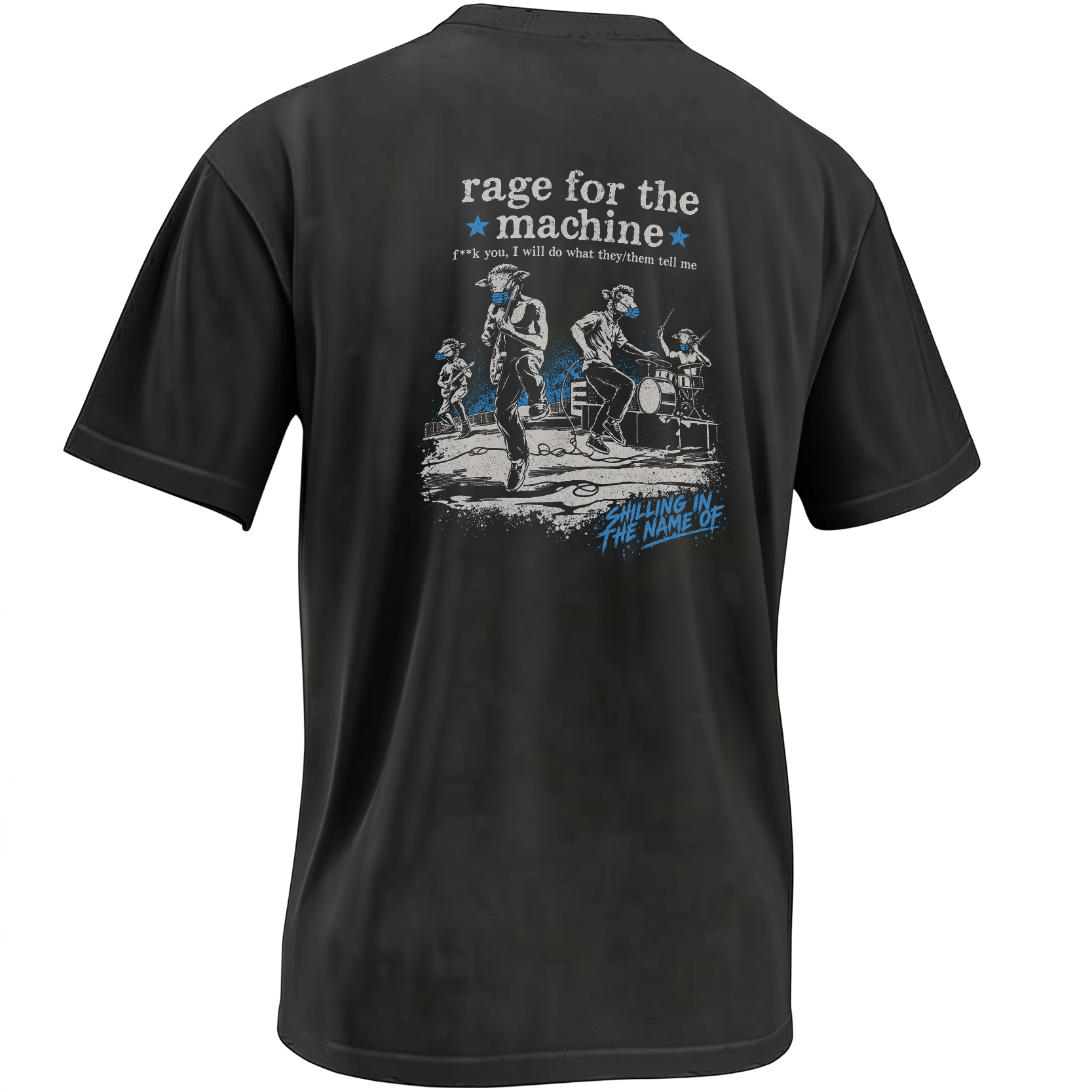
The graphic reconstructs RATM’s protest-rock language as a dark parody about rebellion, obedience and perceived political conformity.
View the graphic →The Sheep Are the Punchline
Visually, the strongest decision is replacing a human band with sheep. “Sheep” has long operated in political meme language as shorthand for people accused of following authority without questioning it. The face masks push the satire toward the pandemic-era culture wars, while the altered lyric and pronoun language expand it into a broader critique of contemporary progressive politics.
That does not make every factual claim surrounding the meme true. In particular, the recurring claim that Rage Against the Machine itself required vaccine proof at its eventual 2022 reunion concerts has been disputed by Morello, who said venue policies existed earlier but were no longer in effect by the time those performances occurred.
The distinction matters editorially. The design works best as a record of an argument, not as documentary evidence. It captures how critics frame RATM’s modern politics, while the band’s supporters can point to decades of ideological consistency and Morello’s continuing activist work.
And Then Morello Organized Power to the People
That argument received fresh fuel this weekend. The Power to the People Festival arrived just ahead of the 2026 midterm elections and used the language of protest culture openly. The event’s own description emphasized peace, justice, solidarity, music and community action, with voter-engagement organizations connected to the festival.

The current political-music context behind the debate: Morello positioned rock, activism and organized civic participation on the same stage.
Source: Sony Music →For supporters, that looks exactly like the political commitment Rage Against the Machine has always represented. For detractors, institutional partnerships, celebrity networks and mainstream political alignment are precisely why the old anti-system image feels contradictory. Both interpretations explain why the meme refuses to disappear.
The Original Song Still Controls the Reference
The parody only works because audiences still understand the source material. The official “Killing in the Name” video remains a useful cultural anchor: the song’s central tension is obedience versus refusal, which is exactly the axis the parody flips.
Why the Graphic Feels Like an Internet-Era Concert Poster
The black base is important. Instead of bright meme graphics, the composition borrows from underground gig posters: distressed white type, rough monochrome illustration, stage equipment, cables and controlled splashes of electric blue.
Blue becomes the visual interruption. It links the face masks, stars, splatter texture and “Shilling in the Name Of” lettering, creating a single satirical thread through the artwork. The result reads first like rock merchandise and only afterward reveals itself as political parody.
For readers following the wider visual conversation, Ellie Shirt’s newest releases provide the broader cultural archive, while more designs connected to Rage Against the Machine and Tom Morello can be followed through the site search.
Frequently Asked Questions
What does “Rage for the Machine” mean?
It is a sarcastic reversal of Rage Against the Machine, generally used by critics who believe the band or its politics now align with institutions they were expected to oppose.
What is “Shilling in the Name Of” parodying?
It changes the title “Killing in the Name” into a phrase implying promotion or advocacy on behalf of “the machine.”
Why are sheep used in the artwork?
The sheep are a familiar internet metaphor for conformity, allowing the illustration to reverse RATM’s traditional anti-obedience symbolism instantly.
Why is the concept relevant again in October 2026?
Tom Morello organized the October 3 Power to the People Festival, putting political rock and civic activism back into the current news cycle and renewing discussion around what anti-establishment music means today.
Is the graphic claiming every criticism of RATM is factual?
No. It is best understood as satire representing an internet argument about political authenticity rather than a literal factual record of every claim made about the band.
Explore the Rage for the Machine design as a visual artifact of a much larger debate about protest music, cultural authority and who gets to define “the machine.”
Rage for the Machine Shirt turns Rage Against the Machine’s “Killing in the Name” mythology into political satire through masked sheep, altered lyrics and the “Shilling in the Name Of” punchline, newly relevant as Tom Morello returns protest music to the center of the 2026 conversation.