The Godzilla Card Rush Became Its Own Story at Dodger Stadium
Godzilla Minus Zero Night was supposed to be remembered for a bobblehead, a first pitch and a monster-sized drone show. Before the game even began, a line for trading cards and clear tote bags had already created another story entirely.
The giveaway people were arguing about was not necessarily the one handed out at the gates.
On September 24, Dodgers fans arriving for Godzilla Minus Zero Night already knew the headline collectible: a Godzilla bobblehead for the first 40,000 ticketed attendees. What developed behind center field was different. A special booth was distributing Dodgers × Godzilla trading cards and clear tote bags, and the demand rapidly outgrew the space around it.
Japanese baseball outlet Full-Count reported that Dodger Stadium opened its gates around 4:40 p.m., roughly 30 minutes earlier than usual. The line for the booth stretched through major sections of the concourse. By approximately 5:30, the cards and bags were gone.
That means the secondary collectible rush effectively burned through its available supply in about 50 minutes. Fans who had spent their pregame time in line reacted loudly when staff announced there was nothing left, while Full-Count also observed some of the items already being traded or sold inside the stadium.
The strongest collectible moment of Godzilla Night was not created after the event. It was created by the fear of missing something while the event was still happening.
The Line Became Visual Proof of Demand
Collectible hype is easy to exaggerate online because screenshots can make a niche object look universal. A physical queue is harder to fake. Fans were not simply liking a product image from home; they were giving up pregame time and moving through an enormous stadium concourse in the hope of reaching one booth before its inventory disappeared.
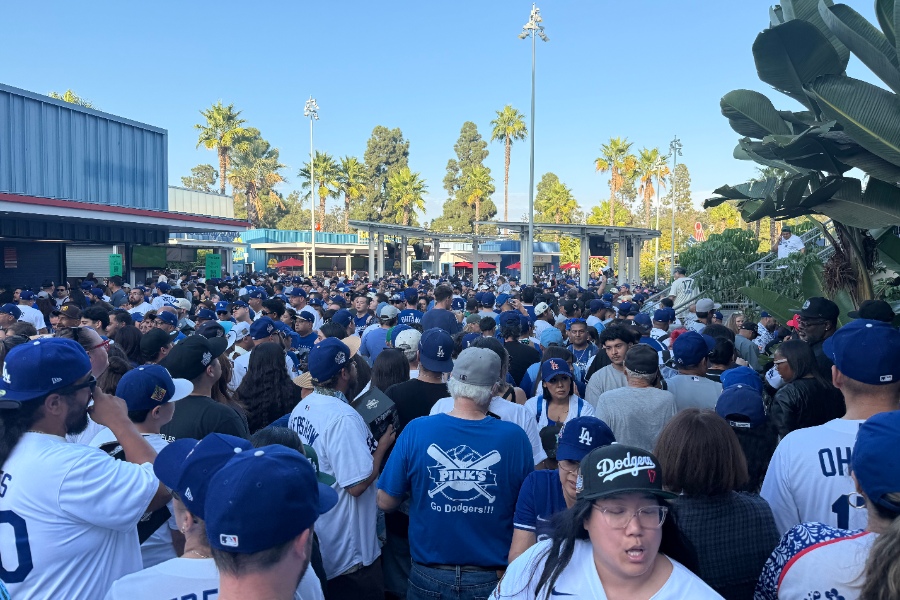
That crowd changes the meaning of any card-inspired design tied to the night. A week earlier, a Godzilla Dodgers card might have been merely another crossover object. After September 24, “Godzilla Dodgers card” describes something fans physically chased inside the stadium.
The Dodgers Had Already Trained Fans to Think Collectible
The anticipation was visible before the event. The Dodgers’ own social feed spent September showing the Godzilla bobblehead, turning the September 24 date into something collectors could plan around rather than discover at the gate.
Once fans arrived, the night effectively offered several collectible layers: the stadium-wide bobblehead, the booth cards and bags, the visual spectacle of the event itself and, afterward, the secondary-market conversation that follows scarcity almost automatically.
Rage +5000 Is a Real Godzilla Card Game Reference
The two Ellie Shirt Metal Wallet Cards use a detail that can look like generic monster-game copy if the viewer does not know the source: Rage (Threat +5000).
In the official Godzilla Card Game rules, Rage is a defined numerical value attached to the Advancing Kaiju. Each point of Rage gives that Kaiju an additional +5000 Threat Level. The wording on the artwork therefore connects the Dodgers stadium crossover to another branch of Godzilla culture: tabletop card-game mechanics.
Rage is not decorative filler. Under the official rules, each point of Rage increases an Advancing Kaiju’s Threat Level by +5000, which is why the phrase feels natural at the bottom of a monster-stat card.
That layer is particularly effective after a night when physical Godzilla cards were already causing lines. The artwork does not need to pretend it is the same card distributed at the stadium. Instead, the Metal Wallet Card format translates that newly visible card obsession into a separate two-sided collectible object.
Minus Zero and 1989 Create Two Different Types of Collector Appeal
The difference is important. The large “1989” on the second design does not refer to a Dodgers season or a date connected to the 2026 promotion. It identifies the Godzilla associated with Godzilla vs. Biollante, the 1989 film in which genetic experimentation creates Biollante, a hybrid built from Godzilla, human and rose DNA.
That choice gives the pair an almost trading-card-set logic. One version belongs to the current movie cycle; the other behaves like a historical variant. Collectors who care mainly about Godzilla Minus Zero have an obvious entry point, while fans of the Heisei period can recognize that the second card is speaking directly to a different era of the franchise.
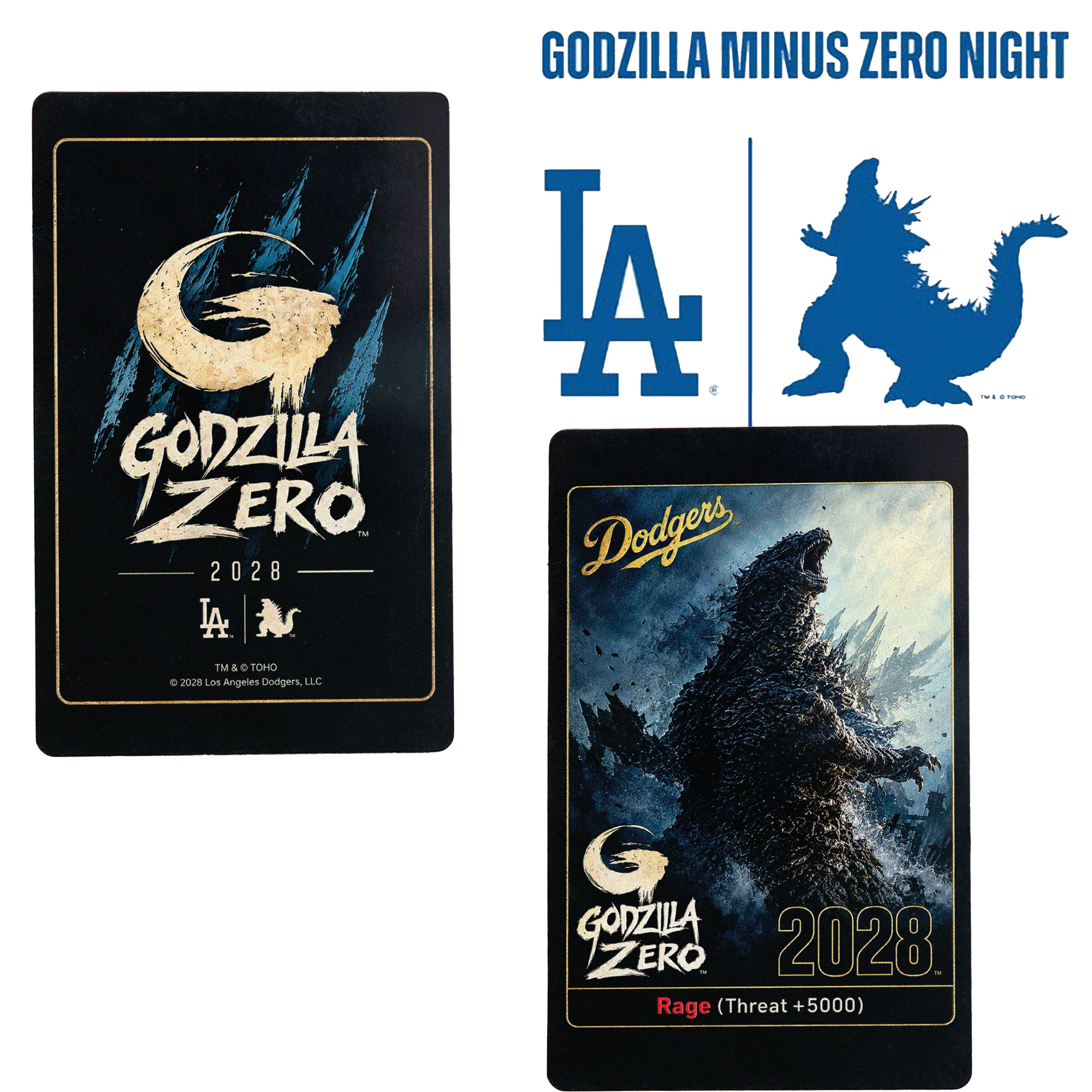
A current-era card treatment built around dark metallic framing, Dodgers crossover identity, Godzilla Minus Zero imagery and the Rage Threat mechanic.
View the Minus Zero card →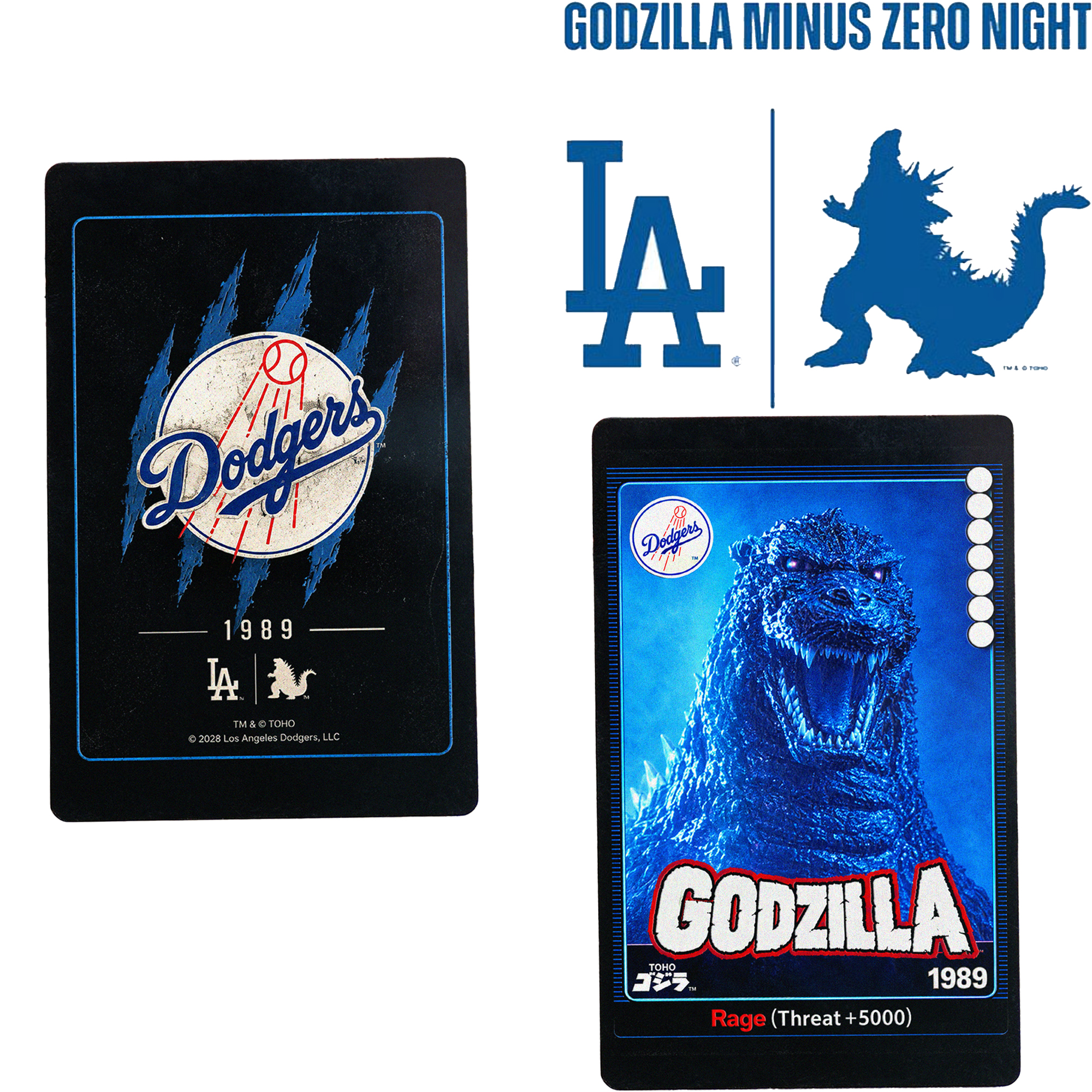
A Heisei-era variant connecting Dodgers Night to the Godzilla vs. Biollante incarnation through electric-blue monster imagery and explicit 1989 labeling.
View the 1989 card →Why Metal Makes Sense for This Particular Moment
Neither Ellie Shirt card should be confused with the paper trading cards distributed at the event. Their value as a concept comes from doing something different: taking the visual grammar of a trading card — identity side, character side, stats, variant year and monster-game terminology — and putting it into a rigid wallet-sized format.
That distinction actually makes the cards more interesting editorially. They are not reproductions of the item fans waited for behind center field. They are artifacts inspired by the same collectible psychology: small objects, recognizable variants and enough coded detail that another fan can immediately understand which version they are looking at.
The Los Angeles Dodgers collection connects the cards to the baseball side of the crossover, while the Movies collection and Godzilla search archive follow the kaiju side. The broader MLB collection places the September 24 frenzy inside the season’s wider fan-culture landscape.
Frequently Asked Questions
Were Godzilla trading cards really distributed at Dodger Stadium?
Yes. A special booth distributed Dodgers × Godzilla trading cards and clear tote bags during Godzilla Minus Zero Night, separate from the 40,000-fan bobblehead giveaway.
Why did the Godzilla card giveaway become a story?
Full-Count reported that the line stretched through large sections of the concourse and that the cards and bags were exhausted by around 5:30 p.m., roughly 50 minutes after the early gate opening.
What does Rage Threat +5000 mean?
It references the official Godzilla Card Game mechanic in which each point of Rage adds +5000 to an Advancing Kaiju’s Threat Level.
What does 1989 mean on the Godzilla card?
It identifies the Godzilla incarnation associated with the 1989 film Godzilla vs. Biollante. It is not the year of the Dodgers event.
Are Ellie Shirt Metal Wallet Cards the same cards distributed at Dodger Stadium?
No. They are separate metal collectibles inspired by the Dodgers × Godzilla cultural moment and card-game aesthetics rather than replicas of the stadium-distributed paper cards.
The Minus Zero card preserves the current 2026 crossover, while the Godzilla 1989 version pulls the same Rage +5000 language deeper into Heisei-era monster history.
Godzilla Metal Wallet Cards capture the Dodgers x Godzilla collectible frenzy through Minus Zero and 1989 variants, two-sided kaiju artwork and the Godzilla Card Game’s Rage Threat +5000 reference.