
Godzilla Minus Zero Night Turned Dodger Stadium Into Kaiju Country
For one September night, the Dodgers’ final regular-season home game stopped looking like an ordinary ballpark promotion. TOHO brought Godzilla into Los Angeles baseball culture, and the visual language was strong enough that two symbols — an LA mark and a monster silhouette — could tell the story without another sentence.
The giant monster was not metaphorical anymore. On September 24, Godzilla was inside Dodger Stadium.
The Los Angeles Dodgers and TOHO staged Godzilla Minus Zero Night during the club’s 2026 regular-season home finale against the San Diego Padres. The first 40,000 ticketed fans received a Godzilla Minus Zero bobblehead built around an almost absurdly perfect crossover image: Godzilla in a Dodgers uniform, blue LA cap on his head, baseball bat clenched between his teeth and “-0.0” used like a jersey number.
That alone would have produced one of the season’s most collectible stadium giveaways. The event kept expanding. Ryunosuke Kamiki, returning as Koichi Shikishima in Godzilla Minus Zero, handled the ceremonial first pitch, while Yoshinobu Yamamoto served as catcher. Godzilla himself appeared at the ballpark, and the postgame program was built around a 2,500-drone presentation titled “The Legacy of Godzilla.”
The crossover worked because Los Angeles did not simply put Godzilla beside the Dodgers. For one night, it made him part of Dodgers visual language.
The Bobblehead Explained the Entire Concept Before First Pitch
The official giveaway remains the cleanest visual summary of the night. Godzilla is not treated like a distant movie character standing outside baseball culture. He has been drafted into it. The blue cap, white jersey and bat make the image unmistakably Dodgers, while the monster’s scales, teeth, claws and curled tail keep TOHO’s identity intact.

That “-0.0” matters because Godzilla Minus Zero is not a random name created for the stadium night. It is Takashi Yamazaki’s follow-up to the Academy Award-winning Godzilla Minus One. Yamazaki returns as writer, director and VFX supervisor, while the story moves forward to 1949, two years after the previous film, with the Shikishima family again facing catastrophe.
The film is scheduled for November 3 in Japan and November 6 in North America, placing the Dodgers event directly inside the movie’s final promotional runway. The stadium was therefore doing two jobs at once: closing the Dodgers’ home regular season and opening another chapter of modern Godzilla culture.
Ryunosuke Kamiki Made the Japan-to-LA Connection Physical
Kamiki throwing the first pitch gave the collaboration a human center. The crossover no longer existed only on posters, bobbleheads or merchandise. The actor associated with Koichi Shikishima physically stepped onto the same field as one of Major League Baseball’s most globally visible franchises.
Yamamoto catching the pitch sharpened that connection further. The visual linked Japanese cinema, Japanese baseball stardom and Los Angeles in a single frame without requiring the night to explain why the partnership made cultural sense.
Two Shirt Designs Reduce the Night to Its Strongest Symbols
The two Ellie Shirt graphics take opposite approaches to the same event. One shows what happens after Godzilla enters the Dodgers world. The other looks like an official meeting between two identities.
The claw-mark design is the more aggressive of the two. From a distance it reads like Los Angeles baseball. Only after the red slashes register does the image change meaning. Those scratches act like evidence: something huge passed through the familiar Dodgers script and left the surface damaged.
The silhouette version removes destruction completely. Godzilla is rendered in Dodgers blue beside the LA mark, with the monster’s heavy legs, dorsal plates and curling tail compressed into a profile recognizable even without a film title. Blue-and-white restraint makes the monster feel absorbed into LA identity rather than pasted over it.
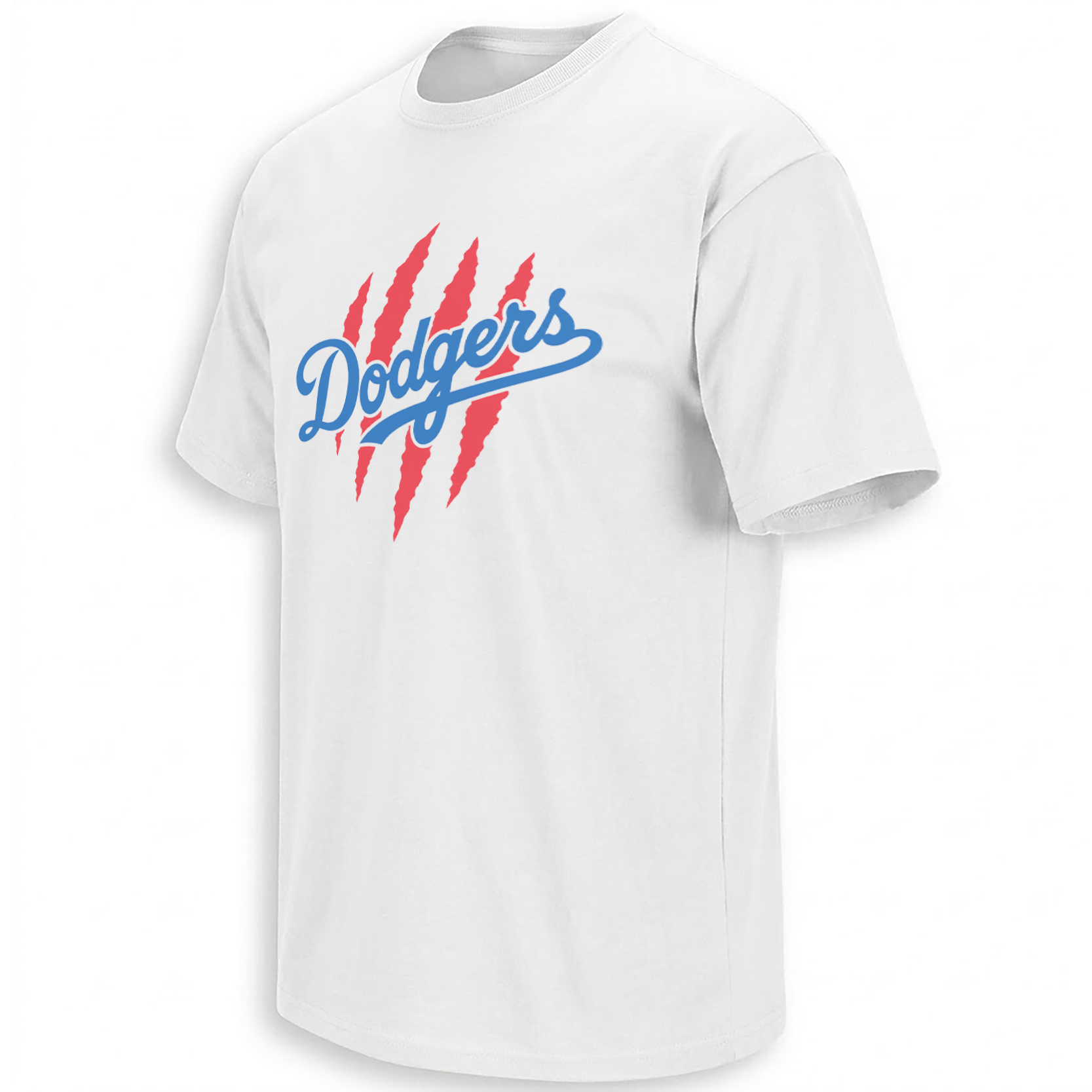
A destruction-first interpretation of September 24: familiar Dodgers typography survives while Godzilla is represented entirely through the marks left behind.
View the claw-mark piece →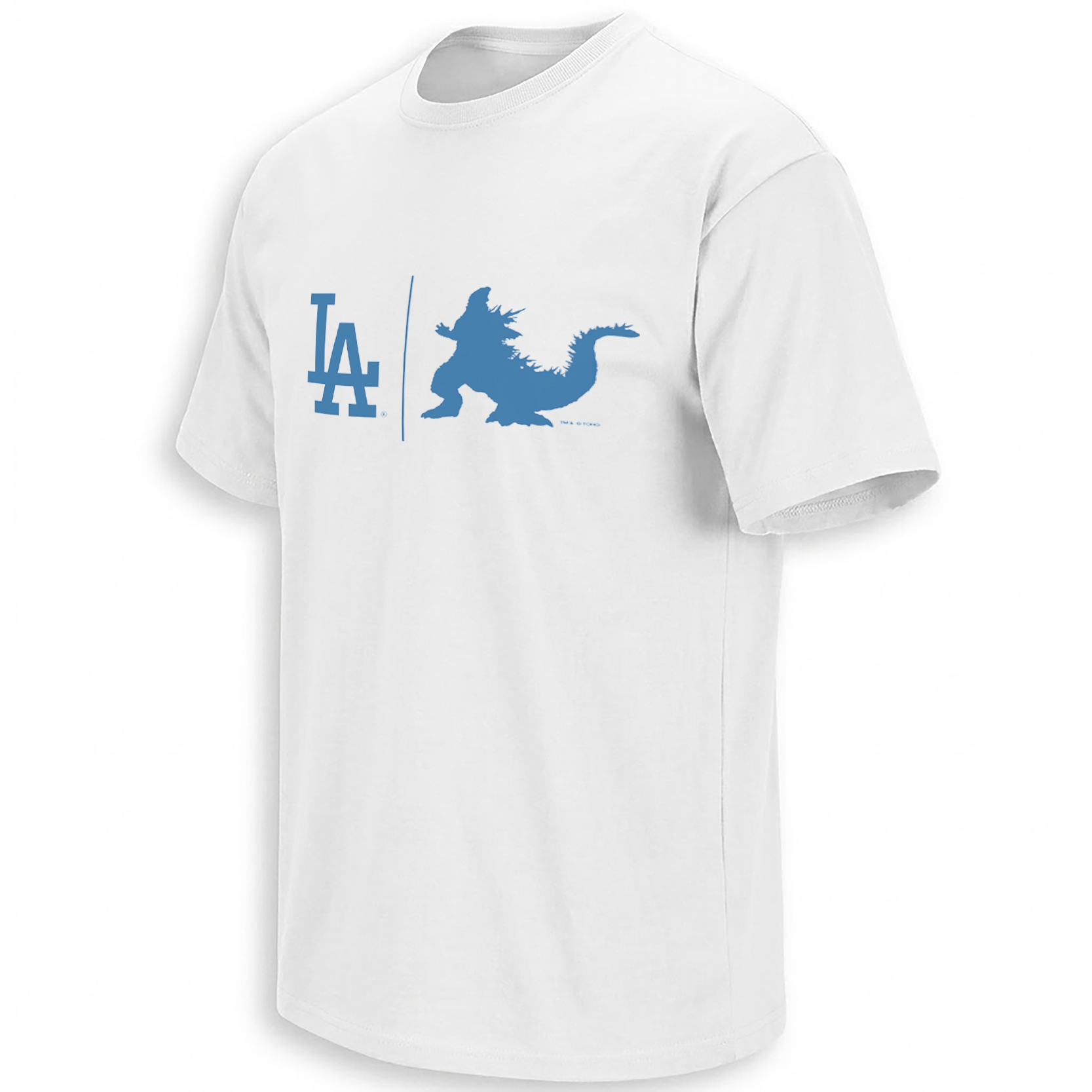
A symbol-to-symbol version of the crossover, reducing the entire event to an LA mark, a divider and one unmistakable kaiju profile.
Explore the silhouette piece →Why Dodgers Culture Keeps Working With Japanese Pop Culture
Godzilla Minus Zero Night also belongs to a larger Los Angeles story. The Dodgers are not approaching Japanese fandom as a niche decoration around the edges of the schedule. Japanese baseball stars, global media attention and repeated entertainment collaborations have made Dodger Stadium one of the clearest meeting points between MLB and contemporary Japanese popular culture.
Godzilla is especially effective in that environment because he needs almost no introduction. Since 1954, the silhouette itself has accumulated enough cultural weight to operate like a logo. That is why the cleanest shirt in this pair can remove movie text, actor names and dates and still remain readable.
The wider Los Angeles Dodgers collection tracks the baseball side of the moment, while the MLB collection places it inside the larger 2026 season. For the cinema side, the Movies collection and Godzilla product search extend the crossover beyond one stadium night.
Frequently Asked Questions
When was Godzilla Minus Zero Night at Dodger Stadium?
The Dodgers and TOHO held the event on September 24, 2026, during Los Angeles’ regular-season home finale against the San Diego Padres.
What did fans receive at Godzilla Minus Zero Night?
The first 40,000 ticketed fans received a special Godzilla Minus Zero bobblehead depicting Godzilla in Dodgers gear with a baseball bat and “-0.0” jersey detail.
Who threw the ceremonial first pitch?
Ryunosuke Kamiki, who returns as Koichi Shikishima in Godzilla Minus Zero, threw the first pitch with Dodgers pitcher Yoshinobu Yamamoto serving as catcher.
What was the postgame Godzilla presentation?
The Dodgers built the finale around a 2,500-drone show titled “The Legacy of Godzilla,” extending the movie crossover into the night sky above the stadium.
Why do the Ellie Shirt designs use claws and a silhouette instead of a full movie poster?
Both graphics reduce the event to recognizable visual shorthand: monster damage in the claw design and a direct LA-versus-Godzilla identity lockup in the silhouette design.
The claw-mark graphic and LA × Godzilla silhouette preserve two different readings of the same September 24 crossover, while the Dodgers archive keeps the moment connected to Los Angeles baseball culture.
Godzilla Dodgers Shirt and Dodgers Godzilla Shirt capture the September 24, 2026 Godzilla Minus Zero Night crossover through monster claw marks, Dodgers-blue kaiju iconography and the collision of LA baseball with TOHO’s King of the Monsters.