
Bradshaw, Polamalu and Watt Explain Why Pittsburgh Football Is Bigger Than One Position
Pittsburgh left Foxborough on September 20 with a 20–3 loss and a 1–1 record. T.J. Watt’s postgame response was not theatrical: the Steelers play to win, so the only useful response was figuring out what went wrong. That instinct connects more cleanly to Steelers history than any stat line.
The Steelers have enough Hall of Famers to build dozens of three-player combinations. No. 12, No. 43 and No. 90 work because they cover three radically different football jobs while preserving one recognizable organizational personality.
Terry Bradshaw represents the 1970s championship machine. Troy Polamalu represents the unpredictable defensive genius of the 2000s. T.J. Watt represents the current version of Pittsburgh’s expectation that its best defensive player should wreck games rather than merely participate in them.
Steelers history is not one uninterrupted defensive story or one quarterback story. It is a standard passed from championship teams to players who are expected to understand exactly what the uniform means.
Terry Bradshaw Is the Championship Foundation
Pittsburgh selected Bradshaw first overall in 1970. His early years were uneven, but by the middle of the decade the Steelers had become an NFL power. Bradshaw started for four Super Bowl-winning teams and was named MVP of Super Bowls XIII and XIV.
He also won the 1978 league MVP award. The important part for this design is not simply that Bradshaw played quarterback. He represents the period when Pittsburgh’s identity changed permanently from old franchise to championship institution.
Polamalu Made Defense Feel Supernatural
Troy Polamalu arrived in 2003 after Pittsburgh traded up to select him 16th overall. His résumé includes two Super Bowl championships, eight Pro Bowls and the 2010 AP Defensive Player of the Year award.
Statistics never fully describe him. Polamalu’s pre-snap movement became part of the entertainment. He could line up deep, walk toward the line, reverse direction, time the snap and appear in a gap before the offense understood what had happened.
Bill Belichick once summarized the problem brutally: if an offense did not know where No. 43 was, he could destroy the play. That unpredictability is why the hair, the number and a crouched stance became enough to identify an entire era of Steelers defense.
T.J. Watt Passed the Steelers’ Cultural Test
Watt tied Michael Strahan’s NFL single-season record with 22.5 sacks in 2021 and won Defensive Player of the Year. He has also repeatedly been voted Pittsburgh’s team MVP.
The more revealing endorsement came from Steelers legends themselves. In an official team feature, figures including Mel Blount and Joe Greene said Watt possessed the intensity and motor that would have allowed him to play with Pittsburgh’s championship generations.

That makes Watt an ideal third figure beside Bradshaw and Polamalu. He is not being projected into history by fans alone. Steelers history has already been used as the measuring stick for him.
The After Dark Design Turns “Steelers Toughness” Into Character
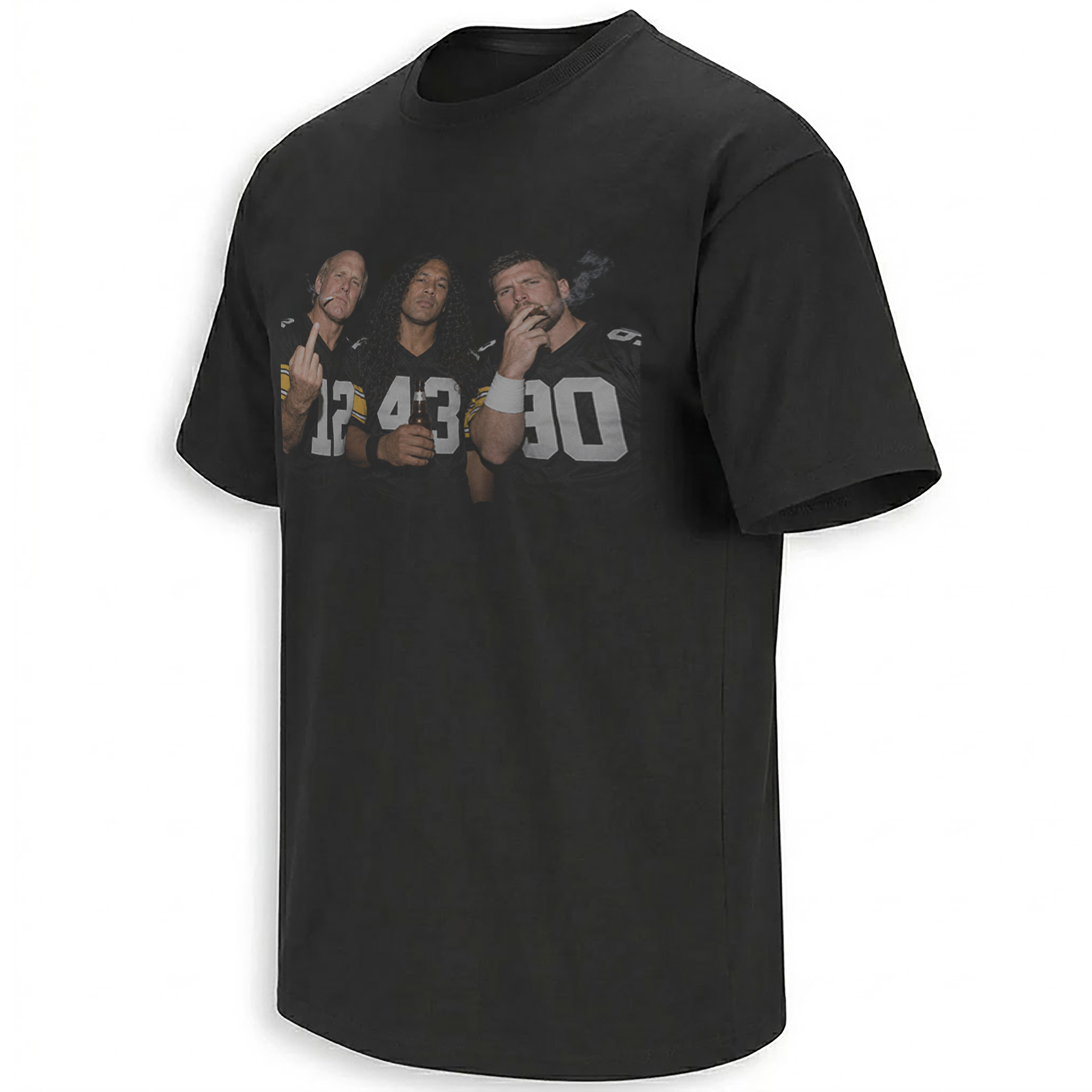
The selection is intentionally positionless. A quarterback, safety and edge rusher are being treated as three faces of the same franchise temperament.
The After Dark styling exaggerates that temperament with drinks, smoke, direct eye contact and a black backdrop. The scene is fictional, but the visual logic is grounded in Pittsburgh’s reputation: hard football, little ornament and an almost obsessive relationship with past champions.
The NFL After Dark series becomes stronger when the players are chosen for franchise DNA rather than positional symmetry. Bradshaw, Polamalu and Watt are not the same kind of football star. That is the point.
From the 1970s to No. 90
The Pittsburgh Steelers collection spans the franchise’s championship history, current roster and fan language, while the broader NFL collection puts this trio beside other team identities.
Bradshaw represents winning becoming institutional. Polamalu represents defense becoming art. Watt represents the current expectation that one defender can still carry old Pittsburgh energy into a completely different NFL.
Frequently Asked Questions
Who are Nos. 12, 43 and 90?
Terry Bradshaw is No. 12, Troy Polamalu No. 43 and T.J. Watt No. 90.
How many Super Bowls did Bradshaw win?
Bradshaw quarterbacked Pittsburgh to four Super Bowl championships and won Super Bowl MVP twice.
What made Troy Polamalu a Steelers icon?
His instinctive, unpredictable safety play helped Pittsburgh win two Super Bowls and earned him the 2010 Defensive Player of the Year award.
Why is T.J. Watt included?
Watt represents Pittsburgh’s current defensive tradition, including a Defensive Player of the Year award and a 22.5-sack season that tied the NFL record.
The Pittsburgh Franchise Icons design compresses three eras into one black-and-gold After Dark portrait.
Pittsburgh Franchise Icons Shirt unites Terry Bradshaw #12, Troy Polamalu #43 and T.J. Watt #90 in an NFL After Dark portrait connecting championship offense, instinctive defense and the modern Steelers pass-rush standard.