
Ken Stabler, Bo Jackson and Maxx Crosby Are Three Different Versions of Being a Raider
The Raiders are 2–0 in September 2026, Maxx Crosby is still setting the emotional temperature of the defense, and the franchise suddenly looks purposeful again. That makes an old Raiders question newly relevant: what qualities actually make somebody feel unmistakably Silver & Black?
Las Vegas beat the Chargers 26–14 on September 20, giving new head coach Klint Kubiak the first 2–0 start by a non-interim Raiders coach since Bill Callahan in 2002. Crosby’s reaction afterward was characteristically brief. Through the Raiders’ own social-reaction roundup, his message was essentially: job finished, next opponent.
That mindset is why No. 98 fits naturally beside Nos. 12 and 34 even though this is not a same-position lineage. Ken Stabler, Bo Jackson and Maxx Crosby are connected less by statistics than by personality. Each represents a Raiders trait the franchise has spent decades mythologizing: swagger, physical impossibility and controlled violence.
Raiders history has never required its icons to play the same position. It requires them to look as if they would make sense wearing Silver & Black in any decade.
Ken Stabler Gave the Raiders Their Outlaw Quarterback
Stabler played for Oakland from 1970 through 1979 and became the full-time starter in 1973. From there, the Raiders reached five consecutive AFC Championship Games. He won league MVP honors in 1974 and eventually quarterbacked Oakland to its first Super Bowl championship after the 1976 season.
But “Snake” mattered beyond his résumé. Raiders history remembers his left arm, late-game nerve, shaggy 1970s persona and willingness to play football as if conventional quarterback behavior were optional. The organization’s own historical coverage describes him as the human embodiment of Raiders swagger.
Bo Jackson Did Not Need a Long Career to Become Permanent
Bo Jackson played only 38 regular-season games for the Raiders. That should make him an odd candidate for a three-man franchise-icons design. Instead, it explains exactly how powerful his mythology became.
Jackson rushed for 2,782 yards, produced two of the longest runs in Raiders history and detonated for 221 rushing yards against Seattle on Monday Night Football in 1987. He was simultaneously playing Major League Baseball, which made every football appearance feel like an athlete operating outside normal professional-sports rules.
A hip injury ended his football career far too early. The lack of longevity did not shrink the legend. It concentrated it. No. 34 represents Raiders spectacle — the player casual sports fans can identify even if they never watched an entire Raiders season from the era.
Maxx Crosby Is the Modern Translation
Crosby arrived as a fourth-round pick in 2019 and gradually became the current player who most naturally carries the old franchise attitude. In January 2026, Raiders teammates voted him the Commitment to Excellence Award winner for the fifth consecutive season.
The detail is unusually appropriate because Stabler himself won earlier versions of that same franchise award three times in the 1970s. Crosby is therefore not merely being placed beside Raiders history visually; the organization’s internal recognition already connects him to it.
That is about as Raiders as a postgame sentence can get. No elaborate celebration, no attempt to make a 2–0 start sound historic. Win, close the file, move to the next fight.
The After Dark Artwork Understands Why These Three Belong Together
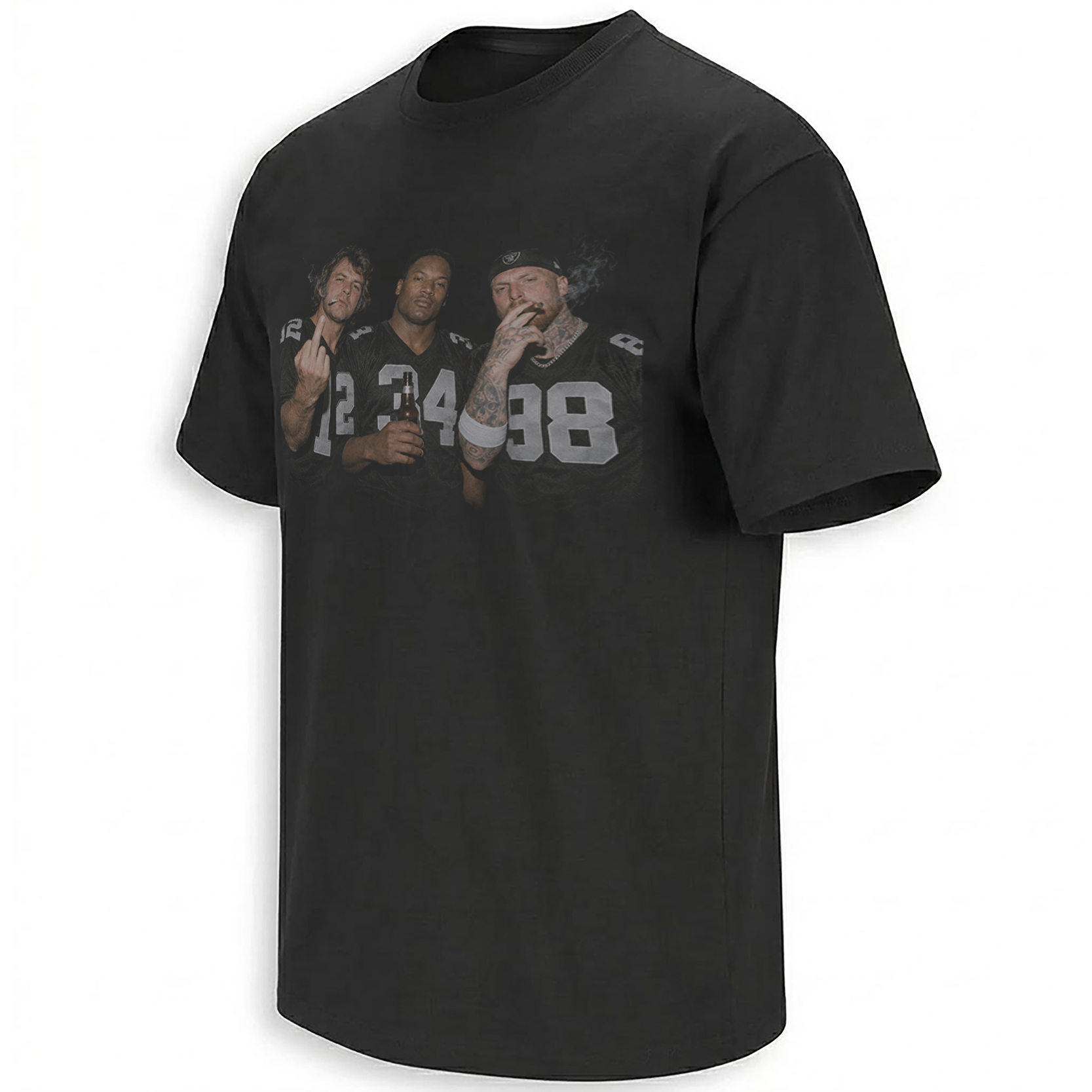
This is where “Franchise Icons” differs from the QB Legends series. Stabler is the quarterback. Jackson is the freak athlete. Crosby is the defensive enforcer. The mismatch is the concept.
In the artwork, cigarette smoke, dark sunglasses, drinks and hostile body language deliberately exaggerate the Raiders’ pop-cultural reputation. It is not documentary history. It is a fictional night in which three generations of Raider Nation recognize each other instantly.
The NFL After Dark collection imagines cross-era franchise figures in scenes that never literally happened, using numbers, attitude and team mythology as the connecting language.
Why 12 / 34 / 98 Is More Interesting Than Simply Picking Three Quarterbacks
The Raiders have had important quarterbacks, running backs, receivers and defenders across Oakland, Los Angeles and Las Vegas. Choosing one player from three different roles says more about the franchise’s identity than a strict position timeline could.
Stabler represents the old Oakland attitude. Jackson represents Raiders cool at its most nationally recognizable. Crosby represents the version still active in 2026.
The Las Vegas Raiders collection carries that history across eras, while the broader NFL collection places the series alongside other franchise cultures.
Frequently Asked Questions
Who are Nos. 12, 34 and 98 in the Raiders design?
They are quarterback Ken Stabler, running back Bo Jackson and defensive end Maxx Crosby.
Did Ken Stabler win a Super Bowl with the Raiders?
Yes. Stabler quarterbacked Oakland to victory over Minnesota in Super Bowl XI after the 1976 season.
Why is Bo Jackson considered a franchise icon despite playing only four seasons?
His extraordinary two-sport fame, explosive rushing performances and cultural impact made his short Raiders career unusually memorable.
Why is Maxx Crosby included?
Crosby represents the modern Raiders identity and entered 2026 after being voted the team’s Commitment to Excellence Award winner five straight times.
The Raiders Franchise Icons piece turns those three ideas into one fictional night inside the wider NFL After Dark universe.
Raiders Franchise Icons Shirt brings Ken Stabler #12, Bo Jackson #34 and Maxx Crosby #98 together in an NFL After Dark portrait built around the outlaw swagger, athletic spectacle and defensive intensity that define Silver & Black culture.