“Our Enemies Aren’t in Iran”: How the Epstein Files Became Protest Language
In 2026, anti-war criticism and demands for Epstein-file transparency have begun colliding in the same signs, congressional arguments and political graphics. The phrase is not a factual verdict. It is a protest slogan built around a question of priorities.
The sentence already existed in the street before it became a graphic. At a 2026 No Kings demonstration in Grand Rapids, Michigan, one protester held a hand-lettered sign reading “EPSTEIN files are NOT in IRAN!” The wording was different, but the political construction was almost identical: reject the foreign-policy focus, redirect attention toward unanswered questions at home.
That contrast has become sharper as the year has moved forward. The United States entered a prolonged conflict with Iran after U.S. and Israeli strikes in late February, while lawmakers in Washington continued fighting over congressional authorization, military policy and the costs of the war. In September, President Donald Trump said he hoped the conflict was moving toward its end, but Iran remained one of the central foreign-policy stories of the moment.
At the same time, the Epstein records have not disappeared from domestic politics. The Department of Justice continues to operate a searchable public Epstein Library containing DOJ disclosures and House Oversight material, while congressional battles over further records, subpoenas and transparency remain active.
The slogan works by forcing two political stories into one frame: foreign war outside the country, accountability questions inside it.
The Protest Sign Came Before the Shirt
Political slogans become culturally significant when different people arrive at versions of the same sentence independently. That is what makes the Grand Rapids photograph useful. The sign does not say “Our enemies aren’t in Iran.” It says “EPSTEIN files are NOT in IRAN!” Yet both expressions use the same rhetorical device: Iran represents the external conflict; the Epstein files represent unresolved domestic scrutiny.
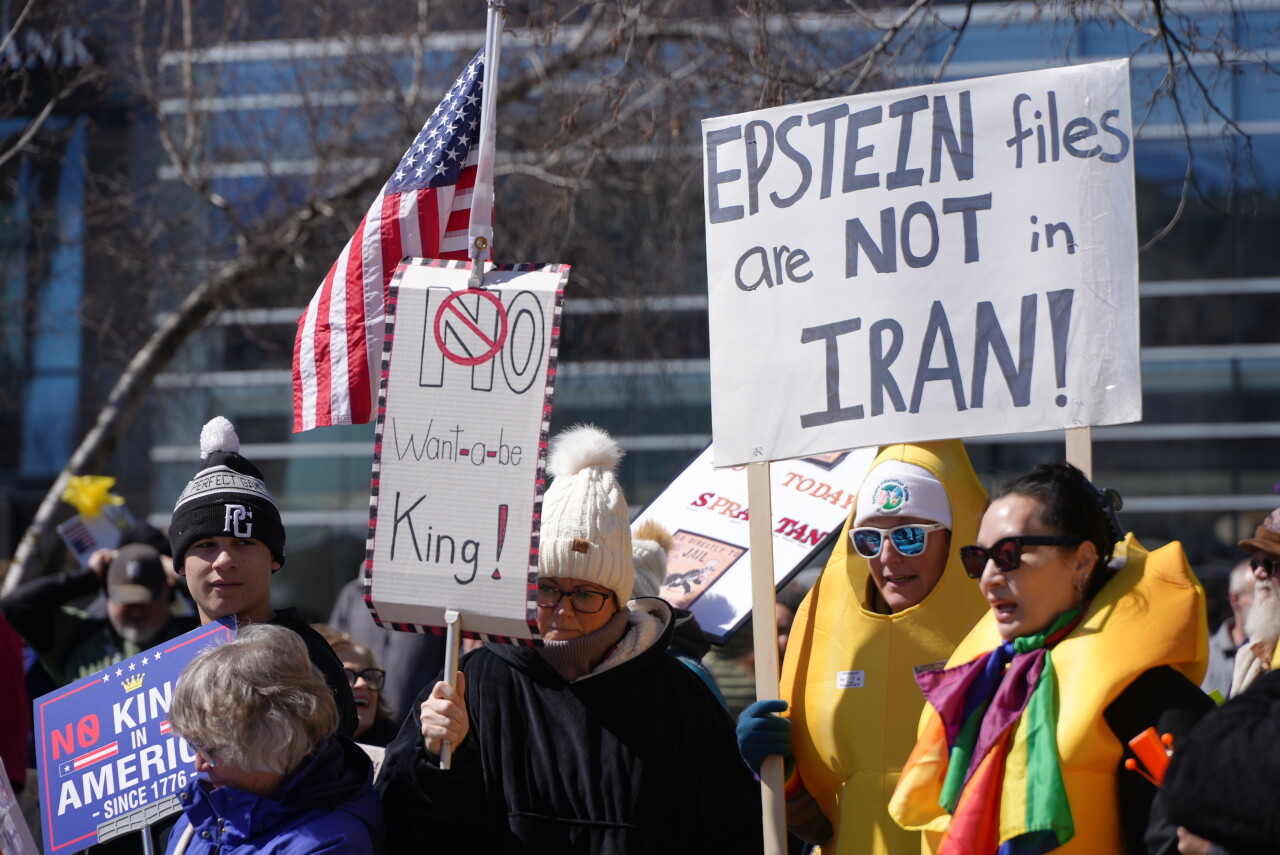
That matters editorially because it shows the idea functioning as protest language rather than only ecommerce copy. Demonstration signs are designed under the same constraint as strong shirt graphics: they need to communicate before the viewer walks past.
Why Epstein and Iran Are Being Put in the Same Sentence
The slogan should not be read literally as a geopolitical analysis. Iran is a sovereign state involved in a real conflict, and the Epstein files are records connected to a convicted sex offender, criminal investigations and ongoing congressional scrutiny. They are completely different categories of issue.
The phrase connects them rhetorically, not factually. Critics use the juxtaposition to argue that government attention, media attention or political energy is being directed outward while important questions about powerful people and institutional accountability remain unresolved at home.
That argument became especially visible in Congress because Republican Representative Thomas Massie has occupied both debates. In September he pursued action against Defense Secretary Pete Hegseth over the Iran conflict while also continuing to push Epstein-file transparency efforts with Democratic Representative Ro Khanna. The overlap gave the two stories an unusual shared political vocabulary.
Appearance in an Epstein-related document, contact record or investigative file does not by itself prove criminal conduct. The design is political protest art. Donald Trump’s silhouette identifies the administration and political target of the criticism; it should not be presented as evidence that the graphic’s implied accusations are established facts.
Trump’s Silhouette Turns the Sentence Into a Poster
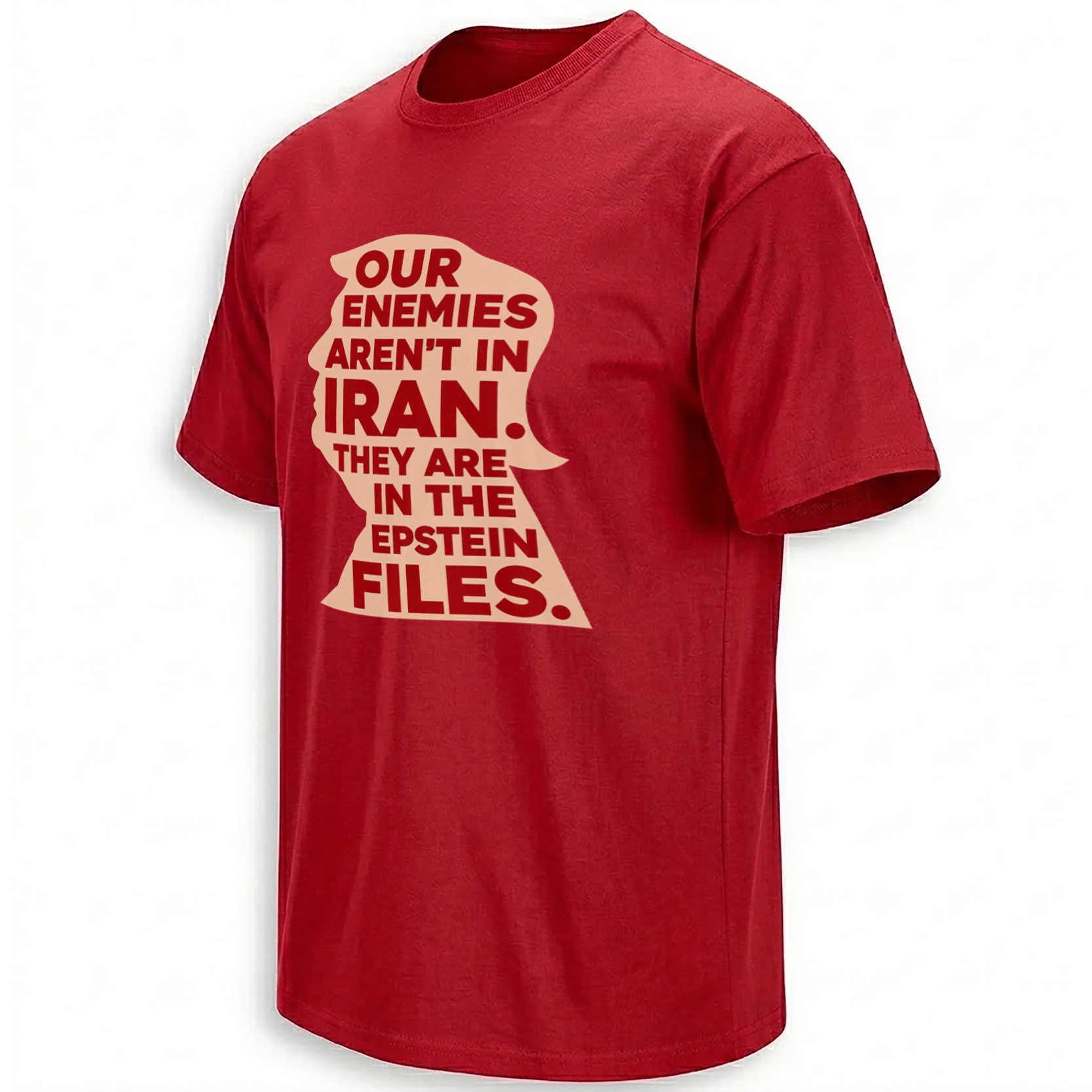
The Our Enemies Aren’t in Iran Shirt avoids a conventional politician portrait. Instead, the entire statement is physically contained inside the cream-colored profile of Donald Trump.
That choice matters. The hair, forehead, nose and chin create the recognizable outline, but the face itself is empty. Language fills the person-shaped space. “IRAN” expands across the upper half; “EPSTEIN FILES” becomes the lower visual anchor. The target and the accusation therefore cannot be visually separated.
The Two-Color Palette Makes It Look Like Street Print
Red, cream and negative space do most of the visual work. There is no photographic detail, flag collage or complicated background. That reduction gives the design the visual economy of protest flyers, union posters and cheaply reproduced political prints.
It also lets the wording dominate. “OUR ENEMIES” establishes confrontation. “AREN’T IN IRAN” rejects one target. “THEY ARE IN THE EPSTEIN FILES” redirects the accusation. The rhythm functions almost like three signs stacked on top of one another.
Within Ellie Shirt, the piece sits naturally beside the broader Anti Trump collection, where criticism of Trump, administration policy and political controversy is treated as a visual archive of current protest culture. More recent cultural and political graphics also appear in the Newest collection. Readers following Trump-specific designs can use the Donald Trump product search.
Frequently Asked Questions
What does “Our Enemies Aren’t in Iran, They Are in the Epstein Files” mean?
It is a protest slogan arguing that domestic accountability and Epstein-file transparency deserve more political attention than continued military conflict with Iran.
Is the phrase literally claiming Iran is not a threat?
No. Its function is rhetorical. It contrasts an external war with domestic political accountability rather than providing a literal intelligence or foreign-policy assessment.
Are the Epstein files still a political issue in 2026?
Yes. The Department of Justice maintains a public Epstein Library, and congressional disputes over documents, subpoenas and further disclosure remain active.
Why is Donald Trump’s silhouette used in the graphic?
The silhouette identifies the protest as criticism of Trump-era political leadership and policy rather than a generic anti-war statement.
Does the design prove Trump committed an Epstein-related crime?
No. The image is political protest art and should not be treated as evidence of criminal conduct.
The Our Enemies Aren’t in Iran design compresses two of 2026’s most persistent political arguments into one red-and-cream poster image, while the wider Anti Trump archive documents how current criticism becomes visual language.
Our Enemies Aren’t in Iran Shirt captures a 2026 anti-war and Epstein-transparency protest slogan inside Donald Trump’s profile, using stark red-and-cream poster styling to frame a debate over political priorities and accountability.