
“Idolizing a Politician” Turns Political Fandom Into One Transactional Joke
The line is crude because subtlety would weaken it: elected officials want votes, attention and loyalty. Mistaking that professional relationship for personal devotion is the entire punchline.
Political support and political idolization are not the same thing. A voter can admire a lawmaker, volunteer for a campaign, donate money or strongly defend a policy without believing that the politician has become a personal friend. “Idolizing a politician is like believing the stripper really likes you” exists precisely in the uncomfortable space where ordinary support begins behaving like fandom.
The analogy is intentionally transactional. Politicians need something from the public: votes, donations, turnout, attention and legitimacy. Adult entertainers perform within another explicitly transactional environment. The joke argues that confusing either professional interaction with unconditional personal affection requires a similar suspension of skepticism.
It is not sophisticated political theory. It is a bar-stool-sized warning against confusing public performance with private intimacy.
The exact quote was online years before the 2026 election cycle
The wording is not a new September meme.
Know Your Meme archived an image containing the exact line on February 19, 2021 and identified its source as a Twitter post from @LarinzoMosley. That establishes that the joke was circulating publicly at least by early 2021.
It does not establish definitive authorship. Internet one-liners are repeatedly reposted, cropped and unattributed, and the available archive is evidence of circulation rather than proof that one account invented the sentence.

The 2021 tweet is the earliest clearly documented source recovered for this article. Because repost culture often removes attribution, it should be described as an archived early appearance, not automatically as the first time anyone ever wrote the joke.
The shirt is not telling people to stop voting for politicians. It is telling them to remember that politicians are not members of the family.
Political science actually has language for the thing being mocked
Researchers increasingly study political parasocial relationships: one-sided feelings of familiarity or attachment that citizens develop toward public figures they encounter repeatedly through television, rallies, podcasts and social media.
The concept does not mean every enthusiastic supporter is irrational. Personal connection can increase political interest and participation. But research also asks what happens when mediated familiarity begins altering how voters evaluate accountability, criticism and mistakes.
A 2026 political-fandom research volume describes modern politicians as increasingly “celebrified,” with supporters consuming content, creating memes, joining communities and developing emotional attachments in ways that can resemble entertainment fandom.
That academic language is far more careful than the shirt. The shirt compresses the same general tension into twelve words and an adult-entertainment analogy.
The 2026 midterms make leader-centered politics impossible to ignore
The design itself does not mention Donald Trump, Republicans, Democrats or any candidate. That neutrality is visible in the artwork and should remain part of the interpretation.
But current politics provides an unusually clear example of why the broader subject is timely.
At the Republican Party’s September midterm convention in Dallas, Trump explicitly encouraged voters to treat November’s congressional elections as though he were personally on the ballot. Reuters found Republican attendees divided over that Trump-centered strategy: some believed his ability to mobilize loyal supporters was indispensable, while others worried that centering one political personality could hurt candidates who needed independent voters.
That does not prove the shirt’s judgment about Trump or his supporters. It demonstrates something narrower: American election strategy in 2026 is openly wrestling with the power of attachment to individual political personalities.
Leader worship is not a formal property of one party. Politicians across ideological systems use personality, social media intimacy, merchandise, rallies and emotional narratives. The design’s visible wording targets the behavior — idolization — rather than telling the wearer which party deserves support.
The artwork looks like a campaign poster that distrusts campaigns
The Idolizing A Politician Shirt is almost entirely typography.
“POLITICIAN” appears in oversized red capitals. Several lines later, “THE STRIPPER” receives the same red treatment. That visual mirroring performs the comparison before the sentence is fully read.
White text handles the connecting language, while small stars and horizontal rules borrow the grammar of campaign graphics without endorsing an actual campaign. Black, red and white keep the design confrontational and legible from a distance.
Most importantly, there is no face.
No Trump. No Vance. No Democrat. No elephant or donkey. The absence keeps the satire aimed at political idolization itself rather than turning an evergreen joke into one election’s merchandise.
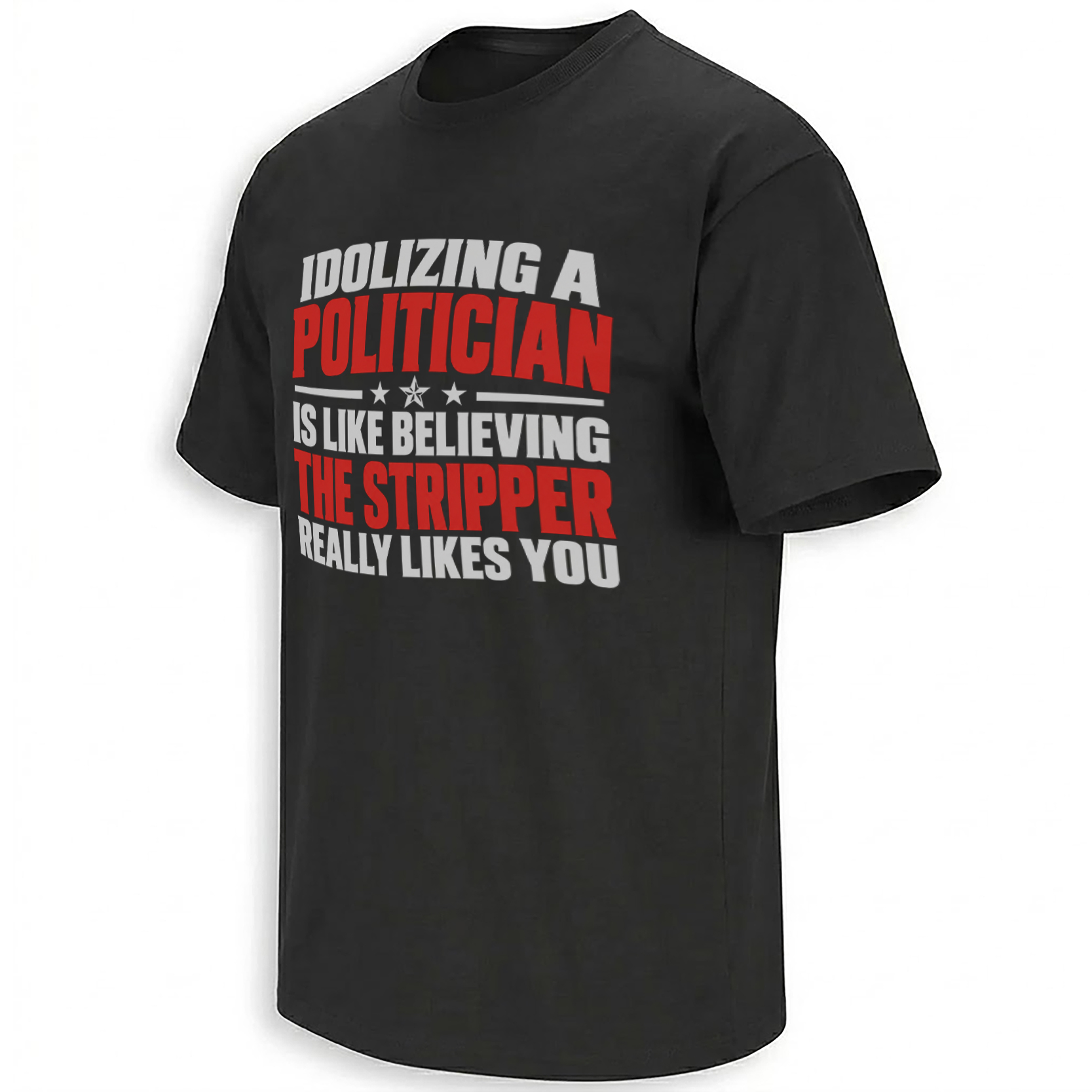
Red-and-white campaign-style typography places POLITICIAN and THE STRIPPER on equal visual footing, turning the transactional analogy into the entire graphic.
View the design →Skepticism is not the same thing as cynicism
There is an obvious counterpoint to the shirt’s worldview. Democracies require participation. Political movements often need inspiring leaders. Admiration can motivate people to organize, vote and pay attention to issues they otherwise would ignore.
The satire becomes most coherent when read as a warning against unconditional loyalty rather than an argument that every politician is fraudulent or every supporter is gullible.
You can like the candidate.
You can still check the receipt.
Where the satire sits inside Ellie Shirt
The product page currently confirms the design inside Ellie Shirt’s Newest collection. Because the visible design does not target one named politician, linking it into a candidate-specific collection would narrow a joke that is intentionally broader.
Idolizing a Politician FAQ
What does the stripper comparison mean?
It jokes that both politics and adult entertainment involve professional performances, so assuming professional attention equals personal affection can be naïve.
Who originally said the quote?
Know Your Meme archived the exact wording from an @LarinzoMosley Twitter post in February 2021, but that does not conclusively establish the account as the original author.
Is the design anti-Trump?
The visible artwork does not name Donald Trump or any other politician. Its stated target is political idolization in general.
Is the shirt saying people should not support politicians?
No. The joke makes more sense as criticism of unconditional hero worship than as criticism of voting, campaigning or ordinary political support.
Why is the quote relevant in 2026?
Leader-centered campaigning, political influencers, social-media intimacy and personality-driven election strategy remain highly visible during the 2026 midterms.
Politics requires trust, but democracy also requires the ability to withdraw that trust. The joke simply makes that principle much less polite. Explore more newly released political and cultural graphics through Ellie Shirt’s Newest collection.
Idolizing A Politician Shirt turns a political one-liner documented online since at least 2021 into blunt red-and-white satire about political fandom, parasocial loyalty and the difference between supporting a public official and worshiping one.