
“We Listen and We Don’t Judge” Became Funniest When Everyone Started Judging
The original challenge asked people to reveal secrets without criticism. The internet quickly discovered that the facial expression of the person trying not to react was often better than the confession itself.
“We listen and we don’t judge” sounds like the beginning of a supportive conversation. For a few seconds, that really was the premise. Friends, couples, family members and coworkers sat beside one another, repeated the phrase and took turns admitting things they had never previously confessed.
Then somebody admitted something outrageous.
The listener remained technically silent, as promised. Their eyebrows did not cooperate. Neither did their eyes.
That contradiction turned a confession game into one of the most reusable reaction formats of the mid-2020s. The words promised empathy. The face delivered a verdict.
The trend did not actually begin with American TikTok couples
Internet-memory compression can make every viral format appear to have begun at the moment American TikTok noticed it. The available trail points earlier.
Know Your Meme traces one of the earliest documented versions to South African creator @thestanlley1, whose April 21, 2024 Instagram sketch showed friends taking turns sharing secrets while reluctantly repeating “we listen, we don’t judge.”
The post later accumulated more than nine million views. By November, American creators had adopted the format in enormous numbers. Videos from couples such as @larobenz and @daveandjanie reached tens of millions of views while audiences watched increasingly dangerous levels of honesty unfold on camera.
What made the challenge unusual was that its stated rule and its entertainment value were pulling in opposite directions. Participants were supposed to provide a judgment-free space. Viewers were watching specifically to see whether that promise could survive the next confession.
The words said “no judgment.” The eyes became a completely separate communication system.
The reaction face eventually became more portable than the challenge
A viral challenge has a limited structure. You need two or more participants, a confession and enough trust to risk hearing the answer.
A side-eye reaction requires none of that.
By 2025, “We Listen and We Don’t Judge” was already circulating alongside exaggerated doll faces and wide-eyed reaction images. The format no longer needed a specific couple or original sound. The phrase itself became shorthand for the experience of hearing something ridiculous while attempting to maintain social composure.
Two people openly confess secrets while promising not to criticize one another.
Someone hears something unbelievable, stays verbally quiet and lets a dramatic side-eye reveal the judgment anyway.

The judgy doll captures the mutation better than another couple video
The We Listen and We Don’t Judge Shirt does not recreate a specific TikTok creator. That is exactly why the design works in 2026.
A glamorous doll-like woman dominates the composition. Long styled brown hair frames the face, sunglasses rest above her head and glossy pink details keep the portrait polished. Then the eyes destroy the idea that anything about the reaction is neutral.
She looks sharply sideways with raised brows and pursed lips — the universal expression of someone who has heard your explanation and is now reorganizing everything they thought they knew about you.
Beneath the portrait, large white serif capitals read “WE LISTEN.” A smaller line promises “AND WE DON’T JUDGE.”
The text and face contradict one another so efficiently that a viewer no longer needs to remember the original challenge mechanics. The meme survives through visual irony alone.
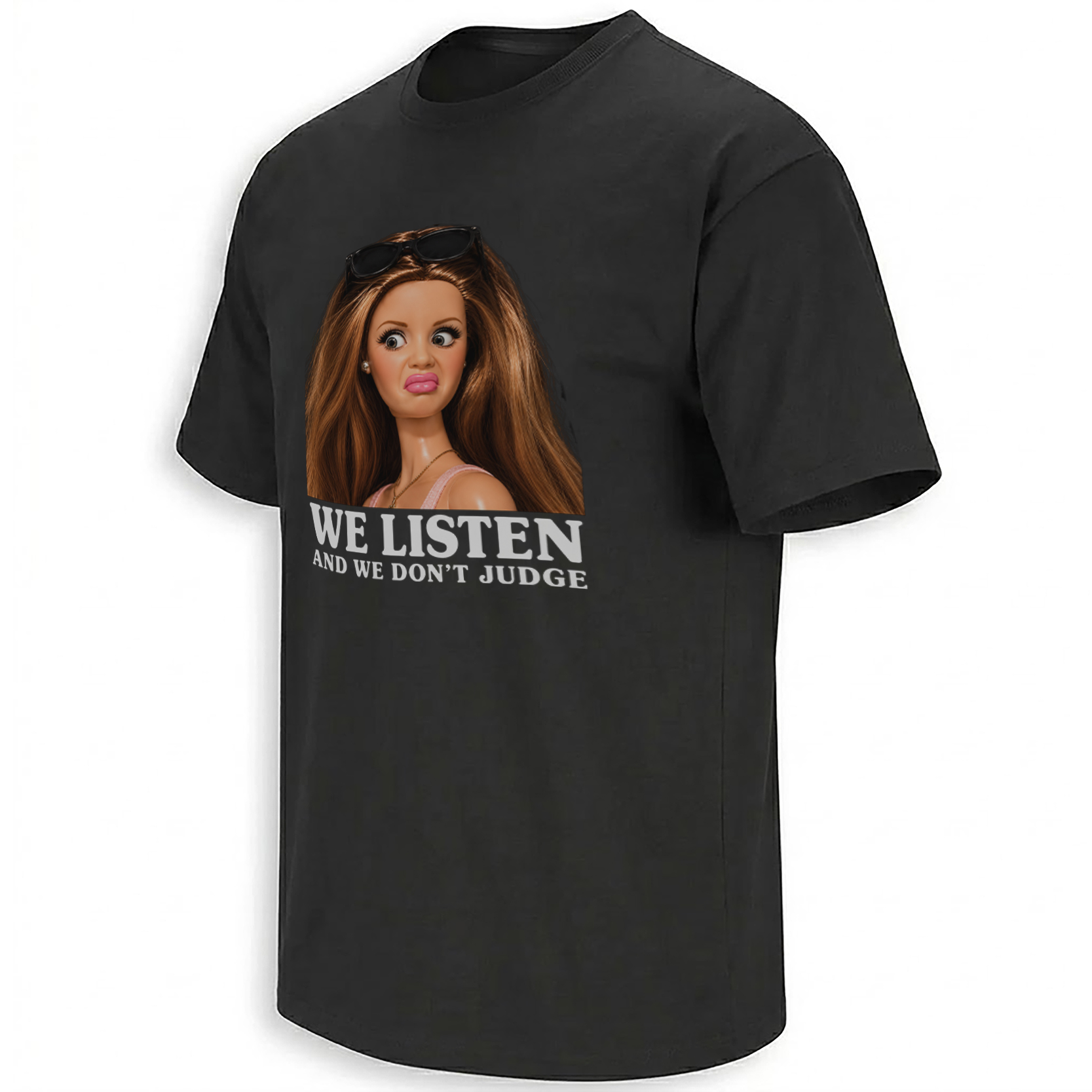
A polished fashion-doll portrait, giant suspicious eyes and a perfectly skeptical side glance turn the supportive confession phrase into the reaction everybody remembers.
View the design →Why the meme survived after the challenge cooled down
Most participatory trends disappear when people get tired of repeating the format. Reaction memes have a better chance of surviving because they can be applied to new situations.
“We Listen and We Don’t Judge” now works when a coworker begins oversharing, when a friend reveals a questionable dating decision, when someone explains an obviously terrible purchase or when a family member begins a sentence with “don’t be mad, but.”
The viewer already understands the contradiction. Listening is happening. Judgment is also happening. Only one of those activities is being admitted publicly.
That is why the doll version feels less like nostalgia for a 2024 TikTok trend and more like a reusable 2026 reaction graphic.
Where the meme lives inside Ellie Shirt
The product page currently confirms this design inside Ellie Shirt’s Newest collection. Because the artwork belongs to broad internet-reaction culture rather than one celebrity or creator, keeping the internal path there is cleaner than inventing a dedicated meme collection.
We Listen and We Don’t Judge FAQ
What is the We Listen and We Don’t Judge trend?
It is a social-media confession format where participants reveal secrets while everyone promises to listen without criticizing them.
When did the trend become popular?
Early documented versions appeared in 2024, with the format gaining major U.S. TikTok traction in November and December of that year.
Why is the doll giving side-eye?
The expression is the punchline. The words promise not to judge, while the face clearly suggests intense internal judgment.
Is the doll based on one specific TikTok creator?
No. The design represents the broader reaction meme that grew out of the challenge rather than copying one creator’s video.
Why is the phrase still recognizable in 2026?
The confession challenge peaked earlier, but the wording survived as shorthand for listening silently while facial expressions reveal what someone really thinks.
The original challenge asked whether people could hear uncomfortable truths without judging. Internet culture eventually found a simpler answer: maybe not, but at least the reaction faces are useful. Explore more current meme and culture releases through Ellie Shirt’s Newest collection.
We Listen and We Don’t Judge Shirt turns the 2024 confession challenge into a 2026 side-eye reaction meme, pairing the familiar phrase with a glamorous doll whose expression clearly breaks the no-judgment promise.