Josh Hoover Didn’t Just Wear Crimson. He Bled It.
Indiana’s new No. 10 walked into one of the hardest jobs in college football — replacing a Heisman-winning quarterback for the defending national champions — and left his debut with four touchdowns, a bloodied face and one image that made “Bleed Crimson” suddenly feel literal.
Josh Hoover’s first afternoon as Indiana’s starting quarterback already had enough pressure before anyone touched his facemask. The Hoosiers were unveiling the memory of a perfect 2025 national-title season, Bloomington was packed, and the player wearing No. 10 was following Fernando Mendoza into a position where winning had abruptly become the expectation.
Then the second quarter supplied an image no marketing campaign could have planned. A North Texas defender grabbed Hoover’s facemask, twisted his helmet off and left the quarterback on the turf with blood running from the bridge of his nose.
Hoover stayed in. Soon afterward, he threw another touchdown.
“Bleed Crimson” began as school-color language. One quarter into Hoover’s Indiana career, it had acquired an image fans could actually remember.
The Bloody-Face Moment Changed the Meaning of the Graphic
Indiana’s official recap did not bury the moment. It described Hoover as bloodied, noted that he continued playing and quoted Curt Cignetti saying the quarterback had earned the respect of his teammates. Hoover himself treated the injury much more casually, explaining afterward that it looked worse than it was.
That contrast is exactly why the image traveled. The visual was dramatic; Hoover’s reaction was not. Instead of turning it into theater, he went back to operating the offense.
By the end of Indiana’s 52-16 win, he had completed 13 of 16 attempts for 231 yards, four touchdowns and no interceptions. For a player entering Bloomington with 31 career starts from TCU, the afternoon made experience visible immediately.

Why “Bleed Crimson” Works Better Now Than Before Kickoff
“Bleed” language has existed across college sports for generations. Fans bleed school colors, rivalries run in the blood and uniforms become shorthand for identity. Most of the time, it is metaphor.
Hoover accidentally gave the phrase documentary value. The design’s crimson typography, No. 10 uniform and player portrait now correspond to a real opening-week image: the new quarterback standing in the middle of Indiana’s title defense with blood visible on his face and refusing to leave.
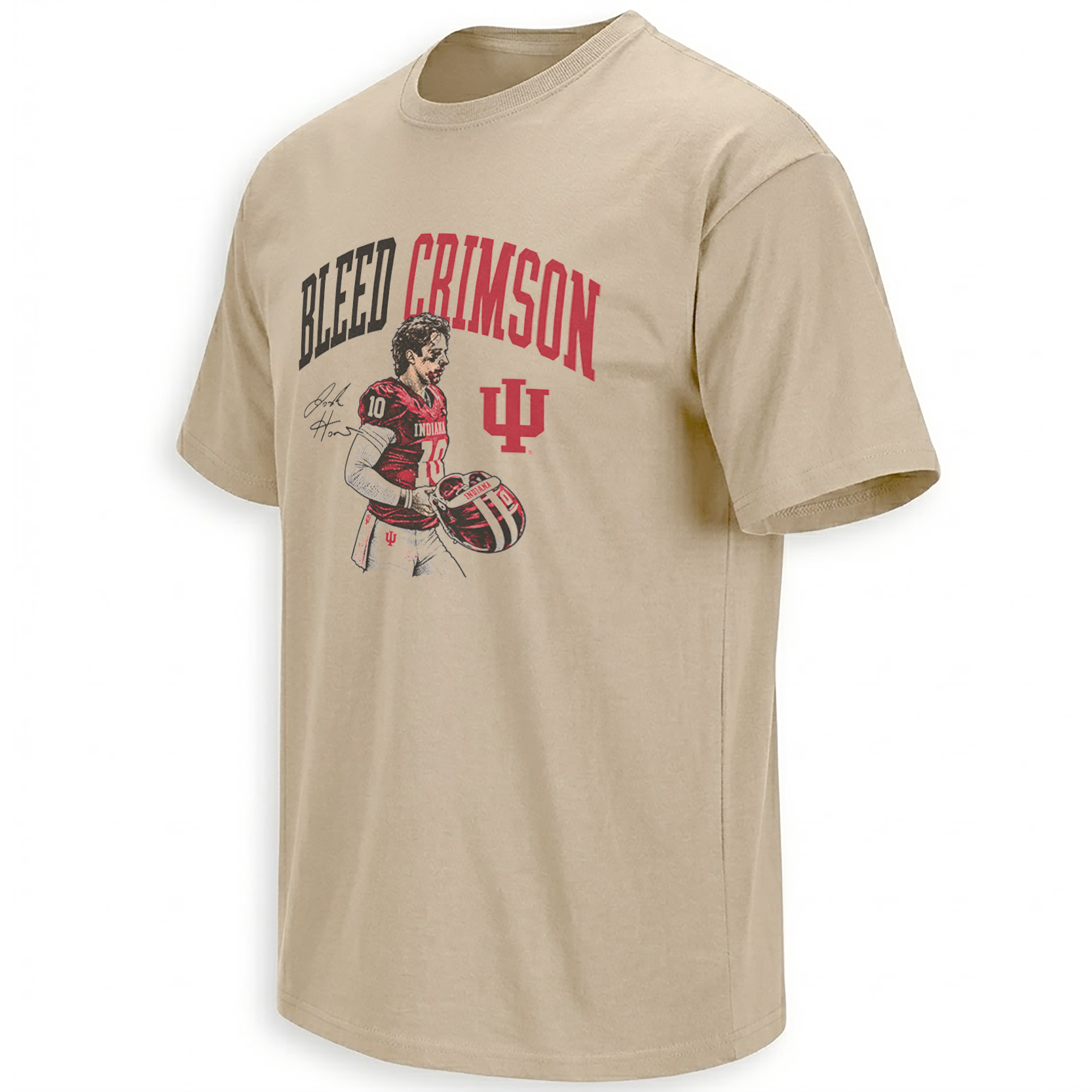
A vintage-college player composition built around Hoover, Indiana crimson and the phrase that unexpectedly matched the defining visual of his Hoosiers debut.
View the No. 10 piece →The Harder Story Is Replacing a Heisman Winner
The bloody-face photograph is memorable, but the larger football story will determine whether the design lasts. Hoover is taking over a team that went from historic outsider to defending national champion in almost no time.
That changes the emotional mathematics of Indiana football. The goal is no longer merely to prove the program belongs. Every new quarterback is now compared with the standard established by the championship team that preceded him.
Hoover arrived prepared for that pressure in a way few transfers could. Indiana lists 9,629 career passing yards, 71 touchdown passes and sixteen 300-yard games from his TCU career. He is not learning college quarterback play from scratch; he is learning what Curt Cignetti wants those skills to look like inside a championship program.
The shirt avoids scoreboard graphics and lets the player carry the story. Condensed “BLEED CRIMSON” lettering, Indiana red, the No. 10 uniform and signature treatment make it feel closer to an old player poster than instant game-result merchandise.
Indiana’s Standard Did Not Relax After 52 Points
Cignetti’s reaction was revealing. He praised Hoover’s production while also pointing toward protection reads, timing and throws that could improve. That is the current Indiana culture in miniature: four touchdown passes can be both excellent and unfinished.
The Hoosiers host Howard on September 12 before moving deeper into a schedule that eventually includes Ohio State, Michigan and Purdue. Hoover’s debut bought confidence, not immunity from scrutiny.
The wider Indiana Hoosiers collection follows that evolving championship-defense story, while the NCAA collection places Indiana’s new expectations inside the broader culture of college-football players, rivalries and weekly moments.
Readers following the quarterback specifically can also browse the Josh Hoover design archive.
Frequently Asked Questions
Why is “Bleed Crimson” connected to Josh Hoover?
Crimson is Indiana’s core school color, but the phrase gained an unusually literal connection when Hoover continued playing after a facemask penalty left his face bloodied during his Indiana debut.
How did Josh Hoover perform against North Texas?
Hoover completed 13 of 16 passes for 231 yards, four touchdowns and no interceptions in Indiana’s 52-16 victory.
What number does Josh Hoover wear for Indiana?
Hoover wears No. 10 for the Hoosiers in the 2026 season.
Where did Josh Hoover play before Indiana?
He played four collegiate seasons at TCU before transferring to Indiana.
Why was Hoover’s Indiana debut important culturally?
He became the first quarterback tasked with leading Indiana after its perfect national-championship season, so his opening performance immediately became part of the program’s transition from breakthrough story to defending champion.
The Bleed Crimson design preserves No. 10 at the beginning of a title-defense season that suddenly has its own unmistakable Josh Hoover image.
Bleed Crimson Shirt captures Josh Hoover’s Indiana No. 10 era just as the phrase became unexpectedly literal — a bloodied quarterback staying in the game and throwing four touchdowns in his Hoosiers debut.