
Before Today’s Magic, There Was Shaq and Penny.
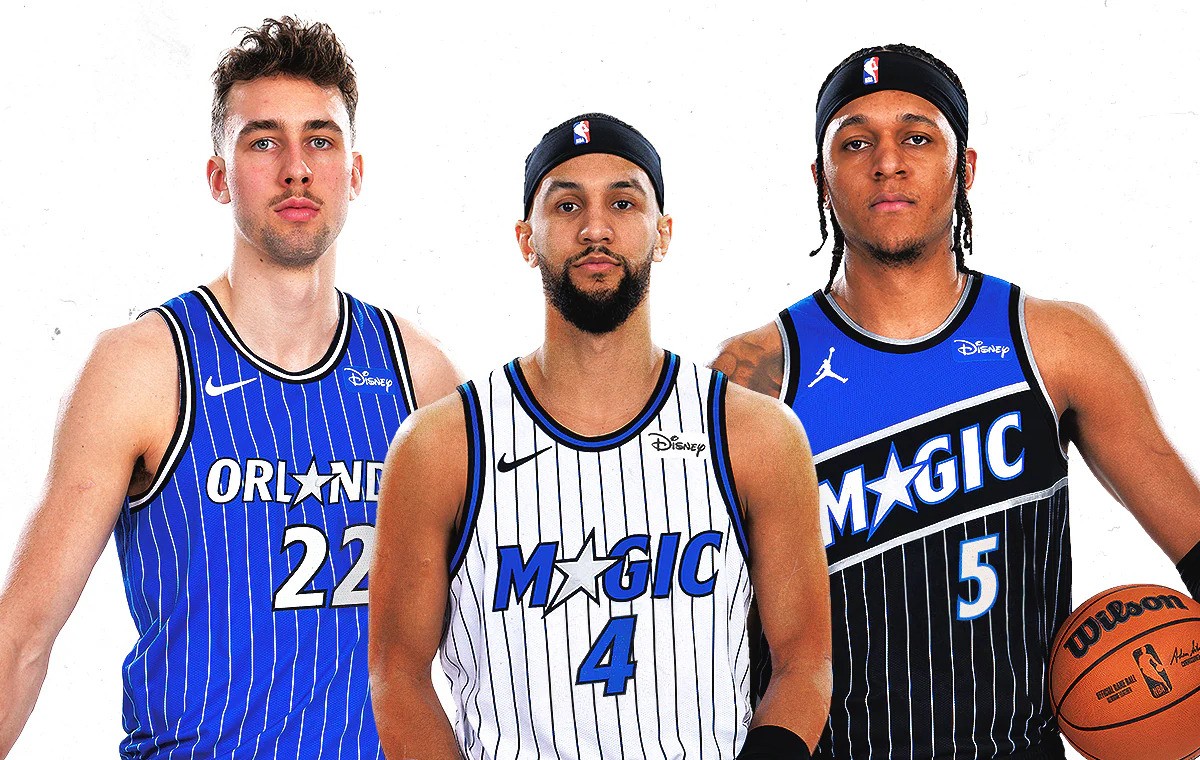
Orlando is preparing for another NBA season wearing stars and pinstripes again. That makes the Shaquille O’Neal–Penny Hardaway era feel unusually present: the young duo that first turned an expansion franchise into Finals basketball has become the visual reference point for the team’s future.
Orlando Magic training camp opens September 29. The regular season follows October 21 against Atlanta at Kia Center. Yet the visual language surrounding this next chapter looks deliberately backward: Magic blue, black, silver, stars and bold pinstripes.
Those elements carry weight because Orlando already lived its most explosive first basketball era inside them. Shaquille O’Neal arrived as the No. 1 pick in 1992. Penny Hardaway joined him a year later. By 1995, a franchise that had entered the NBA only six seasons earlier was playing in the NBA Finals.
Three decades later, the current Magic identity has intentionally brought pieces of that era back. Orlando’s 2025 redesign centered the star again and restored prominent pinstripes, openly connecting today’s uniforms to the teams that made Shaq and Penny global basketball figures.
Orlando’s current stars-and-pinstripes revival works because Shaq and Penny already taught an entire generation what those graphics were supposed to feel like.
Shaq Changed the Scale of Orlando Basketball
Expansion teams are usually asked to be patient. O’Neal made patience almost impossible. His size, athleticism and personality changed the visibility of the franchise immediately, and his Orlando years remain foundational enough that the Magic later made his No. 32 the first jersey number retired by the organization.
He was not simply a statistical centerpiece. Shaq gave a young Florida franchise national gravity. By the 1994-95 season he led the NBA in scoring at 29.3 points per game while Orlando finished with one of the league’s best records and began a playoff journey that would eliminate Michael Jordan’s Chicago Bulls before reaching the Finals.
That scale is why the artwork places O’Neal at its visual center. The oversized #32 figure behaves like the cover star of a 1990s basketball magazine rather than one image among several equal portraits.
Penny Made the Partnership Feel Futuristic
Hardaway changed the geometry of the pairing. At 6-foot-7 with guard vision and fluidity, he offered a radically different silhouette beside Shaq. Orlando suddenly had an enormous center built for power and a tall lead guard who could create, score and feed him above the rim.
The partnership lasted only from 1993 through 1996, which is part of why the era acquired such mythology. It reached the 1995 NBA Finals and the 1996 Eastern Conference Finals, but it ended before fans could discover how long the combination might have remained near the top of the East.
Penny later spoke openly about regretting that the core did not stay together. That unfinished quality keeps the era from feeling like a closed championship dynasty. It remains basketball’s great Orlando “what if.”
The Graphic Looks Like Something Pulled From a 1995 Bedroom Wall
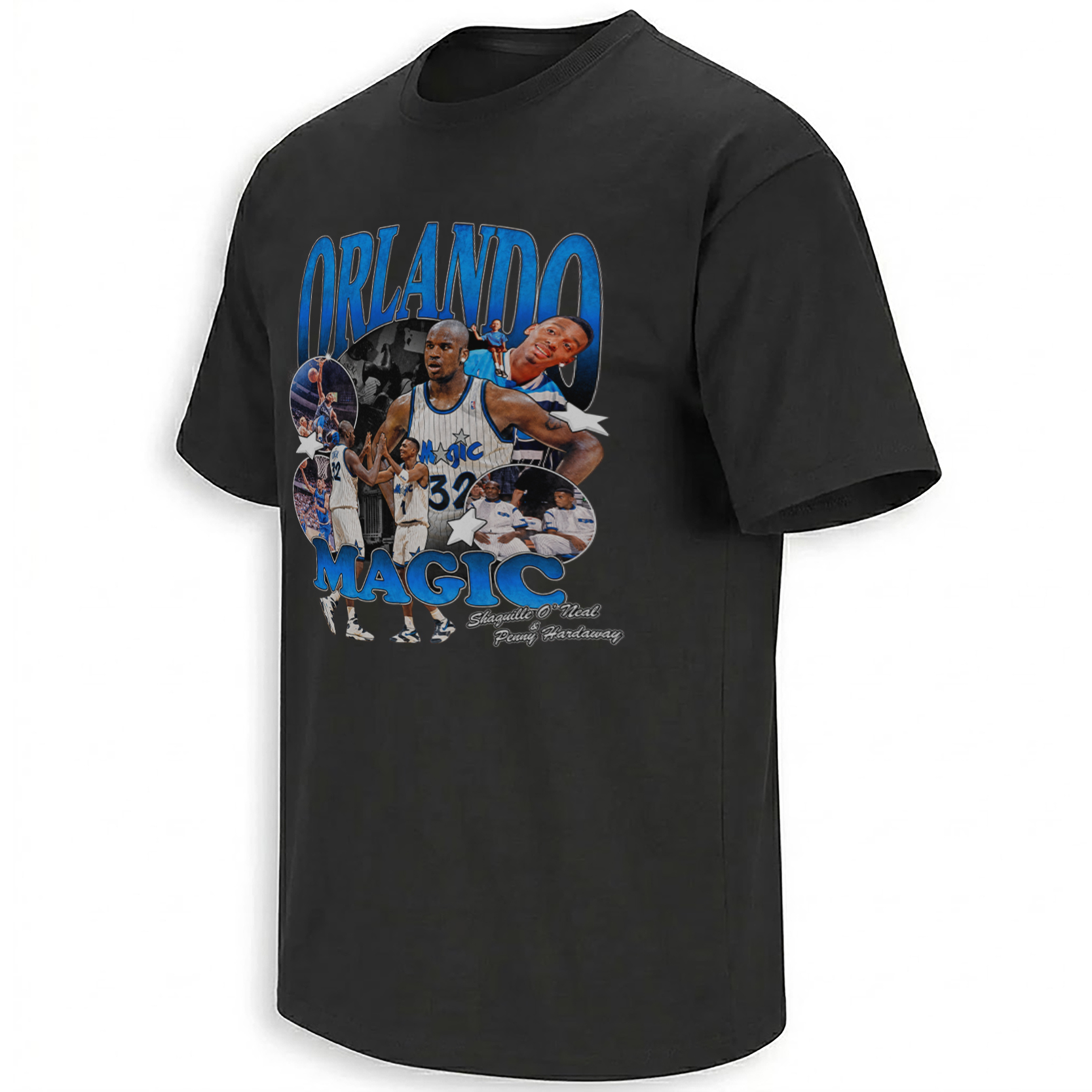
An oversized 1990s-style collage built from #32, Penny imagery, curved action frames, stars, pinstripes and the saturated Orlando blue that defined the duo’s era.
View the legends piece →The composition intentionally ignores modern minimalism. Multiple action images overlap. Curved frames compete for space. White stars break through the background. “MAGIC” lands at the bottom in oversized rounded blue typography while the two names sit underneath in script.
That density is culturally accurate. Mid-1990s basketball graphics often behaved like highlight reels frozen onto fabric: one dominant portrait surrounded by smaller dunks, poses and secondary angles. The goal was not negative space. The goal was abundance.
Black creates the poster wall, Magic blue supplies the era, white pinstripes provide instant Orlando recognition and the scattered stars connect the collage to a logo system the franchise has now consciously revived.
1995 Is Still the Season That Defines the Duo
Orlando’s 1995 run moved quickly from young-team excitement into league history. The Magic beat Boston in the first round, eliminated Chicago in six games and defeated Indiana in Game 7 of the Eastern Conference Finals to reach the franchise’s first NBA Finals.
The Finals ended in a Houston sweep, but the loss did not erase what Orlando had become. The Magic had gone from expansion arrival in 1989 to the championship stage in six years, with Shaq and Penny functioning as one of the NBA’s most recognizable young pairings.
Their dominance at home stretched beyond that postseason. From March 1995 to March 1996, Orlando won 40 consecutive home games, then an NBA record. The run helps explain why old photographs of those pinstripe teams still carry the atmosphere of a franchise that seemed to be accelerating faster than normal basketball timelines allowed.
Why the Nostalgia Feels Current in 2026
Retro pieces become much more interesting when a franchise itself begins speaking the same design language again. Orlando’s current identity is not a literal copy of 1995, but the star trails, pinstripes and colors give younger players a visible connection to the Shaq-Penny era.
That bridge becomes especially relevant as the Magic prepare for training camp and another season built around a modern core. The past is being used less like a museum exhibit and more like a visual foundation: a reminder of what Orlando basketball looked like the first time the franchise became nationally unavoidable.
The wider Orlando Magic collection creates a natural bridge between those eras, while the NBA collection places the Shaq-Penny visual language inside the larger cycle of basketball nostalgia, player mythology and modern throwback culture.
Because both legends are central to this piece, readers can also browse the Shaquille O’Neal archive and the Penny Hardaway archive.
Frequently Asked Questions
When did Shaquille O’Neal and Penny Hardaway play together for Orlando?
They were Orlando Magic teammates from 1993 through 1996.
Did Shaq and Penny reach the NBA Finals together?
Yes. Orlando reached the franchise’s first NBA Finals in 1995 after defeating Boston, Chicago and Indiana in the Eastern Conference playoffs.
Why are pinstripes so closely associated with Shaq and Penny?
Stars and pinstripes were defining elements of Orlando’s original visual identity and were worn throughout the duo’s rise into one of the NBA’s most recognizable young teams.
Why does Shaq wear number 32 in the design?
O’Neal wore No. 32 with Orlando. The Magic later made it the first player number officially retired by the franchise.
Why does the Shaq-Penny era feel relevant again now?
Orlando’s current identity has deliberately restored stars and prominent pinstripes, reconnecting the modern franchise visually with the era that first carried the Magic to the NBA Finals.
The Orlando Magic Legends graphic preserves Shaq and Penny as fans remember them — oversized, blue, pinstriped and surrounded by stars — just as the modern franchise has begun speaking that visual language again.
Orlando Magic Legends Shirt captures Shaquille O’Neal and Penny Hardaway through a dense 1990s basketball collage of #32, classic pinstripes, stars and Orlando blue, preserving the duo that carried the Magic to their first NBA Finals in 1995.