Larry Bird Flipping the Bird: Why the Joke Still Feels Like No. 33
Forty years after Boston’s 1986 championship, Larry Bird remains a symbol of Celtics brilliance and competitive arrogance. The middle-finger graphic pushes that mythology into an intentionally ridiculous visual pun.
In June 2026, the NBA looked back exactly forty years to Game 6 of the 1986 Finals. Larry Bird had already won his third consecutive league MVP and helped Boston build a 67-win regular season. With the championship one victory away, he finished the clincher against Houston with 29 points, 11 rebounds and 12 assists.
The numbers explain why Bird belongs in the historical argument. They do not fully explain why old Bird imagery continues to work as internet material. For that, you need the other half of the mythology: the confidence, the stories of calling shots before taking them, the rivalry energy and the reputation for treating trash talk as another part of competition.
“Larry Bird flipping the bird” takes that personality and reduces it to the most literal joke possible. His surname is already the slang phrase. Add an illustrated No. 33 giving the gesture, and the setup, subject and punchline arrive at the same time.
Bird’s legacy is serious enough to survive an unserious joke — which is exactly why the joke works.
Forty Years Later, the 1986 Version of Bird Still Defines the Myth
The 1985–86 Celtics were not simply champions. They became a reference point for dominant Boston basketball. Bird won his third straight MVP, the Celtics went 40–1 at home during the regular season, and Boston rolled through the Eastern Conference playoffs before defeating the Rockets in six games.
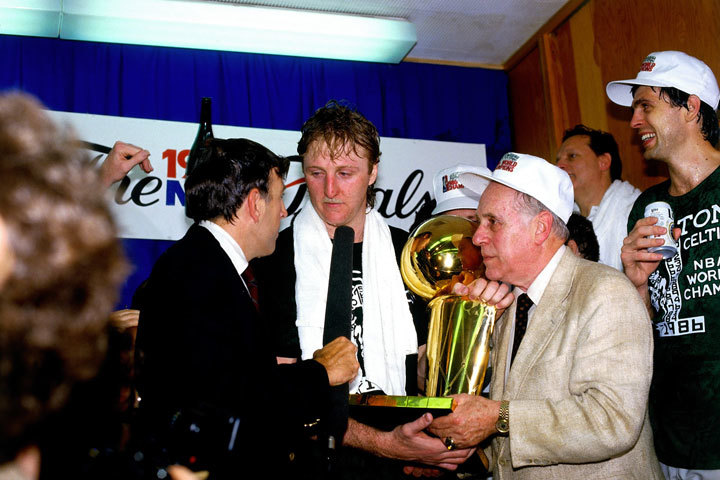
Bird recorded a triple-double in the deciding game, but the NBA’s anniversary treatment emphasizes something equally useful for understanding his cultural memory: he approached the game with the confidence of a player who expected to control it.
That confidence is why modern fans often encounter Bird through two parallel archives. One is statistics and championships. The other is stories — shooting competitions, opponent exchanges, impossible passes and moments where he seemed to announce what was about to happen before making it happen.
No. 33 Is Enough to Identify the Player
Boston officially retired Bird’s No. 33 after a career that included three championships, three MVP awards and career averages of 24.3 points, 10.0 rebounds and 6.3 assists. Few player numbers have such immediate franchise recognition.
That allows a visual parody to be extremely economical. A green jersey, white “33,” light hair and Bird’s face do most of the identification before the viewer even notices the hands.
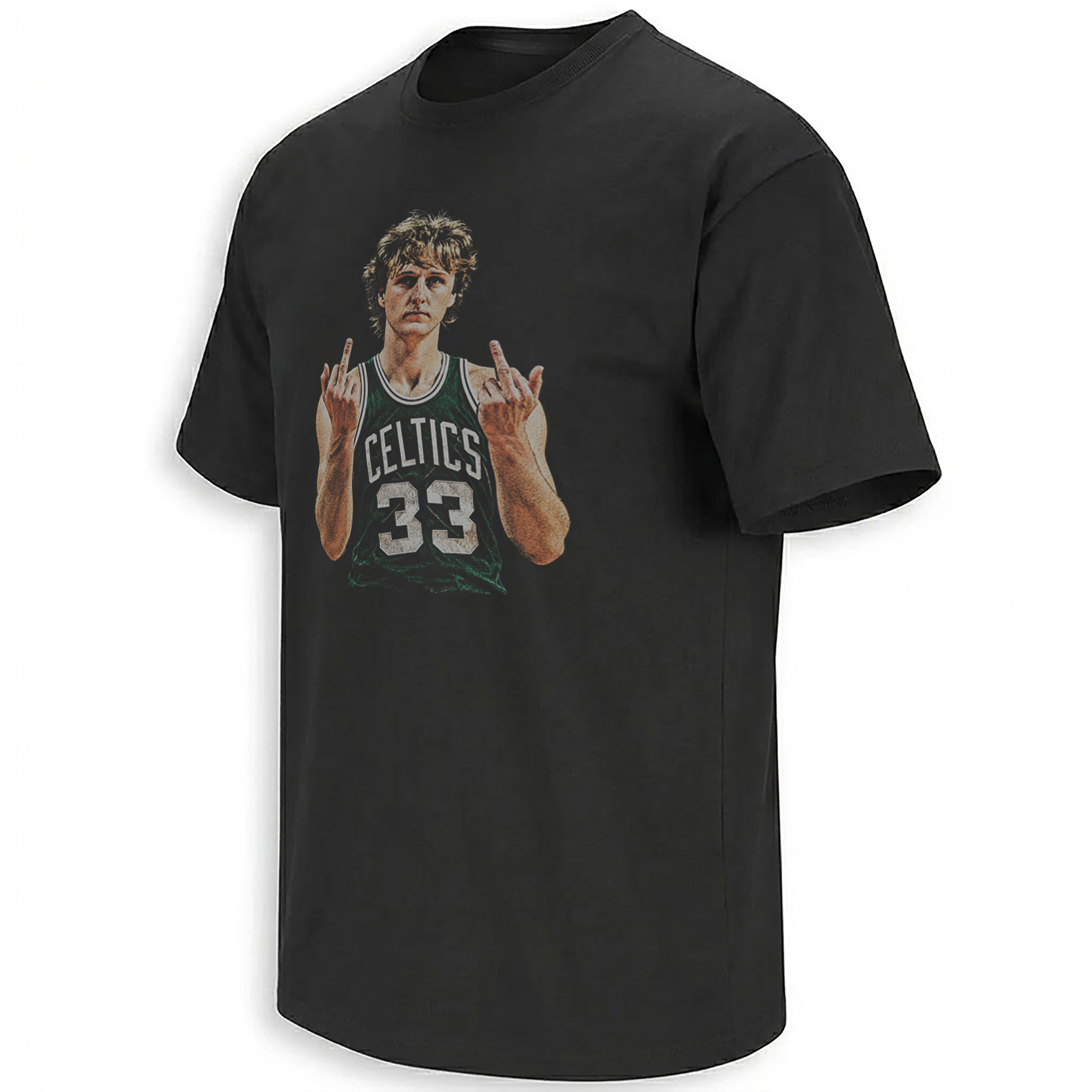
A black field removes every distraction except a green Celtics-era jersey, the number 33 and a deliberately exaggerated double middle-finger gesture.
View the Bird graphic →The artwork should be treated as a humorous composite-style illustration. Reliable archival research does not establish this exact double-middle-finger scene as a documented historic Larry Bird photograph, so the graphic is best understood as visual parody rather than photojournalism.
The Joke Works Because “Flipping the Bird” Already Exists Without Basketball
Most sports memes require knowledge of a quote or game. This one barely requires basketball literacy. “Flipping the bird” is already common slang for raising the middle finger. Larry Bird’s name turns the phrase into a built-in surname pun.
The graphic doubles down by giving him both hands raised. That symmetry makes the design read faster and moves it further away from a realistic courtside photograph. The exaggeration is the joke.
The black background also changes the tone. A full arena scene would invite questions about when and where the image occurred. Removing the arena allows Bird to float like a vintage bootleg cutout, turning him from photographed athlete into a recognizable basketball symbol.
Bird’s Actual Competitive Personality Gives the Parody Its Edge
The joke would land differently with a player remembered primarily for quiet reserve. Bird’s public basketball mythology is sharper. NBA historical coverage repeatedly emphasizes his unusual confidence, game intelligence and ability to create memorable moments without needing conventional athletic flash.
His 60-point game is a good example. The scoring alone is historic, but the surviving video matters because it lets younger viewers see the combination of shot-making and visible certainty that statistics flatten. Decades later, those clips keep Bird available to fans who were not alive during his playing career.
2026 Gives Vintage Bird Culture a Fresh Anniversary
The fortieth anniversary of the 1986 title makes this an especially natural year for Bird imagery to resurface. That championship sits at the center of his peak: third straight MVP, another Finals MVP, another banner and one of the most celebrated Celtics teams ever assembled.
That anniversary also illustrates why a deliberately crude design can coexist with historical reverence. Boston already has formal Bird memorabilia. The retired jersey, trophy photographs and NBA archive cover that territory. Humor occupies a different layer of fandom — the layer where legends become shorthand, memes and inside jokes precisely because everybody already knows the serious résumé underneath.
The verified Boston Celtics collection places the No. 33 graphic inside Boston’s wider championship and player archive, while the NBA collection connects Bird to the broader visual history of basketball legends and current league culture.
Readers looking specifically for No. 33 can also use Ellie Shirt’s Larry Bird search archive.
Frequently Asked Questions
Why is Larry Bird’s No. 33 so important to Celtics history?
Bird wore No. 33 throughout his Celtics career, winning three championships and three MVP awards. Boston later retired the number.
What happened in Larry Bird’s 1986 championship season?
Bird won his third consecutive regular-season MVP and helped Boston win 67 games before defeating Houston in six games in the NBA Finals.
What does “Larry Bird flipping the bird” mean?
It is a visual surname pun combining Larry Bird’s name with the common slang expression “flipping the bird,” meaning displaying the middle finger.
Is the double-middle-finger design a verified historical photograph?
No reliable archival source establishes that exact double-gesture composition as a historical Bird photograph. The artwork is best read as a humorous composite-style illustration.
Why is Larry Bird nostalgia especially relevant again in 2026?
June 2026 marked the 40th anniversary of Boston’s 1986 championship, one of the defining seasons of Bird’s Celtics career.
The Larry Bird Flipping the Bird piece leans into the irreverent side of his competitive mythology, while the Boston Celtics archive preserves the larger championship culture behind the joke.
Larry Bird Flipping the Bird Shirt turns Boston’s legendary No. 33 into a blunt surname joke, pairing a vintage Celtics look with exaggerated middle-finger humor during the 40th anniversary year of Bird’s iconic 1986 championship season.