
Mansell Gave Senna a Lift — 35 Years Later, F1 Still Remembers the Image
Nigel Mansell won the 1991 British Grand Prix at Silverstone. Ayrton Senna ran out of fuel on the final lap. What happened next lasted only minutes, yet the image of one fierce rival carrying the other back toward the pits became one of Formula 1’s most enduring visual memories.
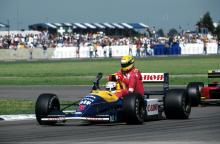
Thirty-five years later, the strange beauty of the photograph is that almost none of its meaning requires explanation. Nigel Mansell is still inside the Williams. Ayrton Senna is perched on the car beside him. Silverstone is crowded behind them. The two men who spent so much of their careers trying to beat one another suddenly occupy the same machine.
The moment came on July 14, 1991, after Mansell had delivered a dominant home victory in the British Grand Prix. Formula 1’s official record lists the Williams driver first after 59 laps, with Gerhard Berger and Alain Prost completing the podium. Senna, whose McLaren stopped after running out of fuel on the final lap, was classified fourth.
Mansell encountered his stranded championship rival on the slowing-down lap and stopped. Senna climbed onto the Williams, and the improvised ride back became the photograph that outlived many of the race’s statistics. Silverstone still singles it out in its historical archive; Formula 1 itself describes it as one of the sport’s iconic images.
Rivalry created the tension. The ride home created the memory.
The Famous Silverstone Photograph Was Almost an Accidental Epilogue
The race itself belonged to Mansell. After an early challenge from Senna, the Williams driver established control and won by more than forty seconds. Yet the image most frequently carried forward from that afternoon was not Mansell crossing the line. It came after the competitive part of the day was supposedly finished.
That matters because motorsport imagery is usually built around separation: one driver ahead of another, one car passing another, one helmet framed against a different set of colors. The Silverstone ride reverses that visual grammar. Competition temporarily collapses into proximity.
Why Mansell and Senna Made the Moment Bigger
This was not a casual interaction between drivers whose careers rarely intersected. Mansell and Senna were two of Formula 1’s defining competitive personalities, and 1991 placed them directly inside the championship struggle. Senna entered the season as reigning world champion; Mansell and Williams increasingly became the threat capable of disrupting McLaren’s control.
Their battles could be spectacular. Later that same season, they would run almost side by side down Barcelona’s pit straight in an image Formula 1 still celebrates. Rivalry is therefore essential to understanding Silverstone. Without the competitive history, the lift is simply helpful. With it, the gesture becomes emotionally legible.
It is also why the phrase “Keep Your Friends Close” works around this particular image. The joke borrows the familiar language of keeping friends close and rivals closer, but the photograph already contains that contradiction without needing to explain it. Here are two competitors physically closer than racing normally permits, captured immediately after one has won and the other has suffered a last-lap disappointment.
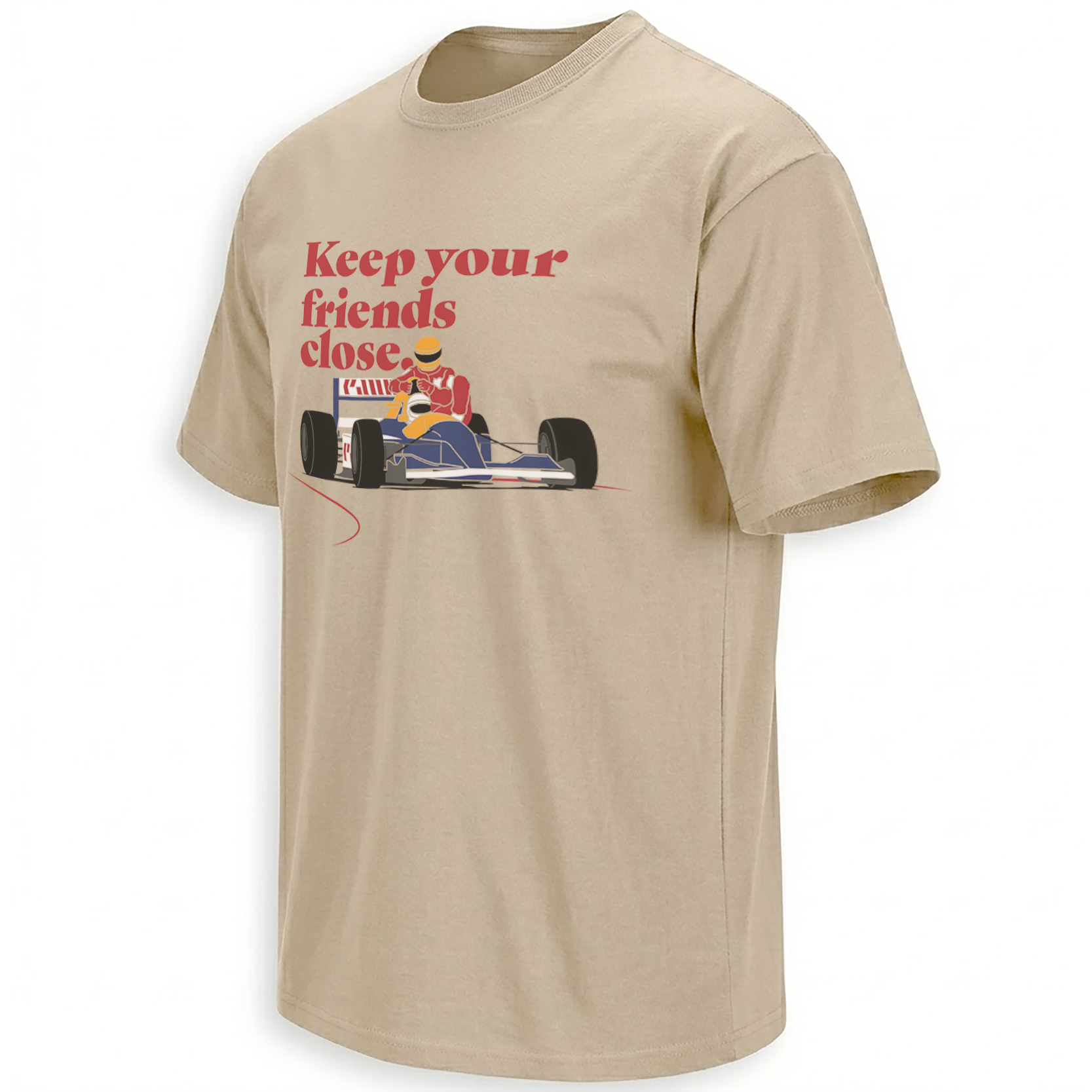
The design turns the famous post-race ride into a compact piece of Formula 1 memory, using the tension between friendship, rivalry and physical proximity that made the original photograph unforgettable.
View the F1 memory piece →A Formula 1 Moment That Keeps Returning Online
Historical motorsport survives differently in the social-media era. A younger fan may encounter a thirty-five-year-old Grand Prix not through a season review or a statistics book, but through a short clip, a photograph reposted on an anniversary, or a thread asking when rivalries appeared more personal.
Mansell and Senna fit that format almost perfectly. The footage is immediately readable even without commentary: a stranded driver, a winning rival, an unusual passenger position and a crowd recognizing what it is seeing. That visual clarity is one reason clips of the ride continue to circulate well beyond the generation that watched the race live.
The Graphic Works Because It Does Not Need to Invent a Story
Motorsport-inspired graphics sometimes depend on manufactured slogans. This one begins with a scene that already possesses its own narrative architecture. There is a winner, a rival, a mechanical failure, an unexpected gesture and a photograph recognized across generations of Formula 1 fandom.
The visual therefore functions like an old paddock photograph pulled from a magazine archive rather than a generic racing motif. The year “1991” anchors the piece historically, while the Mansell–Senna pairing immediately identifies an era when Formula 1’s personalities felt enormous and the visual difference between teams was unmistakable.
Its strength comes from preserving one recognizable human scene instead of trying to summarize an entire rivalry. The graphic becomes a timestamp: Silverstone, July 1991, Mansell victorious, Senna stranded, and one unlikely journey back toward the pits.
From Historic Rivals to the Wider F1 Drivers Archive
The Mansell–Senna image belongs naturally inside Ellie Shirt’s F1 Drivers collection, where individual driver stories can be read as different fragments of Formula 1 culture rather than as a single timeline.
Readers following Ayrton Senna specifically can also explore Ayrton Senna-related pieces, while the Nigel Mansell search archive connects the Silverstone moment to another of the sport’s most recognizable personalities.
What makes this particular scene different from a normal racing highlight is that neither speed nor victory is ultimately the whole subject. Thirty-five years later, fans remember what happened after the competitive question had already been answered.
Frequently Asked Questions
Why did Nigel Mansell give Ayrton Senna a lift at Silverstone in 1991?
Senna’s McLaren ran out of fuel on the final lap of the 1991 British Grand Prix. After winning the race, Mansell encountered his stranded rival on the slowing-down lap and carried him back toward the pits on the Williams.
Where did Ayrton Senna finish in the 1991 British Grand Prix?
Although his McLaren stopped on the final lap, Senna was officially classified fourth. Nigel Mansell won ahead of Gerhard Berger and Alain Prost.
Why is the Mansell and Senna lift considered an iconic F1 image?
The photograph places two fierce championship rivals together in an unusually human post-race moment, combining competition, disappointment and mutual respect in one instantly understandable frame.
What does “Keep Your Friends Close” mean in this design?
The phrase plays on the familiar idea of keeping friends close and rivals closer. It fits the 1991 Silverstone photograph because Mansell and Senna were major competitors yet were literally brought together on the same car after the race.
Why is the Silverstone moment especially relevant again in 2026?
The 2026 season marks thirty-five years since the July 14, 1991 British Grand Prix, giving the famous Mansell–Senna image another anniversary moment within Formula 1’s constantly resurfacing visual history.
The Keep Your Friends Close Mansell–Senna piece preserves one of those images, while the wider F1 Drivers archive follows the personalities and moments that keep returning through racing culture.
Keep Your Friends Close Shirt revisits Nigel Mansell giving Ayrton Senna a lift after the 1991 British Grand Prix, turning Silverstone’s iconic rivalry image into a 35th-anniversary Formula 1 memory piece.