
Carmelo 2003: One Freshman Season That Never Left Syracuse
Twenty-three years after Syracuse cut down the nets in New Orleans, Carmelo Anthony’s single college season is circulating again as basketball heritage — a championship run compact enough to fit into one year and large enough to define an era.
The timing is unusually sharp. In early September 2026, a fresh wave of Carmelo Anthony and Syracuse heritage apparel pushed the 2003 championship back into the basketball conversation. That revival arrived only a year after Anthony entered the Naismith Basketball Hall of Fame, giving the old Syracuse photographs a different weight: they no longer show only a brilliant freshman. They show the opening chapter of a Hall of Fame career.
The original story remains almost impossibly compressed. Syracuse defeated Kansas 81–78 on April 7, 2003, at the Superdome in New Orleans to claim the first NCAA men’s basketball championship in program history. Anthony finished the title game with 20 points and 10 rebounds; the Hall of Fame also credits him with seven assists. His two-game Final Four performance earned him Most Outstanding Player honors.
For Syracuse supporters, that is why “Carmelo 2003” behaves almost like a complete sentence. A name and a year are enough. They call up the orange jerseys, the freshman confidence, Jim Boeheim’s first national championship and the closing seconds against Kansas when Hakim Warrick’s block protected a three-point lead.
One season was enough to turn No. 15 into permanent Syracuse basketball memory.
The Championship Photograph Still Explains the Emotion
College basketball produces constant turnover by design. Players graduate, coaches change, conferences rearrange and every March creates another set of images. Yet a program’s first championship becomes resistant to that churn. It is replayed through anniversaries, arena banners, family stories and old footage until the moment belongs to people who were not even watching when it happened.

The final was not a one-man show. Gerry McNamara supplied six three-pointers and 18 points. Warrick’s block with 1.5 seconds remaining became the defensive image attached to the ending. That supporting cast matters because it keeps the Carmelo mythology grounded in a team achievement rather than turning 2003 into an isolated individual highlight reel.
Why Carmelo’s Freshman Run Became Basketball Folklore
Anthony arrived at Syracuse with elite expectations and immediately played with the visual confidence of someone who appeared older than his college résumé. By the Final Four, the freshman label had become almost irrelevant. His scoring, rebounding and ability to control possessions gave Syracuse a centerpiece who could change the feel of a game without needing several seasons to grow into the role.
That is one reason his college career has aged differently from a normal one-and-done season. There is no complicated middle chapter. The Syracuse story begins, accelerates and ends with a championship. He left for the NBA after one year, and the brevity became part of the mythology.
How the Carmelo 2003 Graphic Reads Like an Old Tournament Program
That archival quality is what gives the Carmelo 2003 Championship design its cultural logic. Instead of trying to recreate every round of the tournament, the composition concentrates on the identifiers fans already know: Carmelo, Syracuse and 2003.
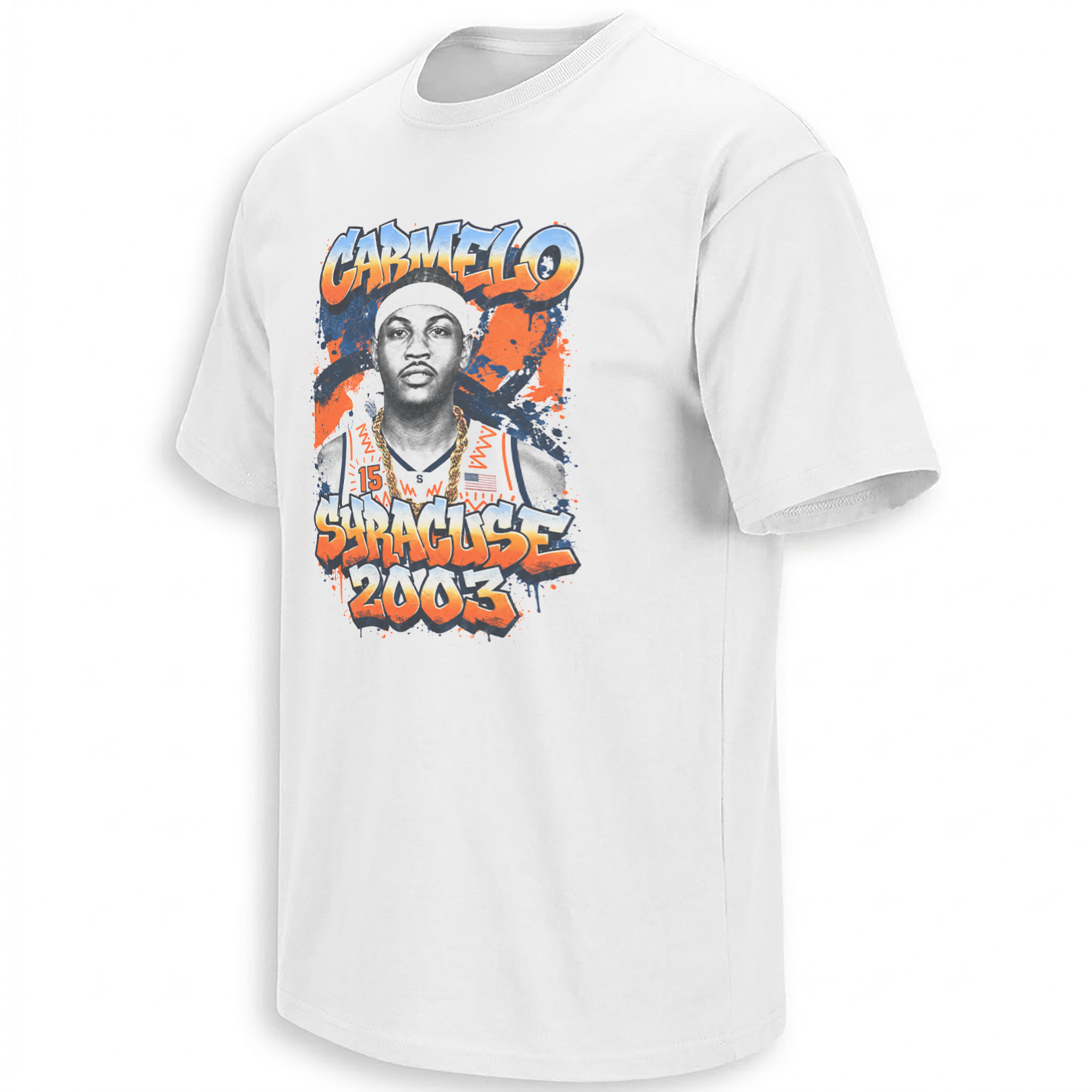
Oversized player-name typography, a young Carmelo portrait and orange-blue championship-era color fields make the visual feel pulled from an early-2000s college basketball souvenir program.
View the championship piece →The cream foundation is important. It pulls the composition away from slick contemporary sports graphics and toward paper, ticket stubs and faded tournament memorabilia. The orange and navy then behave like memory cues rather than decoration. A viewer does not need the full score printed across the chest to know which basketball world the piece is referencing.
Why 2003 Keeps Returning in 2026
Anthony’s 2025 Hall of Fame enshrinement gave fans another reason to revisit the college chapter that came before 28,289 NBA points, ten All-Star selections and three Olympic gold medals. Then the September 2026 heritage-apparel conversation returned directly to Syracuse. The cycle reveals how sports nostalgia works: anniversaries matter, but milestones in a person’s later life can suddenly reactivate an older photograph.
The wider Syracuse Orange collection works as a running archive of those program-specific memories, while the broader NCAA collection places 2003 alongside the rivalries, tournament runs and player moments that continue to shape college sports culture. Fans following Anthony specifically can also browse the Carmelo Anthony search archive.
Frequently Asked Questions
Did Carmelo Anthony win an NCAA championship with Syracuse?
Yes. Syracuse defeated Kansas 81–78 on April 7, 2003, to win the first NCAA men’s basketball championship in program history.
What did Carmelo Anthony do in the 2003 championship game?
Anthony recorded 20 points, 10 rebounds and seven assists against Kansas and completed a Final Four performance that earned him Most Outstanding Player honors.
How long did Carmelo Anthony play at Syracuse?
Anthony played one college season, 2002–03, before entering the NBA Draft. That single season ended with Syracuse’s national championship.
Why is Syracuse’s 2003 championship especially important?
It remains the first NCAA men’s basketball championship in Syracuse program history, making the team and its defining images permanent reference points for Orange basketball culture.
Why is Carmelo’s Syracuse era receiving fresh attention in 2026?
Anthony entered the Basketball Hall of Fame in 2025, and new Syracuse-focused heritage apparel released in September 2026 renewed attention around his championship season.
The Carmelo 2003 graphic records the year through player-first visual language, while the Syracuse Orange archive carries the program’s wider basketball memory forward.
Carmelo 2003 Championship Shirt revisits Carmelo Anthony’s one-season Syracuse run, the 81–78 national-title victory over Kansas and the early-2000s visual language that still defines Orange basketball memory.