Enes Kanter Freedom’s WNBA Ejection: How Four Words Became Part of the Fever-Sky Story
The Indiana Fever–Chicago Sky game on August 23 produced a viral courtside confrontation involving Enes Kanter Freedom and Natasha Cloud. Almost immediately, the black dictionary-style shirt Freedom was wearing became inseparable from the images circulating afterward.
The image was almost impossibly simple compared with the argument surrounding it: a black shirt, clean white lettering, a dictionary-style layout and four words presented as a definition. Yet by late Sunday night, “WOMAN — adult human female” was no longer functioning only as a political slogan. It had become a visual marker of one of the WNBA’s most discussed moments of the weekend.
Freedom was seated along the baseline at Wintrust Arena during the Chicago Sky’s game against the Indiana Fever. Late in the third quarter, after Natasha Cloud scored, Cloud moved toward his courtside area while pointing and shouting. Security and Sky players stepped between the two, and Freedom was subsequently escorted away from his seat.
Cameras continued following him as he left, and that mattered. The message across his chest remained visible through the sequence, transforming the shirt into part of the visual record of the confrontation rather than a background detail.
The argument was complicated. The visual was not. That contrast is precisely why the shirt became so easy to recognize in the footage.
The confrontation arrived inside an argument already consuming WNBA discourse
The incident did not emerge in isolation. Earlier in August, Freedom and former NBA player Royce White publicly declared themselves eligible for the 2027 WNBA Draft while saying they identified as women, positioning the move as a challenge to how the league defines eligibility.
The WNBA responded by stating that Freedom and White were not eligible to play in the league, rejecting what sources called “publicity stunts” designed to demean and marginalize others. The league’s collective bargaining agreement states that “only players who are women are eligible to play in the WNBA,” without specifying further language regarding gender identity or sex assigned at birth.
Those facts have produced two sharply different readings of the same public debate. Freedom and others critical of transgender participation in women’s sports frame their position around sex-based competitive categories. The WNBA, along with players and coaches supportive of transgender inclusion, has emphasized dignity, human rights, and protecting players from courtside distractions.
That context is essential because it explains why a four-word dictionary graphic carried far more meaning at courtside than the typography alone suggests.

A dictionary layout designed for instant recognition
Visually, the Woman Definition Shirt does almost the opposite of modern sports graphics. There is no portrait, team crest, jersey number or arena illustration. The design instead borrows the visual authority of an online dictionary entry.
“WOMAN” sits at the top in bold uppercase white lettering beside a small pronunciation-style phonetic mark. “noun.” appears beneath it in smaller italic text, followed by “adult human female.” in crisp serif typography. The high contrast on a solid black tee makes the phrase readable from a distance while creating the appearance of an informational reference rather than a conventional slogan.
That visual restraint is what makes it effective as an internet artifact. Screenshots move quickly. A complex image often requires context; four large words do not.
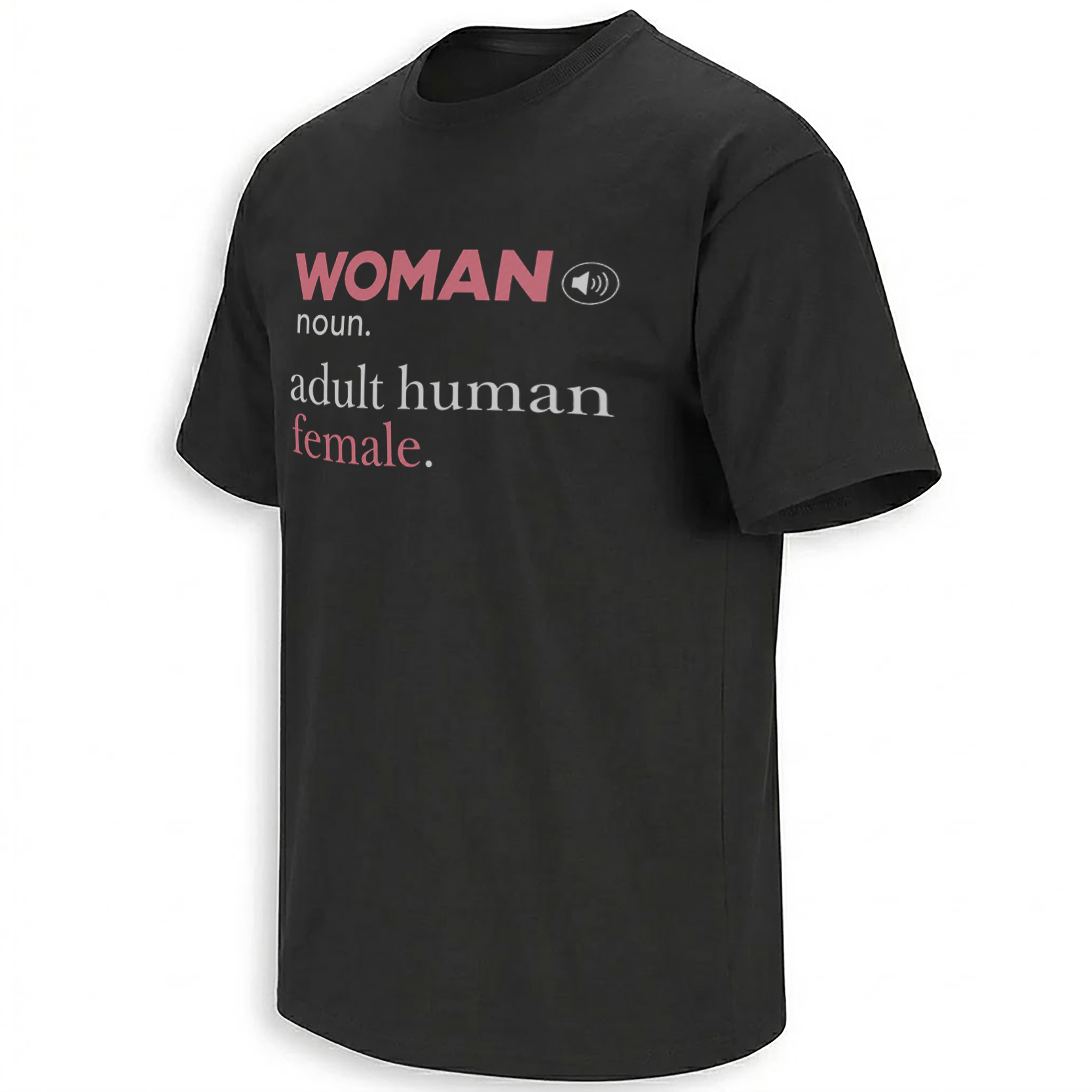
A minimalist dictionary treatment that became visually connected to the August 23 Freedom–Cloud confrontation once cameras followed the scene beyond the baseline.
View the piece →The social-media replay made the shirt part of the incident
Live sports controversies now have a second life measured in vertical clips, screenshots and reposts. The original basketball sequence lasts only moments. Online, individual frames can circulate for hours or days, detached from the live broadcast and interpreted by communities arriving with very different political assumptions.
That happened here. Video of Cloud approaching Freedom and footage of Freedom being escorted away moved through X and sports-media accounts almost immediately. In those clips, the shirt was repeatedly visible, giving audiences an instant visual shorthand for what the confrontation represented.
Natasha Cloud’s response changed the emotional frame
Chicago coach Tyler Marsh defended Cloud after the game, describing her as someone who protects her teammates and people she believes need protecting. Cloud later posted on Threads in support of trans individuals, while Sky players emphasized focusing on basketball.
Freedom presented the event differently. While being removed, he argued that he was being ejected because he was “supporting women.” Those two interpretations now sit beside each other across coverage of the same scene, which is why reducing the episode to a simple hero-villain narrative misses much of what made it spread.
The game supplied the stage, but the argument involved identity, eligibility, political expression and player boundaries. The shirt compressed those larger themes into a graphic that could be understood in a single screenshot.
Where the design sits inside Ellie Shirt’s WNBA archive
Because the graphic is linked to a league-wide discussion rather than one specific roster, the broader WNBA collection is the clearest basketball context. It places the design beside player moments, team culture and other visual records of the league’s 2026 season.
Recent culture-driven releases also sit inside the Newest collection. Readers looking specifically for Freedom-related pieces can use Ellie Shirt’s Enes Kanter Freedom product search.
Frequently Asked Questions
Why was Enes Kanter Freedom removed from the Fever-Sky WNBA game?
Security escorted Freedom from his courtside area after a heated third-quarter exchange with Chicago Sky guard Natasha Cloud at Wintrust Arena on August 23, 2026.
What did Enes Kanter Freedom’s shirt say?
The black shirt used a dictionary-style layout reading “WOMAN,” “noun.” and “adult human female.”
Why was the shirt central to the viral footage?
Its large, highly readable text remained visible during the courtside confrontation and while Freedom was escorted away, making the graphic part of the visual story.
What has the WNBA said about transgender eligibility?
The league confirmed in August 2026 that male players like Enes Kanter Freedom and Royce White are not eligible for the WNBA draft, emphasizing its CBA stance while rejecting publicity stunts.
Is the Woman Definition Shirt an official WNBA product?
No. It is an independent commentary-driven graphic connected culturally to the August 2026 WNBA debate and courtside incident.
The Woman Definition design preserves the visual language seen during the August 23 controversy, while Ellie Shirt’s WNBA archive tracks the broader player moments and cultural conversations surrounding the league.
Woman Definition Shirt captures the dictionary-style “adult human female” graphic seen on Enes Kanter Freedom during his viral August 2026 courtside confrontation with Natasha Cloud at the Fever-Sky WNBA game.