
Girlfriend, Boyfriend and Friend All Have an “End” — But King Doesn’t
Long before confidence memes started calling everyone “king,” the internet was already obsessed with finding the word “end” hiding inside relationship vocabulary. The new version simply gives the old quote-card formula a much more self-assured punchline.
Girlfriend. Boyfriend. Friend. The joke asks you to stop reading those words for meaning and start looking at them like a puzzle. Each contains the same three letters at the end: “end.”
Then comes the final word: king. No “end.” No breakup. No friendship collapse. No sentimental explanation. Just a crown and the deliberately overconfident conclusion that being a king somehow escapes the grammatical fate waiting inside everyone else.
That is the entire mechanism behind the Girlfriend Boyfriend Friend End King Shirt. It is simple enough to resemble an old Facebook quote image, but the final turn places it firmly inside modern “stay up, king” meme language.
It is not profound advice. That is why it works. The meme pretends English spelling has just revealed an ancient law of self-respect.
The “end” word trick is much older than the king punchline
Versions of this format have circulated for years. Earlier image macros highlighted “end” inside friend, girlfriend, boyfriend or best friend before revealing a supposedly deeper conclusion such as “friendship has no end” or “relationship has no end.”
Those older versions belonged to a recognizable generation of inspirational internet culture: plain backgrounds, red underlines, romantic conclusions and the kind of text people forwarded through Facebook pages, WhatsApp groups and Pinterest boards.

“King” changes the emotional logic of the joke
The older meme wanted reassurance. Friends last forever. Relationships endure. Love survives. The king version has much less interest in promising permanence between two people.
Instead, the punchline turns inward. Girlfriends can end. Boyfriends can end. Friendships can end. Your identity as “king” does not have to depend on any of them.
Of course, that conclusion is constructed from spelling rather than philosophy. But the exaggerated confidence is precisely what makes it useful as a meme. Modern internet encouragement often sounds intentionally theatrical: “keep your head up, king,” “know your worth,” “the crown stays on.”
The joke moved from sentimental relationship wisdom toward ironic self-empowerment. Same word puzzle, different internet generation.
The design makes “KING” feel like the answer to the puzzle
Visually, the Ellie Shirt graphic behaves almost like a classroom exercise. Girlfriend, boyfriend and friend are stacked vertically so the repeated ending becomes impossible to miss. Lines and emphasis isolate the letters “END,” teaching the viewer how to read the joke before the final reveal.
Then “KING” appears at the bottom with crown imagery and greater visual authority. The hierarchy makes it less like another vocabulary item and more like the conclusion of an equation.
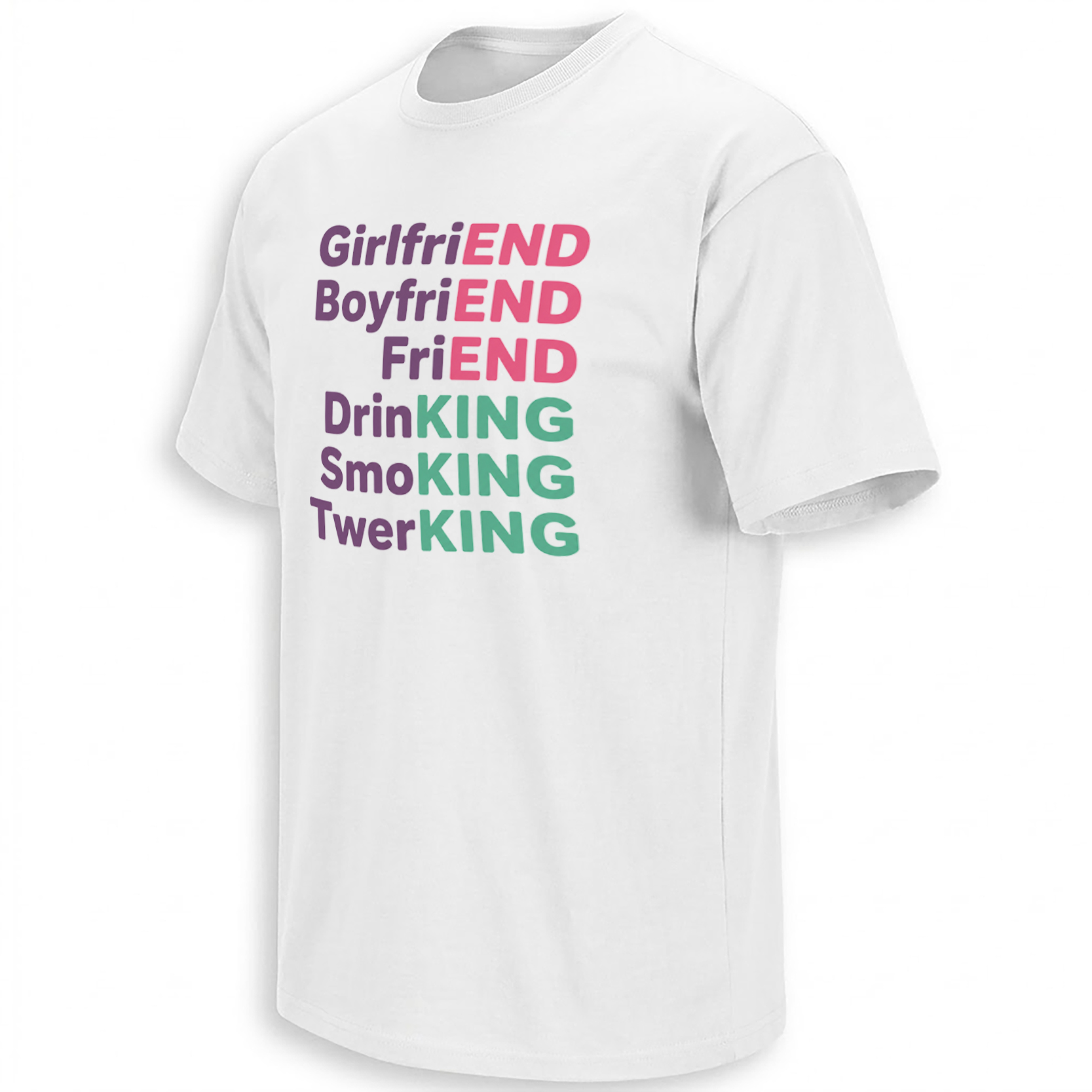
A minimalist spelling joke that highlights the “end” inside relationship words before letting KING escape the pattern with a crown-shaped punchline.
Open the wordplay graphic →Why extremely simple memes survive so well on clothing
Complicated memes can struggle outside their original platforms. Once a joke depends on a specific TikTok sound, ten screenshots of lore or knowledge of one streamer’s private joke, the audience shrinks quickly.
Wordplay avoids that problem. A stranger can encounter this graphic with no knowledge of who made it, where it first appeared or which social platform popularized it. Reading the four words is enough.
That self-contained structure is unusually useful for graphic culture. The wearer becomes the delivery mechanism, but the joke does not require a caption.
No single viral origin is needed for the meme to keep evolving
Available research does not identify one definitive creator of the original friend/girlfriend/boyfriend “end” formula. Similar versions appear across old status collections, Pinterest-style graphics and quote pages, suggesting gradual circulation rather than one famous source post.
That makes the “king” edition less like a direct reproduction of one historical meme and more like another mutation of a long-running word game. Internet culture often works exactly this way: people inherit a structure, change the final line and send it back into circulation.
The broader Newest collection gives this kind of rapidly circulating phrase a natural home alongside newer internet jokes, reaction graphics and cultural one-liners.
Frequently Asked Questions
What does the Girlfriend Boyfriend Friend End King meme mean?
The meme points out that girlfriend, boyfriend and friend all contain the letters “end,” while the word king does not, turning a spelling observation into a humorous confidence message.
Is the “end” wordplay a new meme?
No. Variations highlighting “end” inside friend, girlfriend and boyfriend have circulated online for years; the king version is a newer self-confidence twist on that older format.
Why does “king” work as the punchline?
“King” does not contain the letters “end,” and modern meme culture also uses “king” as playful language for confidence, self-respect and encouragement.
Who originally created the Girlfriend Boyfriend Friend End meme?
Available research does not establish one definitive original creator. The format appears to have circulated gradually through quote pages, status collections and image-sharing platforms.
Why does this meme work well as a graphic?
The joke is self-contained, requires no external context and can be understood simply by noticing the repeated “end” inside the first three words and its absence from “king.”
The End King graphic updates an old internet word puzzle with modern confidence-meme language, while the Newest archive follows the larger stream of phrases and visual jokes currently moving from timelines into graphic culture.
Girlfriend Boyfriend Friend End King Shirt turns a long-running internet wordplay format into a confidence meme, highlighting the “end” in relationship words before KING gets the final crown.