
The Queen Is Dead at 40: The Smiths’ Most Beautifully Miserable Record Still Refuses to Age Quietly
Released in June 1986, The Queen Is Dead paired Johnny Marr’s brightest guitar work with Morrissey’s darkest humor and one of indie rock’s most unforgettable sleeves — Alain Delon suspended in a strange purple cinematic still.
Forty years after The Queen Is Dead entered the UK chart in June 1986, the album still creates an almost impossible first impression. The title sounds confrontational. The cover looks funereal. The opening track arrives with violence and satire. Then Johnny Marr’s guitar begins glittering through songs so melodic that the darkness starts sounding beautiful.
That contradiction is why the record has lasted. The Smiths did not make an album that simply sounded depressed, angry or romantic. They made one where all three emotions kept interrupting each other.
Official Charts records the album peaking at No. 2 in Britain. Rhino has repeatedly described it as one of the band’s defining achievements. Four decades later, “There Is a Light That Never Goes Out,” “Bigmouth Strikes Again,” “Cemetry Gates” and “I Know It’s Over” remain entry points for listeners who were not alive when Rough Trade first released the LP.
The Queen Is Dead lasts because the music keeps sounding alive even when the words insist everything is finished.
The Cover Does Half the Emotional Work Before the Needle Drops
The Smiths built one of the most recognizable visual systems in British indie music by rarely putting themselves on their own sleeves. Instead, Morrissey selected film stills, actors, models and cultural figures whose faces could carry the emotional temperature of the record.
For The Queen Is Dead, the image came from French actor Alain Delon in the 1964 film L’insoumis, known in English as The Unvanquished. The still captures Delon lying down with his eyes partly closed, suspended somewhere between sleep, exhaustion and death.

The purple tint turns a cinematic image into something closer to memory. Delon is recognizable, but the cover does not behave like a movie poster. It strips away narrative information until the body becomes mood.
Cropped cinema still, limited color, elegant serif typography and deliberate emotional ambiguity created a sleeve that feels romantic and morbid at the same time — exactly the contradiction that defines much of the album.
The Title Sounds Political, but the Album Is Stranger Than a Slogan
The title immediately suggests monarchy, class and British institutions, and the opening song certainly attacks establishment imagery with savage humor. But The Queen Is Dead is not a ten-track political manifesto.
It moves too quickly between subjects. The record contains loneliness, celebrity jokes, publishing-industry resentment, romantic fatalism, literary references, Catholic imagery and schoolyard comedy.
That instability is part of Morrissey’s writing style at its most effective. A line can sound wounded and ridiculous at once. The listener is rarely allowed to sit inside one emotional category for long.
Johnny Marr Keeps the Record From Collapsing Under Its Own Sadness
The musical trick is Marr. If the album had been arranged as slowly and darkly as some of its lyrics suggest, it could have become suffocating. Instead, guitars jangle, accelerate, shimmer and occasionally attack.
“Bigmouth Strikes Again” practically races. “Cemetry Gates” sounds breezy while discussing death and literary rivalry. “There Is a Light That Never Goes Out” turns romantic annihilation into one of the band’s largest melodies.
Romantic fatalism transformed into a song whose melody keeps lifting even as the lyric imagines death.
Marr’s urgent guitar movement turns self-destructive wit into something closer to velocity than misery.
One of the album’s emotional low points, built around isolation, longing and one of Morrissey’s most exposed performances.
Literature, mortality and plagiarism jokes carried on music that feels almost sunny.
Why the Album-Art Graphic Still Works at 40
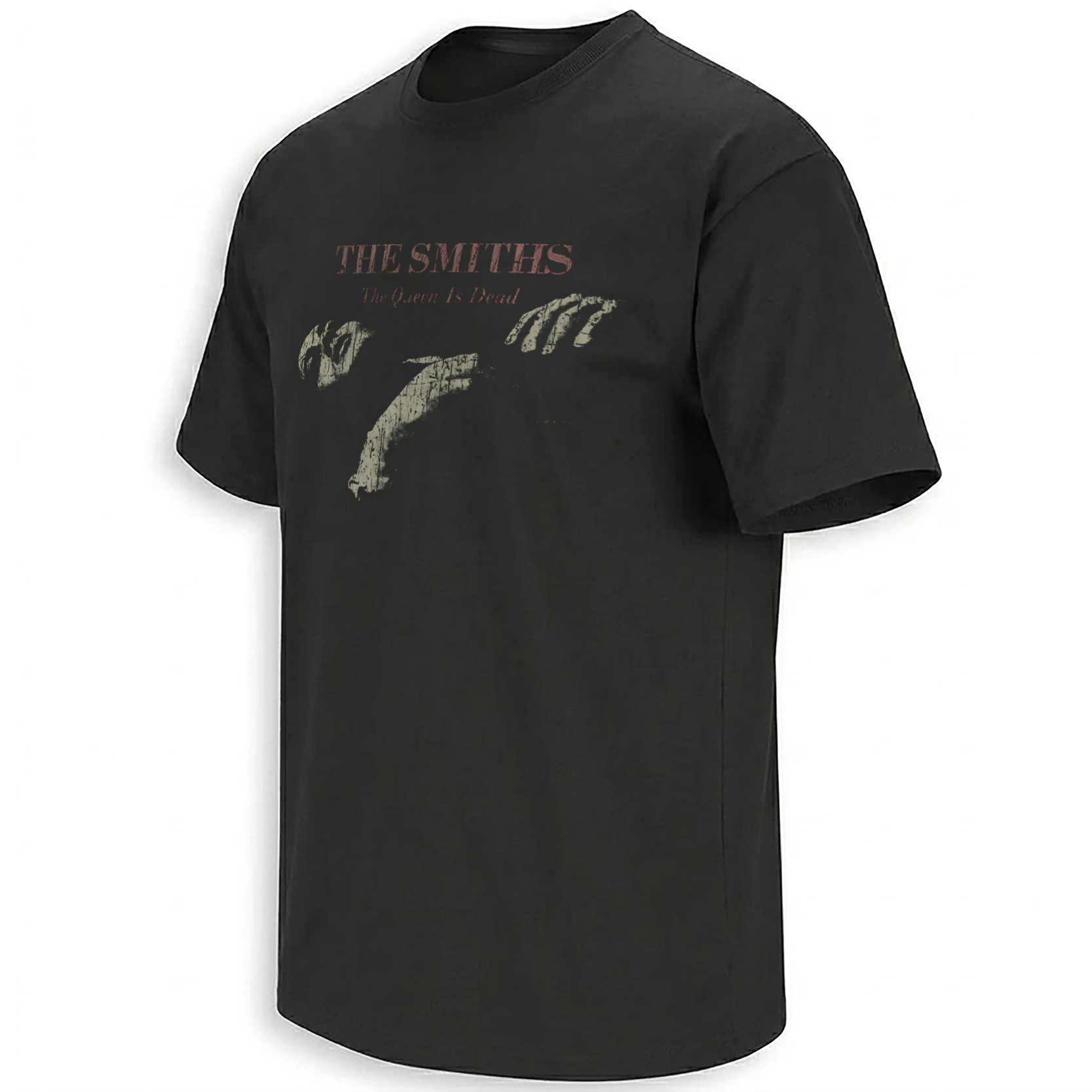
The The Queen Is Dead Shirt The Smiths 1986 is strongest when treated as an album-memory piece. The image already carries forty years of visual association, so the design does not need to overdecorate it.
The Smiths Understood That Album Covers Could Build a Parallel Universe
Their sleeves rarely explained the music literally. That is one reason they aged so well. A still of Truman Capote, Candy Darling, Elvis Presley or Alain Delon could become part of The Smiths’ world simply through cropping, tint and typography.
The consistency made each record feel like a page from the same archive. Fans did not need to see the band members. The visual system itself identified the band.
The Queen Is Dead may be the clearest example because the cover’s emotional ambiguity fits the music almost perfectly. Delon looks simultaneously glamorous, vulnerable, exhausted and untouchable.
Forty Years Later, the Album Still Generates New Listeners
The Smiths existed for only a few years, yet their afterlife has been enormous. Rhino describes the band as a major precursor to later British guitar music, and their influence can be heard across indie rock, Britpop and generations of guitar bands that learned how sadness could coexist with brightness.
The album’s strongest songs also escaped the boundaries of 1980s alternative culture. “There Is a Light That Never Goes Out” has become one of those tracks younger listeners discover repeatedly through films, playlists, social media edits and inherited record collections.
The 40th anniversary therefore does not feel like a museum date. It gives listeners an excuse to notice how little the record resembles a sealed historical object.
The Cover Also Carries Alain Delon’s Own Film History
Using Delon was not random decoration. His screen image carried glamour, alienation and danger — traits that fit Morrissey’s fascination with old cinema and beautiful outsiders.
That connection matters because The Smiths’ visual universe constantly borrowed from older culture without pretending the references were new. The band made twentieth-century cinema, literature and pop photography coexist with Manchester indie music.
Readers looking for more related pieces can browse Ellie Shirt’s The Smiths search archive, along with the Morrissey search archive. No unconfirmed music collection URL is used here.
Frequently Asked Questions
When was The Smiths’ The Queen Is Dead released?
The album was released in June 1986 and reaches its 40th anniversary in 2026.
Who is pictured on The Queen Is Dead album cover?
The cover features French actor Alain Delon in a still from the 1964 film L’insoumis, also known in English as The Unvanquished.
How successful was The Queen Is Dead in the UK?
Official Charts records the original 1986 album peaking at No. 2 on the UK Albums Chart.
Why is The Queen Is Dead considered so influential?
Its combination of Johnny Marr’s melodic guitar work, Morrissey’s literary and darkly comic lyrics, and a distinctive visual identity helped shape later British indie rock and Britpop culture.
Why does the album cover still feel distinctive forty years later?
The cropped film still, limited purple palette and minimal typography create emotional ambiguity rather than literal explanation, allowing the sleeve to age more like cinema photography than conventional band artwork.
The The Queen Is Dead design preserves the Alain Delon imagery and violet atmosphere of the 1986 album, while the The Smiths archive connects the record to related visual pieces.
The Queen Is Dead Shirt captures The Smiths’ landmark 1986 album through Alain Delon’s iconic film still, muted violet artwork and the 40-year legacy of one of British indie rock’s defining records.